Wildlife Removal Services Near You With Inspection and Quotes
If you need wildlife removal services, call someone local who is licensed, not a stranger from a search result with no address near you. A raccoon can rip open a roof vent in a single night and be living in your attic by morning, and a store-bought trap rarely solves the real problem, which is the hole it came through. Homeowners around Fort Worth, Denton, and Granbury deal with this more than they expect, since old vents, loose soffits, and chimney gaps give animals easy openings all year.
A trapped animal without a sealed entry point just means another one moves in behind it. That is why the fix has to include finding every gap, not only the obvious one, and closing it for good. Wildlife X Team works throughout Fort Worth, Denton, Granbury, Glen Rose, Weatherford, Possum Kingdom Lake, Southlake, Grapevine, Colleyville, North Richland Hills, Roanoke, Trophy Club, Flower Mound, Azle, Saginaw, Haslet, Watauga, and Argyle, handling raccoons, squirrels, and other animals that end up in attics, walls, and crawl spaces.
Table of Contents
Why Wildlife Keeps Picking North Texas Homes
Raccoons, squirrels, and possums account for most of the attic calls across the region. Each one has a different reason for picking your house, but the result looks the same: scratching noises, torn insulation, and droppings nobody wants to find.
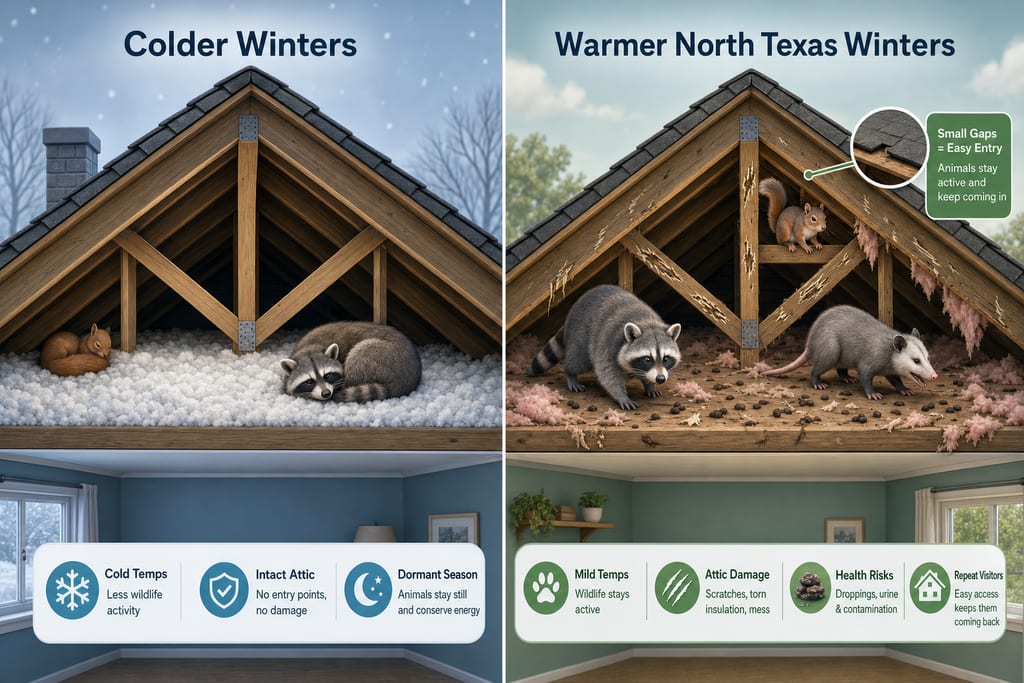
Warmer winters in North Texas mean these animals do not slow down the way they would further north. They stay active and keep breeding through months that used to give homeowners a break, so a problem that starts in October can still be growing by spring.
Older homes near Fort Worth and Denton add to the problem because rooflines built decades ago were not sealed to today's standards. Gaps around fascia boards, vent stacks, and chimney flashing widen as materials age, and those small openings are exactly what a raccoon or squirrel needs to get inside.
A technician walking a job site shows how much of this work happens before any animal is even trapped.
Knowing which animal you are dealing with changes the approach. Raccoons tear and widen openings, squirrels chew through thinner materials like soffit vents, and possums usually slip in through gaps already left by something else.
Service Areas Covered Near Fort Worth and Denton
Coverage runs across Fort Worth, Denton, Granbury, Glen Rose, Weatherford, Possum Kingdom Lake, Southlake, Grapevine, Colleyville, North Richland Hills, Roanoke, Trophy Club, Flower Mound, Azle, Saginaw, Haslet, Watauga, and Argyle. The home base sits at 11833 Katy Rd, Keller, TX 76244, which keeps drive times short across most of the service footprint. Both residential and commercial properties qualify, so a homeowner in Grapevine and a warehouse manager in Roanoke get the same response.
A few things to check before you call, so the visit covers what you actually need:
- Confirm your city or town falls inside the list above
- Note whether the issue is residential or commercial, since scheduling can differ
- Have the address ready for the closest available technician
- Mention if the property has had wildlife issues before
Being close to the job matters for anything involving an active den. A raccoon with young in an attic needs attention within days, not weeks, and a shorter drive means a faster slot on the schedule.
How to Request Your Free Wildlife Inspection
Call (817) 799-8686 to schedule an inspection or get a quote. The call itself takes a few minutes, mostly confirming the address, the animal you suspect, and whether you are hearing noise in the attic, walls, or under the house.
A technician then walks the property checking attics, crawl spaces, foundations, and rooflines, since animals use all four as entry points depending on the species. This video walks through what a full point-by-point inspection actually looks like on a real property.
Before any repair work starts, you get a Wildlife Inspection Report® that documents what was found and where. The steps from first call to report in hand look like this:
- Call and describe the noises or damage you've noticed
- Schedule a time for the technician to walk the property
- Technician checks attic, crawl space, foundation, and roofline
- Receive the written report before agreeing to any repair
That order matters. You see the findings in writing before you decide what to fix.
What Happens During Removal and Animal Proofing
Removal starts with getting the animal out of the attic, wall, or crawl space without harming it, since trapping and relocation are handled as humanely as the situation allows. Once the animal is gone, the real work is making sure nothing follows it in. That means walking the whole roofline and foundation, not stopping at the first hole found.
A customer named Jesse Bernard described a squirrel problem where the obvious opening was only part of the picture. The crew found a couple of other entry points he never would have spotted on his own, and the attic has stayed clear months later. Exclusion work typically includes:
- Chimney caps to block a common raccoon entry point
- Vent guards over roof and soffit vents
- Foundation repair where gaps have opened up
- Caulking and sealing smaller cracks and seams
Every entry point found gets sealed, not just the one that's easiest to reach. Skipping a second or third hole is how a homeowner ends up calling back three months later for the same problem.
Keeping Attics and Businesses Protected Long Term
Removal and sealing solve the immediate problem, but attics often need cleanup after an animal has been living in them. Contaminated insulation gets pulled out, the space gets disinfected, and new insulation goes in before entry points are sealed for good. Skipping this step leaves odor and droppings behind even after the animal is gone.
Businesses face a different set of risks. Wildlife in a commercial building can damage inventory, chew through wiring, and create health risks for staff and customers, so commercial jobs are handled with the same inspection and sealing approach as a home, scaled to the building. A typical attic restoration moves through these steps:
- Remove and discard contaminated insulation
- Disinfect the affected area
- Seal every entry point identified during inspection
- Install new insulation to restore the space
The work is backed by a renewable lifetime warranty, which covers the property against repeat invasions after the sealing is done. That warranty is the piece that turns a one-time repair into ongoing protection, for a home in Flower Mound or a storefront in Southlake alike.
A Trap From The Store Or A Sealed Attic
A trap from the hardware store costs less upfront and might catch the animal you can see. It does nothing about the gap it used to get in, so a second raccoon or squirrel often finds that same opening within weeks. You end up paying for traps twice and still have an open hole in your roofline.
A sealed, warrantied repair costs more at the start but covers the property if something tries to get back in later. That protection only matters if the repair actually finds every entry point, not just the one you noticed first. Jerry and Anita S. mentioned being told what needed to be done before any work started, and Mark Thompson's review points to raccoons removed and the attic secured against future problems, not just a single catch.
Renters and short-term owners who just want one animal gone might reasonably choose the cheaper trap. Anyone planning to stay in the house, or running a business where downtime costs money, is better off paying for the inspection and the seal, since a repeat call costs more than doing it right once.
Deciding When To Get Your Property Checked
Cooler nights push raccoons, squirrels, and possums to look harder for warm, dry shelter, and an attic beats a hollow tree every time. Waiting until you hear scratching overhead usually means an animal has already settled in, and the repair bill grows along with the damage to insulation and wiring. Calling before that happens costs less than calling after. Wildlife X Team answers at (817) 799-8686 across Fort Worth, Denton, Granbury, and the rest of the service area, and a quick walk of the roofline now is the cheaper half of this decision.
Common Questions About Wildlife Removal
Do you charge extra for inspections outside Fort Worth city limits?
No. The inspection is the same whether the property sits in Fort Worth or in a smaller town like Azle or Argyle, as long as it falls within the listed service area. The home base in Keller keeps drive times short across the whole footprint, so location inside that area doesn't change the visit.
Can a technician come out the same week for a non-emergency squirrel noise?
Scheduling depends on how full the calendar is that week, but attic noise without an active den usually gets a slot within a few days of calling. Active dens with young move ahead of general noise complaints, since those need faster attention. A call to (817) 799-8686 gets you the next open time for your area.
What if the animal has babies in the attic when the technician arrives?
Wildlife X Team handles the mother and young together using humane methods, since separating them usually just means the mother tears back in to reach them. The goal is getting the whole family out and the entry points sealed in one visit, not a partial removal that leaves animals behind the wall.
Does the warranty cover damage caused before the exclusion repairs were finished?
No. The renewable lifetime warranty starts once the sealing and exclusion work is complete, and it covers repeat invasions after that point. Damage from the original problem, like chewed insulation or a torn vent, is handled during the cleanup and restoration step, before the warranty coverage begins.