
Where Squirrels Live Around Homes in North Texas
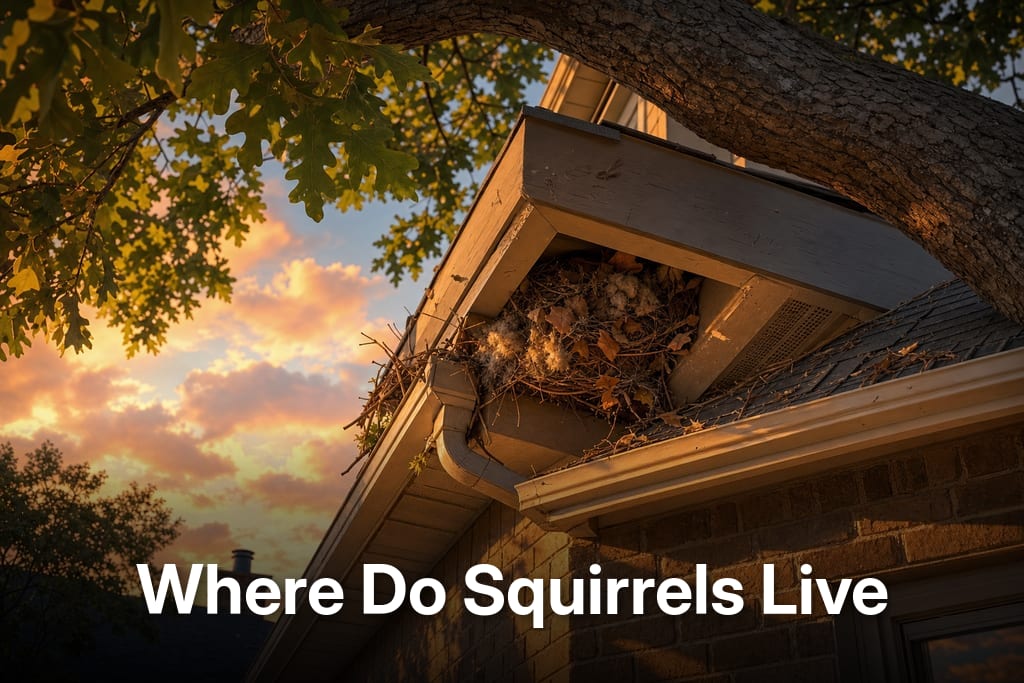
Where do squirrels live around a typical North Texas home? Mostly in the big trees out front, but also in spots much closer than most people think, like the attic, the chimney, and the thick shrubs lining the yard. A squirrel does not need much room to get comfortable. A gap near the roofline or an uncapped chimney looks like a hollow tree branch to them, and they will move right in.
Neighborhoods across Fort Worth, Denton, and Granbury with mature oaks and pecan trees are some of the best squirrel habitat around, simply because there is so much food and cover within a short jump of every roof. Squirrels build nests, called dreys, high in those branches, then scout nearby structures for a drier, warmer backup spot once the weather turns. Knowing where they tend to settle, inside and out, gives homeowners a real chance to spot the early signs, like scratching in the ceiling or chewed wood near the eaves, before a few visitors turn into a full nest.
Table of Contents
Why North Texas Yards Attract Squirrels
Mature oak, pecan, and elm trees are the main draw across Fort Worth, Denton, and Granbury. These trees drop acorns, pecans, and seeds for months at a time, and their thick canopies give squirrels cover from hawks and owls while they travel between yards.
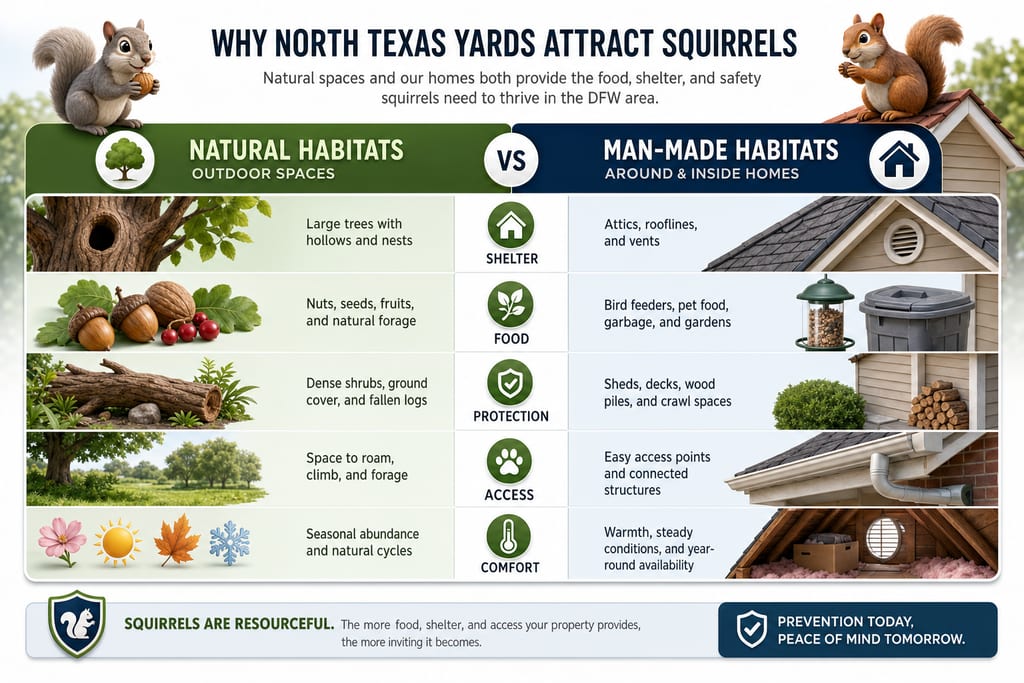
Texas winters rarely get cold enough to force squirrels into hibernation. That means they stay active and keep building or reusing nests all year, instead of slowing down for a few months like squirrels do farther north.
A tree den and an attic solve the same problem for a squirrel: shelter from weather and a safe place to raise young. The difference is that tree dens come apart in storms, while attic insulation and wall voids stay warm and dry no matter what the weather does, which is part of why squirrels switch over so readily.
Outdoor cover and indoor shelter end up competing for the same squirrel. Sheds, garages, and detached workshops offer a middle ground, less insulated than an attic but drier and sturdier than a branch, so they get used heavily too, especially once the easy entry points nearby are already occupied.
Tree Nests and Leaf Dens in the Yard
A drey is the leafy, ball-shaped nest squirrels build high up in a tree fork, usually 20 feet or more off the ground. Oaks and pecans across Fort Worth and Denton are favorite spots because the thick branches hide the nest from hawks while keeping it close to a steady food supply.
Old woodpecker holes and natural tree cavities make sturdier winter homes than dreys, since solid wood blocks wind and rain better than woven leaves and twigs ever can. A squirrel will often keep two or three nests going at the same time, rotating between them so there is always a backup if one gets damaged or raided by a predator.
Comparing drey to cavity makes the choice clear:
- Dreys: built from leaves and twigs, finished in a day, easily torn apart by storms
- Tree cavities: natural or woodpecker-made, hold heat far better, reused for years
- Backup nests: usually within a few hundred feet of the main one
Yards with a mix of mature trees and open cavities tend to hold the highest squirrel numbers, since the animals never have to travel far to switch between the two.
Attics, Soffits, and Roof Gaps
Loose shingles, gaps in the soffit, and uncovered roof vents are the easiest way for a squirrel to get from a tree branch into a house. Once inside, attic insulation gives them a warm, dry nesting spot, which is exactly what a female squirrel looks for during fall litters and again in early spring.
Scratching noises around dawn or dusk are usually the first clue, since those are the hours squirrels are most active moving in and out to feed. A few entry points show up again and again on inspections:
- Soffit gaps where the roofline meets the siding
- Roof vents missing a screen or cap
- Shingles lifted or chewed along the edge
- Gable vents with torn or rusted mesh
A single open gap, even one just two inches wide, is big enough for an adult squirrel to squeeze through, which is why sealing one spot and missing another leaves the problem half solved.
Here's a short video showing the five most common nesting spots squirrels pick around a home.
Chimneys, Sheds, and Garage Corners
An uncapped chimney works just like a hollow tree trunk, dark, enclosed, and sheltered from wind, so squirrels treat it the same way they'd treat a natural den. A chimney cap is a cheap fix that closes off this entry point for good, rather than something a homeowner has to deal with every season.
Sheds, garages, and stacked firewood near the house give squirrels cover close to a food source without the risk of climbing all the way up to the roofline. Utility line gaps, where cable or electrical lines enter the house, are another overlooked opening worth checking. A few spots worth a walk-around:
- Chimney flue, especially if the cap is missing or rusted through
- Firewood stacks against an exterior wall
- Garage door gaps at the corners
- Utility line entry points near the foundation
Any one of these can turn into a nest site within days, since squirrels do not need much time to settle once they find a quiet, enclosed spot.
How to Spot an Active Nest Nearby
A fresh drey looks tight and full, packed with green leaves that have not yet dried out, while an old abandoned one looks loose, gray, and thin from months of weather. That difference alone tells a homeowner whether a nest is worth worrying about or just left over from last season.
Chewed wood trim, droppings near a roofline gap, and dark, oily rub marks around an entry point all point to regular traffic, not a one-time visitor. Walking the property with these points in mind catches most problems early:
- Check tree forks for drey color and tightness
- Look under eaves and soffits for chew marks
- Scan the chimney cap and roof vents for gaps
- Check firewood piles and shed corners for droppings
If several of these signs show up in the same area, that spot is likely an active nest, and that's the kind of detail a Wildlife X Team inspection is built to catch before it turns into a bigger repair.
Watch Outside or Check Inside
A homeowner has two real options once squirrels show up nearby: keep an eye on the yard, or get the house checked. Watching the yard works fine if the trees still have room for new nests and the population looks stable. It stops working the moment a neighbor cuts down a big oak or a storm takes out a few branches, because every squirrel displaced from that tree starts looking at rooflines instead.
Breeding season raises the stakes on that choice. Late winter and again in summer, females need a warm, enclosed spot to raise young, and a crowded tree stand pushes more of them toward attics and chimneys at exactly those times. Waiting it out costs nothing until one of those litters ends up in the insulation above a bedroom.
Checking inside means something more specific than a walk around the yard. A Wildlife Inspection Report® maps every gap in the roofline, siding, and foundation before squirrels find them, not after. Jesse Bernard's case shows why that matters: one entry point into the attic was obvious, but the inspection turned up a couple more that would have let squirrels right back in even after the first hole got sealed.
Deciding Whether to Walk the Yard or Call for an Inspection
Pick a weekend and walk your own property with the checklist above: look up at the big trees, scan the roofline, and check the chimney cap. Five minutes catches most of the obvious trouble. What it will not catch are the gaps behind siding, inside a vent, or under a ridge cap, the blind spots that only show up when someone is looking for them specifically. If your trees are mature, your neighborhood has lost branches to a recent storm, or you just want those blind spots covered, a Wildlife X Team inspection covers Fort Worth, Denton, Granbury, and the surrounding North Texas communities. Either way, the choice is yours to make now, before a litter settles in.
Squirrel Nesting Habits Around Your Home
Do squirrels move between an outdoor nest and an attic nest at the same time?
Yes, a squirrel will often keep an outdoor drey going while also using an attic as a backup den. It is the same instinct that keeps them rotating between tree nests, just applied to a warmer, drier option. This is why sealing an attic gap sometimes just pushes the squirrel back outside rather than removing it from the property entirely.
Can trimming tree branches away from the roof actually stop squirrels from getting inside?
It helps, but it rarely solves the problem on its own. Cutting back limbs that touch or overhang the roofline removes the easiest bridge from tree to house, and squirrels are far less willing to jump a gap of several feet than to walk a branch. The catch is that squirrels can still reach a roof from a fence, a power line, or a neighboring tree, so trimming works best paired with sealing the actual entry points.
Will squirrels rebuild in the same chimney or attic spot year after year?
Often, yes, especially if the opening was never actually closed up after the squirrels left. A spot that worked once, warm, enclosed, close to food, stays attractive to the next generation of squirrels in the area, not just the original occupant. That repeat pattern is one reason Wildlife X Team pairs removal with sealing the entry point, instead of just clearing the animals out and leaving the gap open.
Does removing one squirrel nest from a tree make the others in the yard leave too?
No, removing a single nest usually just means that squirrel rebuilds somewhere else close by, often within the same tree or the one next to it. Yards with good food and cover tend to hold several squirrels at once, each with its own nest or two. Clearing one drey does not change the food supply or the shelter that drew the whole group there in the first place.