
What Skunk Droppings Look Like Around Your Home
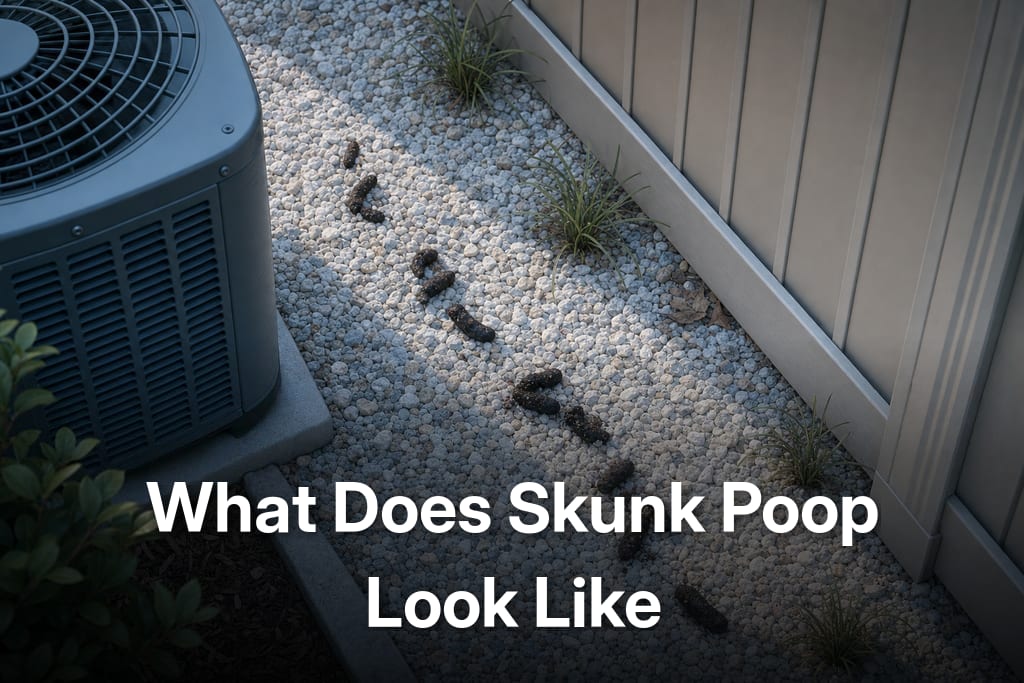
What does skunk poop look like? It comes in short dark tubes, usually an inch or two long, and if you look close you'll often see bits of insect shells or seeds packed inside from whatever the skunk was digging up that night. You'll typically find it near burrow openings, along the edge of a deck, or scattered through garden beds where the soil is soft and easy to dig. Catching it early, before the pile grows or the smell sets in, can save a homeowner from a much bigger mess of torn up lawns and a yard that reeks every evening.
Table of Contents
Why Skunk Scat Shows Up Where It Does
Skunks hunt at night and move along the same paths between their den and their food sources. Droppings pile up anywhere they stop to dig or feed, which is why you'll find a cluster near a burrow entrance and then a few scattered pieces along the route they took to get there.
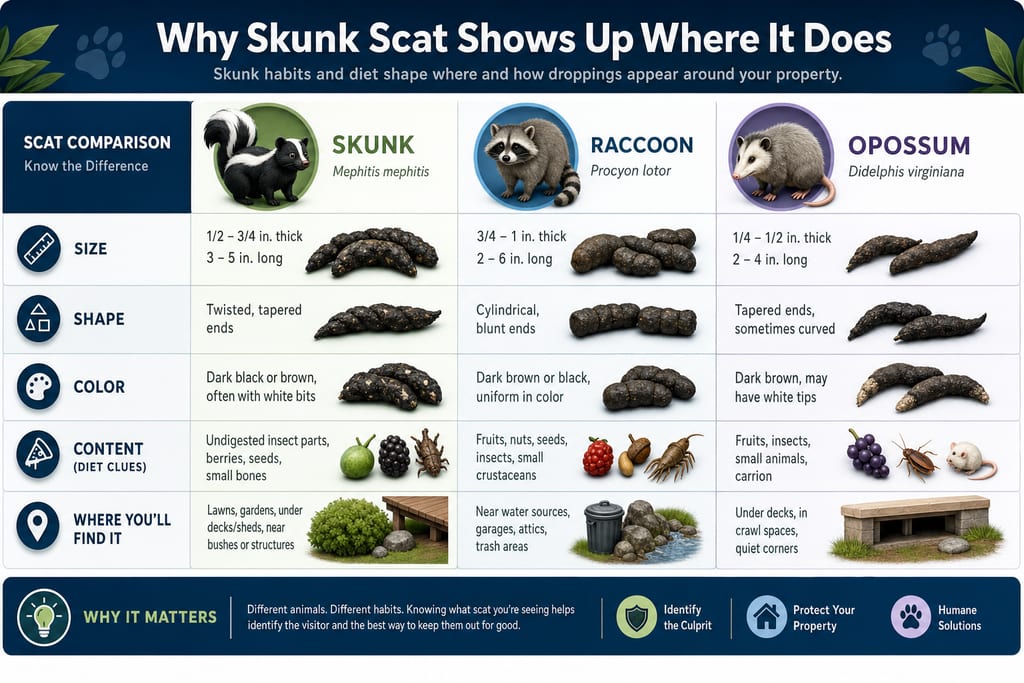
What they eat changes with the season, and that shows up in the scat. In warmer months a skunk eats mostly grubs, beetles, and other insects, so droppings look dark and crumbly with hard shell bits mixed in. Once berries and fruit ripen later in the year, the same skunk's droppings turn softer and darker, sometimes almost purple, with seeds instead of shells.
Compost piles, stacked firewood, and the space under a deck are the three spots homeowners run into scat the most. All three offer cover during the day and easy digging at night, which makes them natural stopping points on a skunk's regular path.
Skunk, raccoon, and opossum droppings get mixed up a lot because they can turn up in the same backyard spots. Raccoon scat is thicker, often three to five inches long with blunt ends, and tends to show whole seeds or bits of trash if the raccoon's been in a bin. Opossum droppings are smaller and lumpier, usually under an inch, and often have fur or bone fragments mixed in since opossums eat small animals along with fruit.
The Shape, Size, and Color to Look For
Skunk droppings run about the width of a pencil, close to half an inch wide, with a tube shape that often twists or bends rather than lying flat. The ends are usually blunt and don't taper to a point the way some other backyard droppings do.
Color shifts with what the skunk has been eating. Most of the year you'll see dark brown to black scat, but during berry season it can turn lighter, sometimes with a reddish or purple tint running through it.
Instead of one long piece, skunk scat tends to break into short segments sitting close together, almost like it was laid down in short bursts. Look closely and you may spot shiny flecks from beetle shells or small seeds pressed into the surface.
- Width: roughly half an inch across, fairly consistent piece to piece
- Shape: tube-like with blunt, sometimes twisted ends
- Color: dark brown or black most months, lighter with a fruit diet
- Texture: broken into short segments rather than one unbroken length
Where Skunks Usually Leave Their Mark
Skunks leave droppings closest to wherever they dig or shelter for the day. Spaces under sheds and porches draw them in because the ground stays soft and shaded, which makes digging easier and gives cover from predators.
Fence lines and the edges of garden borders are another common spot, since insects collect there and a skunk will work the same strip of dirt night after night. Food left outside, whether it's an open trash can or a pet bowl on the porch, pulls them in just as fast as any grub patch would.
The biggest clue isn't a single pile, it's a cluster. Skunks reuse the same latrine spot instead of spreading droppings around the yard, so finding several piles grouped together in one small area usually points straight back to a den nearby.
- Check the dirt along fence lines and garden edges for dug-up patches
- Look under sheds, porches, and decks for burrow openings
- Check around trash cans and any pet food left out overnight
- Note whether droppings are grouped in one spot rather than scattered
Skunk Scat Versus Other Backyard Droppings
Cat droppings are the easiest to rule out since cats bury their waste in soft soil or mulch, so you won't find it sitting out in the open the way skunk scat does. Skunks don't bother covering anything up, which is part of why their latrine spots are so easy to spot once you know where to check.
Opossum droppings tend to look irregular and lumpy, often packed with more plant fiber since opossums eat a wider mix of fruit, plants, and small prey. Skunk scat holds a steadier tube shape by comparison, even when it's broken into short pieces.
Smell is a useful backup check. Skunk scat often carries a faint musky odor even when the animal hasn't sprayed, something that sets it apart from drier, less scented droppings left by other backyard visitors.
- Open and exposed, not buried, rules out cat droppings
- Steady tube shape rules out the lumpier, irregular look of opossum scat
- A musky smell without any spray event points back to skunk activity
Other Signs That Confirm a Skunk Visitor
Droppings tell part of the story, but a few other signs confirm it's a skunk and not something else digging in the yard. Small, cone-shaped holes scattered across the lawn are one of the clearest signals, since skunks punch these while hunting grubs just under the surface.
A faint musky smell drifting from a burrow entrance is common even on nights without a spray event, since the scent clings to the den itself.
Tracks are another giveaway. Skunk prints show five toes with visible claw marks, different from the four-toe prints cats and dogs leave behind. Torn-up mulch piles or flattened garden beds overnight round out the picture, since that kind of damage usually means a skunk worked the area after dark.
- Cone-shaped divots across the lawn from grub hunting
- Musky odor near a burrow with no recent spray
- Five-toe tracks with claw marks showing in soft dirt
- Mulch or garden beds disturbed overnight
One Pile or a Pattern, What You Do Next
A single dropping pile near the fence line is not a reason to call anyone. Skunks pass through yards all the time without settling in, and one pile usually means a visitor that moved on. Repeated piles in the same spot over several nights is a different story, since that pattern means a den is close by and the skunk is treating your yard as home base.
Droppings sitting right at a foundation crack or a gap under a crawl space door are worth acting on fast. That location means the skunk already found a way under the structure, not just into the yard. Waiting on that kind of find usually costs more in the long run than dealing with it now.
Cleaning up scat without closing off the den entrance is a short-term fix at best. The smell and the mess go away for a few days, then the same skunk, or another one, finds the same opening and starts over. Homeowners who want to stop the cycle instead of repeating it every few weeks usually need someone to confirm exactly where the den sits and where the entry gaps are, since those spots are not always the obvious ones a homeowner would check first.
When to Stop Cleaning and Start Calling
If the same spot keeps filling back up after you clear it, that's a den, not a passing visitor. A fresh pile every few nights near a burrow or crawl space gap means the skunk is living there, and scooping droppings won't change that. Wildlife X Team runs a Wildlife Inspection Report to map every entry point around the foundation before the damage spreads further, then pairs humane removal with exclusion work so the gap gets closed for good. That combination is what stops a skunk from digging right back in a week later.
Skunk Dropping Questions Homeowners Ask
Is it safe to pick up or touch skunk droppings myself?
You should not touch it with bare hands. Use gloves, a dust mask, and a disposable bag, then double bag it before tossing it in an outdoor trash bin. Spray the area with a disinfectant afterward and wash your hands and any tools you used, since dried scat can release particles into the air when disturbed.
Can skunk droppings carry diseases that spread to pets?
Yes, skunk scat can carry roundworm eggs and other parasites that pets can pick up by sniffing or digging in the same soil. Dogs are most at risk since they tend to investigate fresh piles directly. Keep pets leashed or supervised in yards where you've found skunk activity, and talk to a vet if your pet has been digging in that area.
How long do skunk droppings stay smelly after being left outside?
Fresh scat holds its musky smell for about a week in mild weather, then fades as it dries out and breaks down. Rain speeds that process up, while a dry stretch can stretch the smell out longer. The odor clinging to a burrow entrance lasts much longer than the droppings themselves, since it soaks into the soil around the den.
Does finding droppings mean the skunk sprayed nearby too?
No, droppings and spray are two separate things. A skunk only sprays when it feels threatened or cornered, not as part of normal feeding or den activity, so you can have a yard full of scat piles with no spray smell at all. If you do catch a sharp, sudden odor along with the droppings, that usually means something startled the skunk recently, maybe a dog or a person walking too close to the den.