
What Mouse Droppings Look Like and How to Identify Them
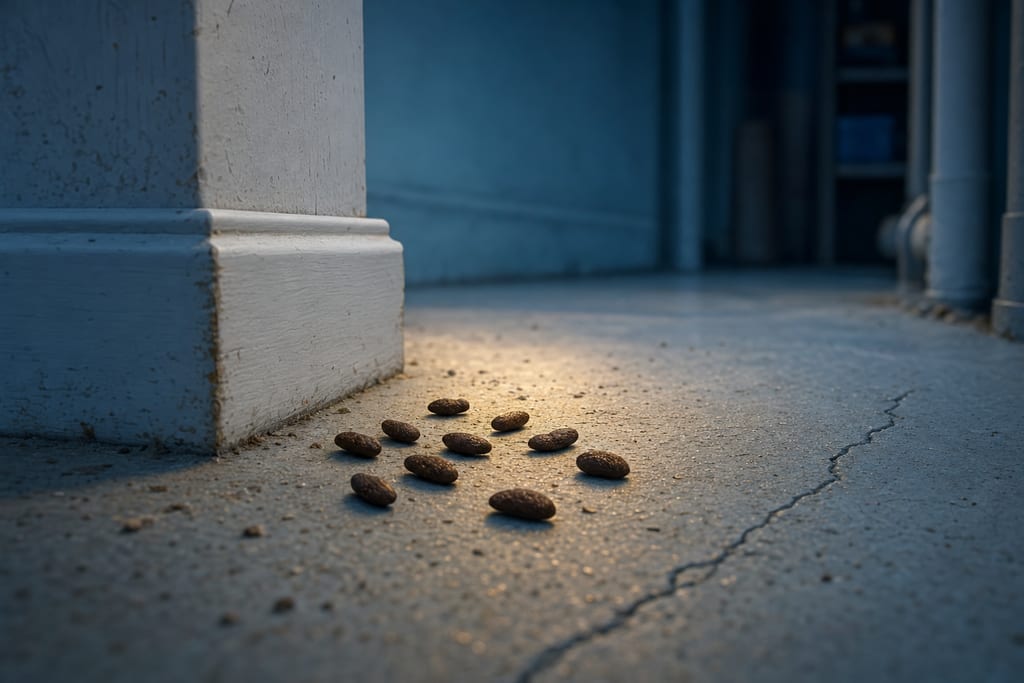
What does mouse droppings look like is easy to answer: small, dark, rice-shaped pellets about a quarter inch long, often scattered near food, baseboards, or inside cabinets. A single mouse can leave 50 to 75 droppings a day, so if you're finding a handful in one spot, there's a good chance more than one mouse is living nearby. Fresh droppings look moist and almost black, while older ones turn gray and crumble when touched.
Knowing what you're looking at matters because droppings from mice, rats, and other small animals aren't the same size or shape, and treating the wrong pest means wasted time and money. Rat droppings are bigger, closer to three quarters of an inch, with blunt ends instead of pointed ones. Getting the identification right tells you whether you're dealing with a mouse problem, a rat problem, or something else entirely, and that decision shapes every step you take after it.
Table of Contents
Fast Facts Before You Look Closer
Texture tells you as much as shape does. Fresh droppings have a slight shine and feel soft if you poke them with a stick, while anything older than a few days dries out, turns gray, and crumbles into dust.
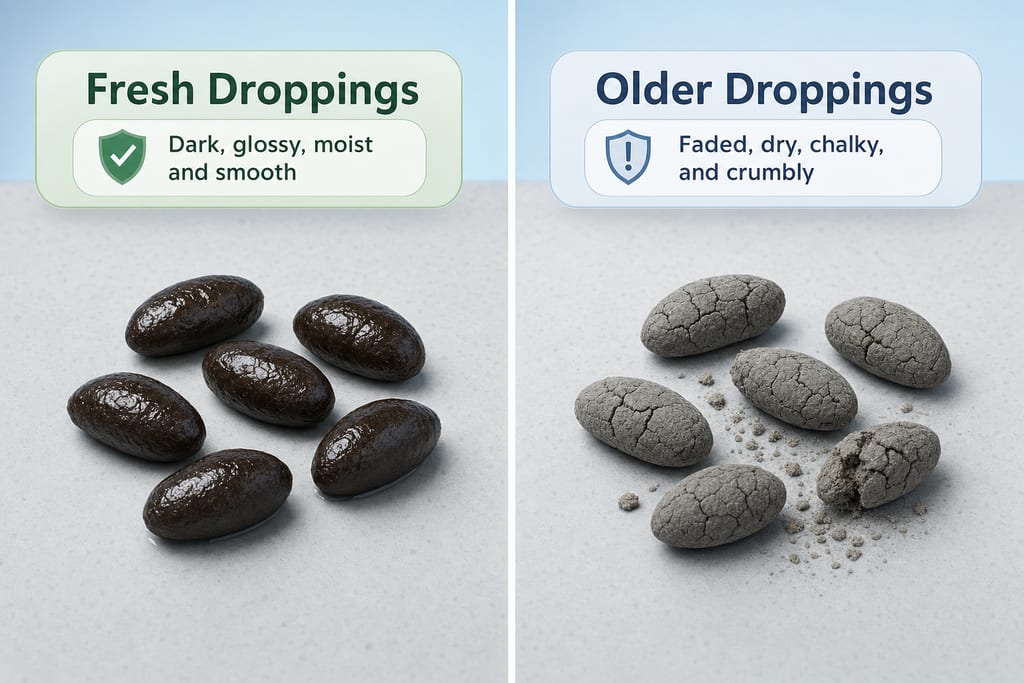
That shift matters for figuring out if the problem is active or if you're looking at leftovers from a past visitor. Dark, glossy pellets mean mice were there recently, so check that same spot again in a day or two before assuming they're gone.
This short video breaks down the visual differences side by side, which helps once you start comparing what you found against mouse versus rat sign.
Mice don't scatter droppings at random. They tend to leave them along the same paths they travel, which usually means pantry shelves, the corners of cabinets, and the dusty space behind refrigerators and stoves.
Checking those four spots first saves time, since that's where most homeowners actually find their first clue. If a spot is clean one week and has fresh droppings the next, that's your sign the activity picked back up.
Spotting the Shape Size and Color
Look at the pellet itself before you worry about where it was sitting. Mouse droppings run about 1/8 to 1/4 inch long, tapered and pointed at both ends, closer to a grain of rice than anything round or blunt.
Color tells you the age. A fresh dropping is shiny black or dark brown, almost wet-looking, while one that's sat for a week or more turns dull gray and crumbles the second you touch it. Surface texture follows the same pattern, since moisture keeps the outside smooth and dry air cracks it.
- Pointed tips on both ends, not rounded or flat
- Length under a quarter inch, roughly a grain of rice
- Dark, glossy surface means it's recent
- Gray, dusty, or crumbly surface means it's old
- Soft when poked is fresh, hard and brittle is not
A labeled chart with these traits side by side helps when you've got a handful of droppings in front of you and aren't sure which column each one belongs in. Matching shape first, then color, keeps you from guessing based on just one trait.
Where Mice Leave Their Droppings Behind
Mice don't drop pellets randomly across a room. They leave them where they eat, nest, and travel, which usually means along walls, inside drawers, and near anything stored as food.
Attics, wall voids, and the dead space behind appliances are the hidden spots people miss until the smell or the noise gives it away. A scattered trail of pellets spaced a few inches apart usually marks a regular travel route, the same path a mouse runs every night between its nest and a food source.
- Check cabinet corners and drawer edges near the kitchen
- Pull out the fridge and stove to look behind them
- Scan baseboards for a line of droppings, not just a pile
- Look inside pantry boxes for chewed corners next to pellets
- Check attic insulation edges and wall voids near pipes
A fresh cluster sitting next to torn food packaging is the clearest sign of an active nest close by, not just a mouse passing through. If you're finding that combination in more than one room, the population is likely bigger than one animal.
Mouse Rat or Something Else Entirely
Size and end shape separate mouse droppings from almost everything else you might find. Rat droppings run 1/2 to 3/4 inch, noticeably bigger than a mouse pellet, with blunt, rounded ends instead of points.
Cockroach droppings are easy to confuse with mouse sign at a glance, but they look more like ground pepper or coffee grounds, often with faint ridges along the sides when you look close. Bat droppings crumble into a fine powder when touched and often glisten with tiny insect wing fragments, since bats eat insects and mice don't.
- Mouse: 1/8 to 1/4 inch, pointed ends
- Rat: 1/2 to 3/4 inch, blunt rounded ends
- Cockroach: pepper-sized grains, ridged sides
- Bat: powdery texture, shiny with insect wing bits
This video walks through the mouse versus rat comparison directly, which is the mix-up that causes the most wasted effort when someone treats for the wrong pest.
What Fresh Droppings Tell You About Risk
Freshness tells you whether you're still dealing with mice or just cleaning up after ones that already left. Moist, dark, shiny droppings mean mice are active in that space right now, while dried, gray, crumbly ones point to an old issue that may already be resolved.
Don't sweep dry droppings without taking precautions first, since they can carry hantavirus and salmonella that become airborne with dust. Wearing gloves and a mask before cleanup, and spraying the area with disinfectant before you sweep, cuts that risk down significantly.
- Wet a paper towel with disinfectant before touching any pile
- Never vacuum or dry-sweep droppings directly
- Wear gloves and a mask for any cleanup, even small amounts
- Bag and seal cleaning materials before throwing them out
A large or growing pile in one spot usually means a nest and a breeding population nearby, not just one mouse passing through on its way to somewhere else. If cleanup, sealed entry points, and repeated checks of the same spot don't stop fresh droppings from reappearing, a team like Wildlife X Team can run a full inspection and handle removal and exclusion at the source.
One Mouse or Many, Here's the Call to Make
A handful of old, gray droppings tucked in one corner usually means a single mouse wandered through and moved on. That's a cleanup job, not an infestation. Wipe it down with disinfectant, seal the gap it likely came through, and check back in a week.
Fresh droppings showing up in more than one room is a different call. That spread means mice are established and breeding somewhere in the structure, not just passing through once. At that point, patching one hole and wiping one shelf won't solve it, since there's a nest feeding the pattern.
Droppings packed into attic insulation or sitting near wiring push the decision further still. That placement means mice have already built a nest and started chewing through material you can't easily inspect or replace yourself. Wildlife X Team's Wildlife Inspection Report checks attic voids, wall gaps, and foundation lines once droppings confirm mice are inside, then maps every entry point feeding the problem so exclusion work actually closes it off instead of just treating the symptom.
Deciding Whether to Grab a Flashlight or Make a Call
Once you've confirmed what you're seeing is mouse droppings and not something else, the next move is a walk-through of entry points: gaps under doors, utility lines, foundation cracks, and vent openings. Mice only need a quarter-inch gap to get in, so small openings matter as much as big ones. Checking now, before numbers grow and droppings spread to more rooms, keeps a one-mouse problem from turning into a nest you can't see. Wildlife X Team serves Fort Worth, Denton, Granbury, and the surrounding areas with inspections that find those gaps and seal them. A short visit can confirm how far the problem has gone before it spreads into insulation, wiring, or walls you can't check yourself.
Mouse Dropping Cleanup Questions
Can mouse droppings in a food box mean I need to throw out the whole pantry?
No, just toss the package the droppings touched or sat near, along with anything open and unsealed close by. Sealed cans and jars are fine once wiped down with disinfectant. You don't need to clear the whole pantry unless droppings show up in several spots, which points to a bigger population working the shelves.
Is it safe to clean up mouse droppings myself without a mask?
No, skipping a mask is risky even for a small pile. Dry droppings release dust that can carry hantavirus and salmonella, and that dust gets airborne the moment you disturb it. Gloves and a mask take a minute to put on and cut that exposure down a lot, so it's worth the short delay before you start wiping anything down.
Why do I keep finding new droppings after I already cleaned them all up?
New droppings after cleanup almost always mean the entry point mice are using is still open. Wiping up pellets doesn't stop the mouse walking the same route tonight. Wildlife X Team's inspection maps those gaps around the foundation, vents, and utility lines so the openings get sealed, not just the mess behind them.
Do dry crumbly droppings mean the mice are already gone for good?
Not necessarily. Dry, crumbly droppings tell you that specific pile is old, but mice could still be active somewhere else in the house. Check the same spot again in a few days, and look at other common areas like baseboards and behind appliances before deciding the problem is over.