
Squirrel Poop vs Rat Poop How to Tell the Difference
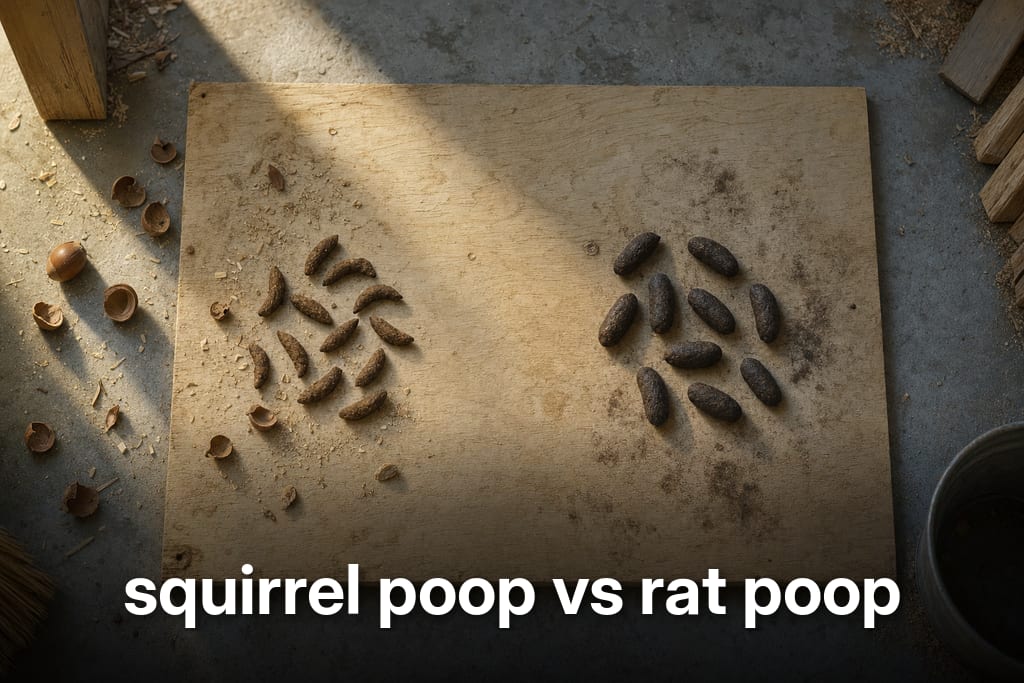
Squirrel poop vs rat poop comes down to size and shape: squirrel droppings are rounder, bigger, and have blunt ends, while rat droppings are thinner, smaller, and taper to a point. Side by side, a squirrel pellet looks like a small olive pit and a rat pellet looks more like a grain of rice with a tail. From across an attic, they can look like the same dark little scatter, and plenty of homeowners guess wrong on the first try.
Getting the ID right matters because it changes what you're dealing with. Squirrels chew bigger holes, often near the roofline, and tend to nest during the day. Rats squeeze through gaps the size of a quarter, run along walls and wiring at night, and leave a different trail of damage behind them. Knowing which one left the mess tells you where to look for the entry point and how serious the cleanup needs to be.
Table of Contents
Why These Droppings Get Mixed Up So Often
Squirrels and rats are both rodents eating a mix of seeds, nuts, and whatever else they find in your attic, so their waste shares the same brown color and the same basic pellet form. That overlap in diet is the main reason people squint at a pile of droppings and can't call it right away.
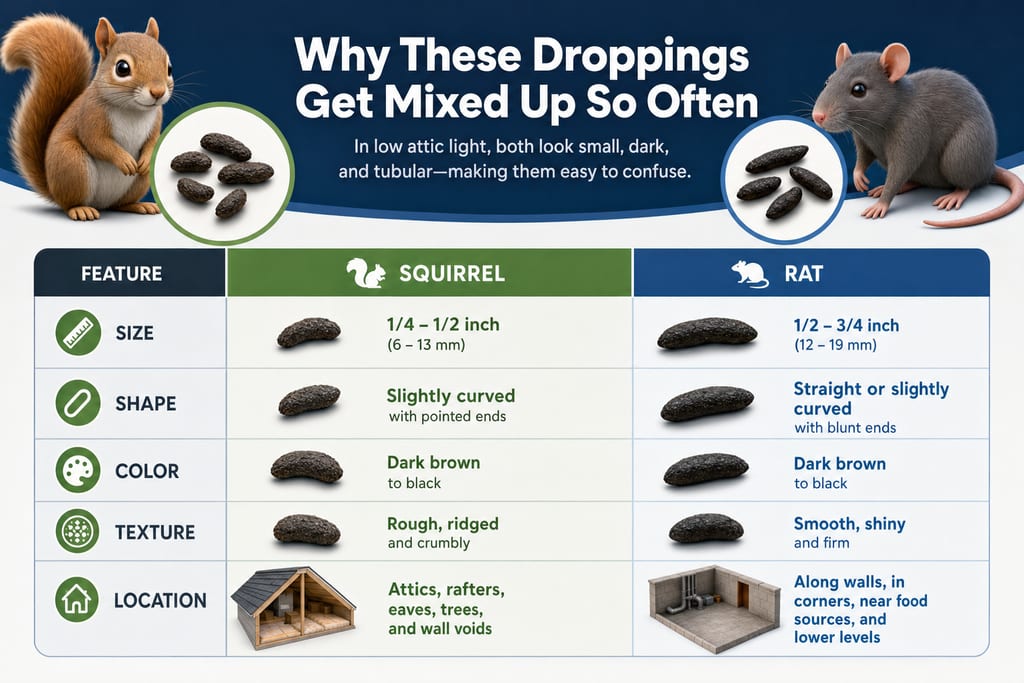
Attics are dim even with a flashlight, and loose insulation or dust settles over everything, blurring the edges of each pellet. Size is the clearest clue between the two, but it's hard to judge accurately when you're hunched over in bad light trying not to step through drywall.
A quick side-by-side look helps most people decide faster than eyeballing a single pile:
Squirrel droppings run about half an inch long, oval with rounded ends, light to dark brown, and usually show up near attic beams or along the roofline where they travel.
Rat droppings run closer to a quarter inch, thin with a pointed tip, dark brown to black, and tend to cluster along wall edges, behind boxes, or wherever they've been running at night.
Watch this for a closer look at telling rodent droppings apart.
Checking Size and Shape First
Size is the fastest way to sort out what you're looking at, and a coin or a ruler next to the pile makes the call in seconds. Squirrel droppings measure close to 1/2 inch with rounded, blunt ends, almost like a small dark jellybean. Rat droppings run shorter, around 1/4 inch, and narrow down to a point at one or both tips.
Roof rats tend to leave the sharpest, most pointed pellets, while Norway rats leave ones that are a touch blunter, which is where some homeowners second-guess themselves. The fix is simple: line up a few pellets and compare width and tip shape at the same time, not just length.
- Lay a ruler next to the pile and measure the longest pellet you can find
- Check both ends for a point versus a rounded tip
- Compare several pellets, not just one, since size varies within a single pile
- Note the width too, rat droppings are noticeably thinner front to back
Reading Color, Texture, and Freshness
Color tells you how recent the activity is, not which animal left it. Fresh droppings from squirrels or rats are dark brown to almost black and have a slight shine or dampness to them. Once they dry out, they turn gray and chalky, and they'll crumble if you nudge them with a stick or a gloved finger.
Squirrel droppings usually sit in small, loose clusters, a handful here and a handful there. Rat droppings pile up in bigger numbers along the same stretch of wood or insulation, since rats repeat the same travel path night after night. Texture alone won't settle the species question, so pair what you see with size and where you found it.
- Dark and slightly shiny means droppings left in the past day or two
- Gray and crumbly means the pile is old and the animal may have moved on
- Small scattered clusters point toward squirrel activity
- Large concentrated piles along one path point toward rats
This video breaks down the same freshness and texture clues side by side.
Tracking Where You Find the Droppings
Location narrows things down almost as well as size does. Squirrel droppings cluster near attic entry points, nest sites, and along the rafters they use to move around. Rat droppings scatter more widely, showing up along baseboards, inside wall voids, near stored food, and along the same runway night after night.
Rats also leave grease marks, dark smudges along the edges of beams or walls where their fur rubs the same surface over and over. Squirrels rarely leave that kind of mark. Gnaw damage near the droppings adds another clue, since both animals chew wood and wiring but leave slightly different patterns.
- Droppings near a roofline gap or nest material usually mean squirrels
- Droppings along baseboards or inside walls usually mean rats
- Dark grease smudges along a travel path point to rats, not squirrels
- Fresh gnaw marks near the pile confirm an active rodent, whichever species it is
Knowing When Droppings Signal a Bigger Problem
A few droppings tucked in one corner is one thing, but a spread-out mess across several spots usually means more than one animal has moved in. Both squirrel and rat droppings can carry salmonella and other pathogens, so gloves and a mask aren't optional during cleanup. If you find fresh droppings in the same spot days after you first cleaned it, the animal is still inside.
At that point, guessing at the species matters less than finding the entry point and getting it sealed. Wildlife X Team's Wildlife Inspection Report walks a property line by line to find exactly where animals are getting in, once droppings confirm something's living there.
- Wear gloves and a mask any time you handle or clean droppings
- Treat a wide, spread-out pile as a sign of an active colony
- Check the same spot again in a few days to see if droppings return
- Call for an inspection once droppings keep showing up after cleanup
Deciding If Droppings Alone Settle the Question
A young squirrel or a rat on a lean diet can leave pellets smaller than the usual range, so size is a strong clue, not a guarantee. If the pile sits right on the border between the two size ranges, don't force a call based on looks alone.
Noise timing backs up what your eyes are telling you. Scratching and thumping during the day point to squirrels, since they're out and active in daylight, while activity that ramps up after dark points to rats. Pair that with the dropping size and shape and you've got two independent clues agreeing with each other, which beats guessing from one pile in bad light.
One more wrinkle: an attic can host squirrels and rats at different times of year, or even the same season, so one batch of droppings doesn't rule out a second animal moving in later. A visual check tells you what's been there recently, not everything that's used the space.
For anyone who wants a final answer instead of a best guess, a professional inspection confirms the species and maps every entry point on the property, not just the hole that's easy to spot from the ground.
Scheduling An Inspection Instead Of Guessing Again
Once you've found droppings and you're still not sure what's in your attic, the next move isn't a closer look with a flashlight, it's a scheduled inspection. Wildlife X Team covers Fort Worth, Denton, Granbury, and the surrounding area, and their Wildlife Inspection Report maps out every gap, vent, and roofline seam an animal could be using before the colony has a chance to grow. Call (817) 799-8686 and get a trained set of eyes on the property instead of spending another weekend comparing pellets under bad light. Sealing the entry point now costs a lot less time and cleanup than waiting for a second animal to move in behind the first one.
Leftover Rodent Dropping Questions
Can squirrel or rat droppings make my pet sick if they eat something contaminated?
Yes, both carry salmonella and other bacteria that can pass to a dog or cat that noses through insulation or chews on debris. Watch for vomiting, diarrhea, or unusual lethargy after an attic or crawl space incident and call a vet right away if any show up. Keep pets out of the affected area until it's cleaned.
Why do I keep finding droppings in the same spot even after I clean it up?
Rodents reuse the same travel paths and latrine areas because the scent marks them as safe. If fresh droppings reappear in the same corner within a day or two of cleanup, an animal is still coming through that exact route, not just revisiting old smells. That's a sign the entry point hasn't been closed yet.
Does finding only a few droppings mean just one animal is inside?
Not necessarily. A small, fresh pile can mean one animal passing through once, or it can mean a nest nearby that just hasn't been fully discovered. Droppings tell you an animal has been there, not how many are living in the space, so a light scatter is worth a second look a few days later.
Can I tell a flying squirrel's droppings apart from a tree squirrel's?
Flying squirrel droppings run smaller and more uniform in size than tree squirrel pellets, and they tend to show up in tighter clusters since flying squirrels nest in colonies rather than alone. Both still beat rat droppings in size. If the pile is small but rounded rather than pointed, an inspection from Wildlife X Team can confirm which species is actually using the space.