
Squirrel Droppings Photos and Signs of an Attic Problem
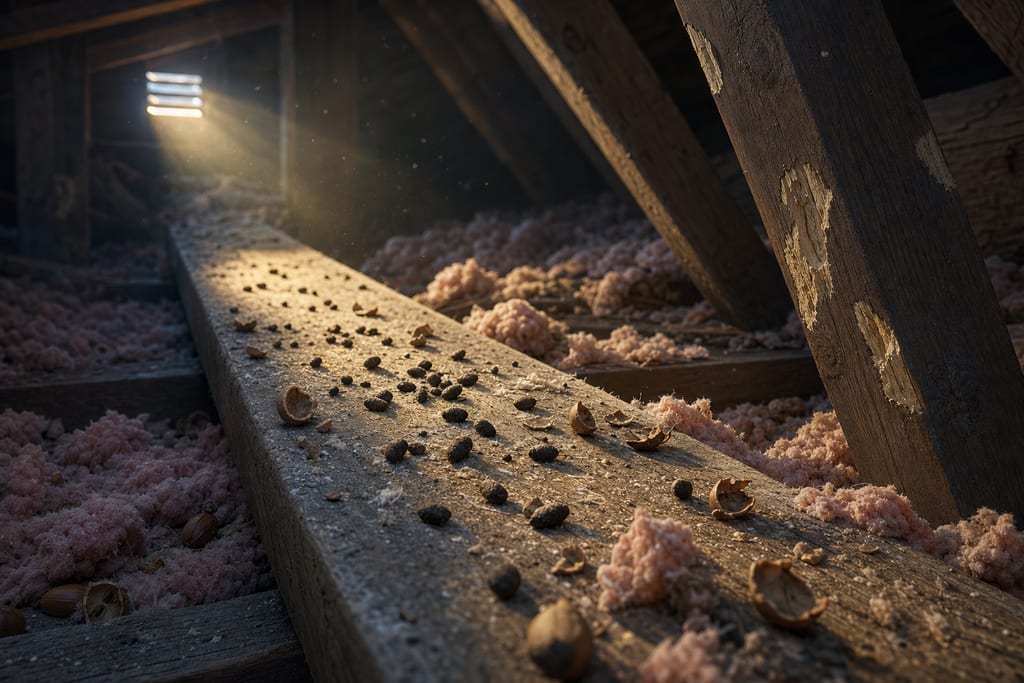
Matching what you see to a real squirrel droppings photo is the fastest way to know what is in your attic without climbing up there yourself. The pellets are oval and small, about 3/8 inch long, and they usually show up in little clusters near a nest or a feeding spot. Fresh droppings look dark brown or black and feel slightly moist, while older ones fade to gray and crumble apart if you poke them with a stick from a safe distance.
That color difference tells you something important before you decide what to do next. Dark, soft droppings mean squirrels are active right now, while gray, dry ones could mean the animals already moved on. Lining up what you found against a clear photo takes a minute and saves you a trip into a hot, dark attic with a flashlight and a mask, especially if it turns out you are dealing with mice or a bird instead.
Table of Contents
Squirrel Droppings Photo Gallery
A top-down shot shows the oval shape clearly, while a close-up at an angle catches the texture, whether it's shiny and moist or dry and crumbly. Side-by-side shots of fresh and weathered pellets help you spot both stages in the same glance, since real attics often hold a mix of old and new droppings at once.
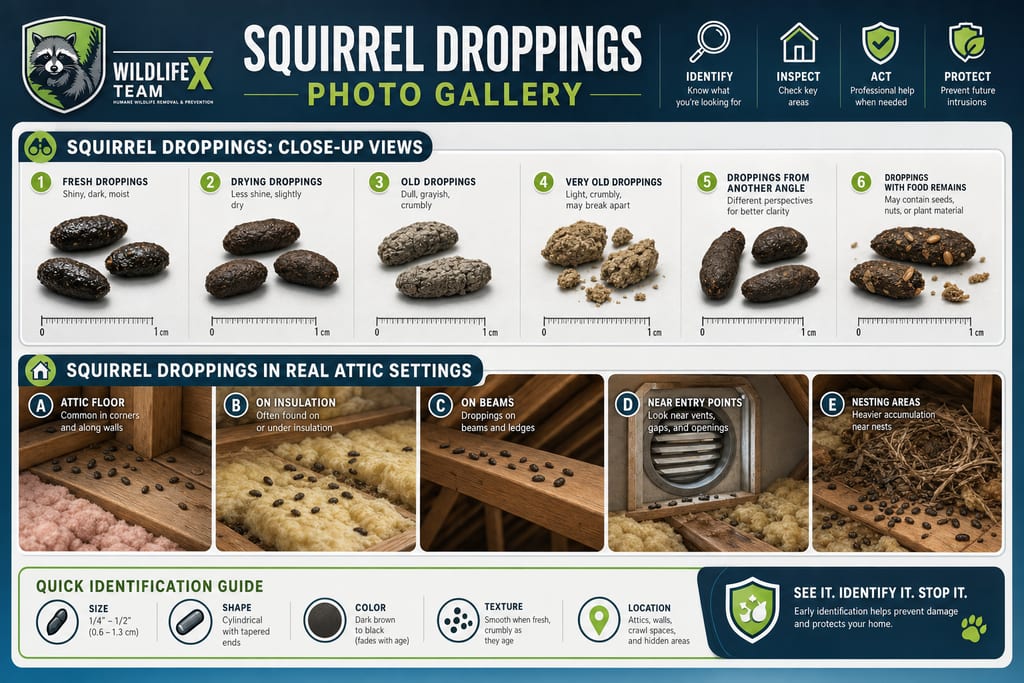
In actual attic settings, droppings rarely sit alone. You'll see them scattered across loose insulation, tucked near soffit vents, or lined up along rafters where a squirrel walks the same path every day.
Clustered piles usually mark a nesting zone, often in a corner or against an exterior wall where it's warmer. Scattered trails along beams point to a travel route instead, which tells you the animal is passing through rather than denning there.
Seeing the damage that goes along with the droppings makes the picture complete.
Chewed wiring, torn insulation, and gnawed wood framing often sit right next to the droppings in these photos, which is why a pile of pellets is rarely the only clue worth checking.
Squirrel vs Rat Droppings Photos Side By Side
Lining up a squirrel droppings photo next to a rat dropping picture makes the difference obvious fast. Squirrel pellets are rounded on both ends and look plump, almost like a small grain of rice with no taper. Rat droppings are thinner, with at least one pointed tip, and that shape holds true whether the dropping is fresh or old.
Location gives you another clue. Squirrel droppings stay up high, near rafters, insulation, and nest sites, while rat droppings often turn up in trails that run toward food sources like stored boxes, pet food bags, or kitchen walls, not just attic beams.
Rat droppings taper to a point, squirrel droppings stay rounded no matter how old they get. Both darken with age, but fresh squirrel pellets feel slightly moist and firm, while fresh rat droppings are softer and more likely to smear if touched.
- Shape: rounded ends (squirrel) vs. pointed tips (rat)
- Size: squirrel pellets run larger and bulkier
- Pattern: clustered piles (squirrel) vs. trails toward food (rat)
- Texture when fresh: firm and moist (squirrel) vs. soft and smeary (rat)
Size and Color Comparison Chart
Measuring what you found against known size ranges settles most identification questions. Squirrel droppings run 3/8 to 1/2 inch long, oval, and smooth along the whole body, with no tapered end like rat droppings have.
Mouse droppings are much smaller, under 1/4 inch, so if what you're looking at is pinhead-sized, it's not a squirrel. Fresh squirrel pellets are dark brown to black, and they lighten to gray or tan as they dry out over days or weeks.
Shape stays consistent across the aging process for squirrels, which helps rule out rats even on older droppings that have lost their color.
- Squirrel: 3/8 to 1/2 inch, oval, smooth
- Mouse: under 1/4 inch, much smaller overall
- Rat: tapered ends, longer and thinner than squirrel
- Fresh color: dark brown to black for all three
- Aged color: gray or tan, shape is the better clue by then
Where Droppings Show Up in a Real Attic
Knowing where to look cuts down the time spent crawling across joists with a flashlight. Piles build up near entry points, like gaps under the soffit or around roof vents, since squirrels pass through those spots every time they come and go.
Trails follow the paths squirrels walk daily, usually along rafters or next to ductwork, and you'll often see insulation stains or matting directly under a dropping cluster. That matting comes from repeated foot traffic over the same insulation, which packs it down and darkens it over time.
Corners near chewed wood or exposed wiring are worth checking too, since squirrels tend to gnaw near where they nest or travel.
- Soffit gaps and roof vent openings
- Rafters and duct runs with repeated foot traffic
- Insulation that looks stained, flattened, or matted
- Corners near chewed wood or wiring
Other Signs That Confirm Squirrels Over Droppings Alone
Droppings alone can leave room for doubt, especially if they're old and faded. Scratching and running sounds during daylight hours are one of the clearest signs, since squirrels are active in the day while rats and mice move at night.
Entry holes chewed near the roofline also help confirm the call. Squirrels chew gaps that run larger than typical rat or mouse openings, often two inches or more across, since they need room for their bigger bodies.
Shredded insulation balled up into a nest shape is another strong sign of active squirrels rather than a one-time visitor.
- Noise during the day, not at night
- Chewed entry holes larger than two inches
- Insulation balled into a nest shape
- Gnaw marks on wood or wiring near the nest site
If several of these line up with what you see in the attic, you're almost certainly dealing with squirrels, and a crew like Wildlife X Team can confirm it with a full inspection before any work starts.
Matching Photos or Getting an Inspection
A photo match tells you the species and roughly how long ago the squirrel was active. It cannot tell you how many squirrels are up there, or where they got in. Those two questions matter more than the species once you're ready to actually fix the problem.
Jesse Bernard found one entry point on his own before calling for help. The crew found two more he would have missed, which meant his own fix would have left the attic open. A self-check based on droppings and a flashlight finds what's obvious, not what's hidden under a soffit panel or behind a roofline flashing.
A Wildlife Inspection Report covers the whole structure, not just the spot where you found droppings. It catches gaps a photo comparison was never built to find, since matching a pellet to a picture only confirms what's already happened, not what's still letting animals in.
If all you need is an ID, the photo comparison gets you there in a minute. If you need to know the full extent of the problem, that calls for someone walking the roofline and attic in person.
Deciding Whether to Schedule an Attic Inspection
Once you've confirmed squirrel droppings, the next move isn't another cleanup pass, it's finding out how the animal got in. That's a different job than identifying what you found, and it needs eyes on the roofline, the soffits, and every gap a squirrel could squeeze through. Wildlife X Team builds that check into a Wildlife Inspection Report, which covers the whole structure instead of just the spot where the pellets turned up, and backs any repair work with a renewable lifetime warranty. They serve Fort Worth, Denton, Granbury, and the surrounding towns, so if you're in that area and the droppings match squirrel, the next call is to get someone out to walk the roof and attic in person.
Squirrel Attic Questions People Still Ask
Can old, faded droppings still be identified correctly?
Shape holds up better than color as droppings age, so a faded pellet can usually still be matched if the oval shape and rounded ends are still visible. Problems come up when droppings crumble to dust or get crushed flat by foot traffic. At that point, look for other clues nearby, like gnaw marks or a nest shape in the insulation, instead of relying on the pellet alone.
What if I see droppings but no entry hole anywhere?
That usually means the hole is hidden, not that it doesn't exist. Squirrels get in through gaps behind soffit panels, under roof flashing, or inside a chimney cap, spots you cannot see from the ground or even from most points inside the attic. A missed entry point is exactly why Wildlife X Team checks the whole roofline and structure during a Wildlife Inspection Report rather than just the area where droppings turned up.
Can squirrels leave droppings without making any noise?
Yes. A squirrel that passed through once, or a nest that's no longer active, can leave droppings behind with no ongoing sound at all. Quiet does not mean the attic is clear. It can mean the squirrel moved on, or it can mean you're just not home during the daylight hours when squirrels are active, so silence alone should not be the deciding factor.
Should I photograph the droppings before I clean them up?
Yes, take a few clear photos first, with one close-up and one wider shot showing where the droppings sit in the attic. Cleaning before documenting removes information that helps with identification, and it can also stir up contaminated dust without the right mask or gloves. Once you have the photos, you can decide whether to clean it yourself or call someone out to look at the whole attic first.