
Skunk Poop Pictures and How to Identify Skunk Droppings

Skunk poop pictures almost always show the same shape: a dark, tube-like dropping about 2 to 3 inches long, often with seeds, berry skins, or bits of insect shell packed inside. That mix is a clue to what the skunk has been eating, whether it's grubs from your lawn or scraps from a trash can. The droppings usually show up in small piles near a den entrance, under a porch, along a fence line, or near a deck, since skunks tend to use the same spot over and over instead of spreading it around.
Spotting this near your home usually means a skunk has settled in close by, not just passed through. A single dropping on open ground might mean nothing, but a cluster in one place points to a den site that needs attention. Knowing what the droppings look like lets you make a quick call: watch and wait, or start looking for where the skunk is getting in and move toward removal.
Table of Contents
Why Skunk Droppings Are Easy to Mix Up
Skunks are nocturnal, so you almost never see the animal itself. The droppings end up being the only proof you have, which is why people mistake them for cat or raccoon scat left in the same yard.
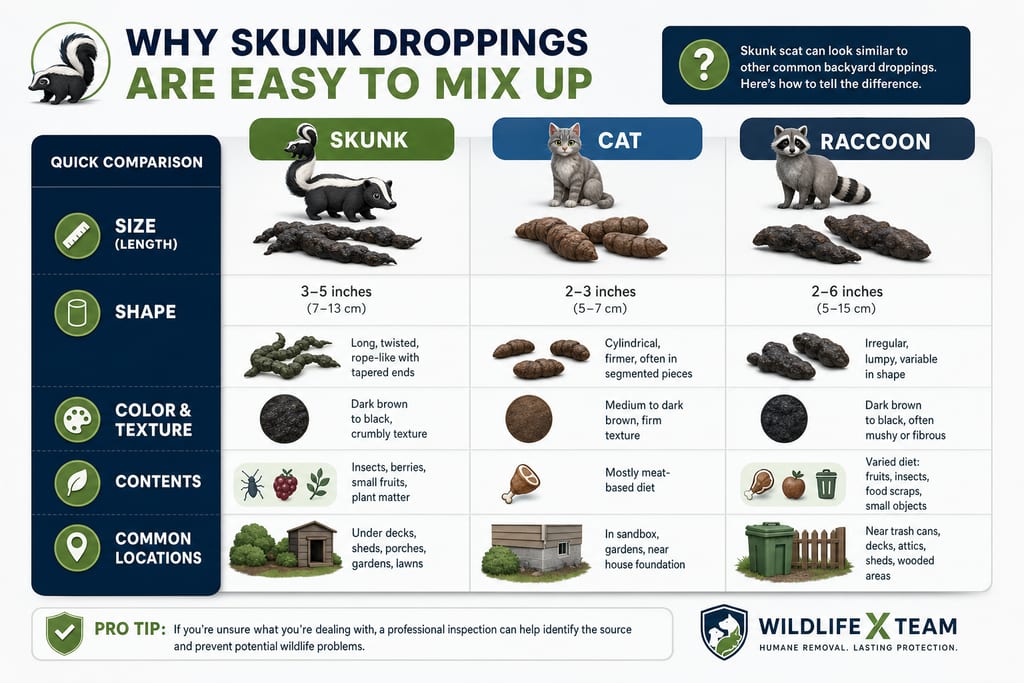
What shows up inside the dropping changes with the season. In winter, skunks eat more small mammals and carrion, so you'll see more fur and bone bits packed in. In summer, their diet shifts toward berries, grubs, and insects, so the droppings look softer and more plant-heavy.
Here's a quick way to tell the three apart. Skunk droppings run 2 to 3 inches, tube-shaped, and turn up near dens or under decks. Raccoon droppings are usually thicker and longer, often 3 to 5 inches, and pile up at a shared spot called a latrine, usually at the base of a tree or on a roof. Cat droppings are more segmented, buried in soft soil or mulch, and lack the seed and insect content skunks leave behind.
A short clip helps more than a written description when you're trying to match what's on the ground to the right animal.
What Skunk Poop Looks Like Photos and Key Traits
Picture placeholder: a fresh dropping on bare dirt, showing the tube shape and blunt, rounded ends that set it apart from a tapered coyote or fox scat. This is the shape to lock into memory before you compare anything else.
Picture placeholder: a dropping broken open to show packed berry seeds and shiny bits of beetle shell, a sign the skunk has been feeding on summer insects and fruit near your yard.
- Length runs 2 to 3 inches, about the size of your thumb
- Diameter sits around half an inch, fairly consistent along the length
- Color ranges from dark brown to near black, rarely gray
- Surface often looks segmented or broken into short sections rather than one smooth log
- Contents shift with diet: fur and bone chips in cold months, seeds and insect casings in warm ones
Before you scroll further, run the dropping you found against that list. If it matches on shape, size, and at least one diet clue like seeds or beetle shell, you're likely looking at skunk and not something else sharing the same patch of yard.
Where Skunks Leave Droppings Around Your Yard
Skunks don't scatter their droppings randomly. They tend to pick one spot near their den and return to it, which is why you'll find small piles rather than single droppings spread across the lawn.
Watch these spots first, since they account for most sightings:
- Under sheds, porches, or decks where the den entrance sits
- Along foundation gaps or crawl space openings
- Fence lines where skunks travel between yards
- Garden beds or lawn patches being dug up for grubs
That repeat-use habit, called a latrine, is actually useful information. A single pile in one fixed location means the den is close by, likely within a few yards, not somewhere across the neighborhood. If you also see fresh digging or small holes near that same pile, that confirms the skunk is actively feeding in the area, not just passing through on its way somewhere else.
Other Signs That Confirm a Skunk Is Nearby
Droppings tell you a skunk has been there, but a few other clues confirm it and help you judge how active the den is. Smell is usually the first one people notice.
A musky odor that lingers near a shed or deck, even without a spray event, often means a skunk is denning close by and marking its territory in passing. Check for these alongside any droppings you've found:
- Small, cone-shaped holes in the lawn from nighttime grub digging
- Five-toed tracks with claw marks visible in soft dirt or mud
- A faint musk smell near the den entrance that doesn't fade after a day or two
- Rustling or thumping sounds under a deck or shed after dark
This clip shows what the actual tracks and scat look like side by side in the field, which is easier to judge than a written description.
If you get two or more of these signs in the same spot as the droppings, you're dealing with an active den, not just a skunk that wandered through once.
Skunk Poop Versus Dog and Raccoon Droppings
Picture placeholder: a skunk dropping next to a dog dropping, showing the difference in shape and the seed content inside the skunk sample. Picture placeholder: a skunk dropping next to a raccoon dropping, showing the raccoon's larger size and blunter ends.
Dog droppings are usually smoother and more uniform in color, without the seeds or insect shell bits you'll find in skunk scat. Raccoon droppings run larger, often 3 to 5 inches long, and tend to show up in communal piles on flat surfaces like a roof edge or a tree stump rather than tucked under a deck.
A few quick checks separate the three when you're not sure what you're looking at:
- Location: skunk scat sits low, near ground-level den openings
- Pile size: raccoon latrines often hold several droppings at once, skunk piles are smaller
- Texture: dog scat looks consistent, skunk scat looks packed with seeds or shell
- Surface: raccoons favor elevated flat spots, skunks stay at ground level near cover
If the pile is low to the ground, near a den opening, and packed with seeds or shell fragments, skunk is the safer bet over dog or raccoon every time.
When a Photo Match Is Not Enough
Old droppings lose their color and shape fast. Rain, sun, and a few weeks of weathering turn a dark tube into a gray, crumbled lump that could pass for almost anything, which makes photo matching unreliable once the scat has been sitting for a while.
Mixed activity muddies things too. A yard with raccoons, possums, and a skunk all using the same crawl space can leave overlapping sign that no single picture sorts out on its own.
At that point a visual guide has done its job and the next step is a trained eye on the property. A Wildlife Inspection Report from Wildlife X Team checks den locations, entry points, and the paths animals use to get in, details a photo can't confirm no matter how sharp it is.
There's also a health angle worth weighing. Skunk droppings can carry parasites and bacteria, so poking around under a deck to collect a sample for comparison carries real risk. Letting a professional handle removal and cleanup costs more than a DIY attempt, but it keeps you from handling waste that can make you sick.
Deciding Whether to Call for a Den Inspection
Once droppings, a lingering musk smell, and fresh digging all show up in the same corner of your yard, that's a den, not a one-time visitor. Waiting usually means more holes in the lawn and a bigger mess under the deck by the time you act. Wildlife X Team serves Fort Worth, Denton, Granbury, and the surrounding area with humane removal and exclusion work that seals the den for good. Call (817) 799-8686 and get an inspection scheduled before the skunk settles in any deeper.
Skunk Poop Lingering Questions
Can skunk droppings make my dog sick if they sniff or eat them?
Yes, skunk droppings can pass parasites like roundworms and bacteria that upset a dog's stomach or worse. Dogs that dig at den sites or snack on old scat are most at risk. Keep pets leashed near known den spots and call your vet if your dog eats any wildlife droppings, skunk or otherwise.
Why do I keep finding fresh droppings in the same spot every few days?
That pattern means the skunk has picked that spot as a regular latrine tied to its den, not a random stop on a route. Skunks are creatures of habit and will keep using the same corner of the yard night after night as long as the den stays active and food is close by.
Does skunk poop near my porch mean there's a den underneath it?
It's a strong sign, especially if the pile sits right at a gap in the lattice or foundation. Porches and sheds offer the dark, enclosed space skunks look for when they den. Wildlife X Team's Wildlife Inspection Report checks underneath these structures to confirm a den and find every entry point before sealing it up.
Can I shine a flashlight at night to confirm it's a skunk before calling someone?
You can try, but approaching a den at night carries real risk of a spray or a bite if the skunk feels cornered. A flashlight from a safe distance, 20 feet or more, might catch the white stripe pattern, but it won't tell you how many entry points exist or how deep the den runs.