
Raccoon Trapping Services: A Complete Guide for DFW Residents

A single raccoon can cause over $5,000 in damage to your attic insulation, wiring, and ductwork in just a few weeks. These masked bandits are drawn to DFW homes because attics provide the perfect warm, dry space for raising their young, especially during peak nesting season from February through May. Understanding why raccoons target your property and how professional trapping services like Wildlife X Team handle these intrusions can save you thousands in repairs and protect your family from health risks.
Table of Contents
The Raccoon Problem in North Texas
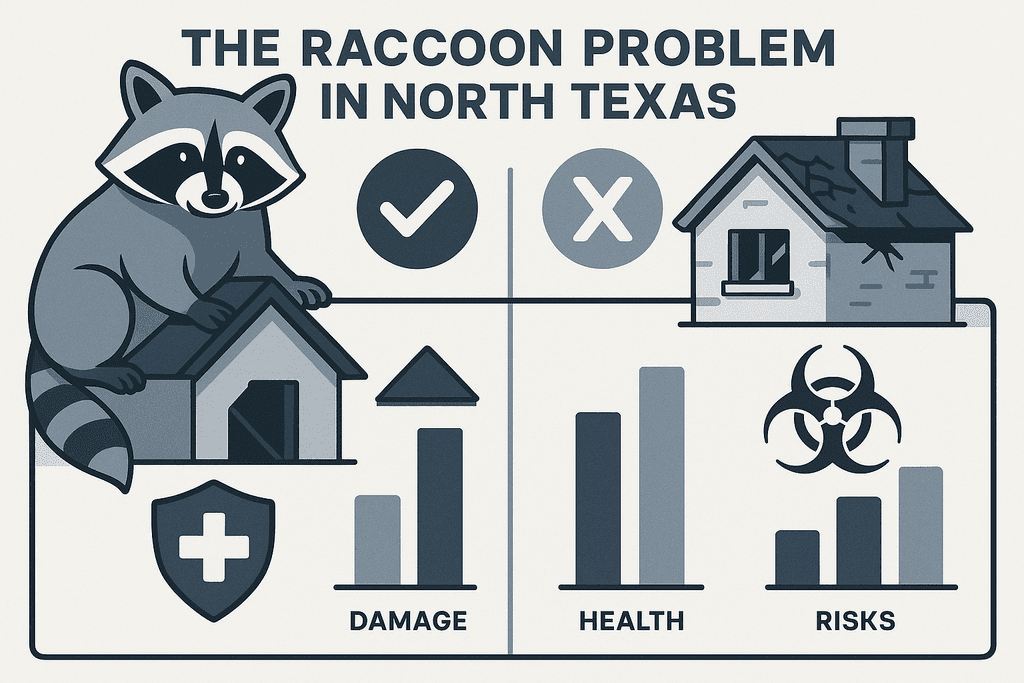
Raccoons in the Dallas-Fort Worth area have become more than just occasional backyard visitors. Over the past decade, the urban raccoon population has grown by nearly 40%, making them one of the most common wildlife intruders in residential neighborhoods. These masked bandits have adapted incredibly well to city life, finding our homes much more comfortable than their natural habitats. What used to be a rare problem has turned into something thousands of DFW homeowners deal with every year.
How Raccoons Get Inside Your Home
Raccoons are surprisingly good at finding weak spots in your home's defenses. They don't need a big opening to get started, and once they find a small gap, their strong paws can make it much bigger. Most homeowners don't even realize these entry points exist until it's too late.
The most common ways raccoons break into DFW homes include:
- Roof vents that aren't properly secured or have damaged screens
- Chimneys without caps or with broken chimney covers
- Damaged or rotting soffits and fascia boards along the roofline
- Gaps where different building materials meet, especially around additions
- Attic vents with weak or missing protective barriers
This video shows exactly how professional trapping systems work and why proper technique matters when dealing with raccoons in your attic or crawl space.
Health Risks Raccoons Bring to Your Family
Beyond the property damage, raccoons carry serious health threats that put your family at risk. Rabies remains one of the biggest concerns, as raccoons are among the most common rabies carriers in Texas. Even if a raccoon doesn't bite anyone, their droppings contain parasites like raccoon roundworm, which can cause severe neurological problems in humans, especially children.
Other health hazards include:
- Leptospirosis bacteria in their urine that contaminates insulation and surfaces
- Fleas, ticks, and mites that spread throughout your home
- Histoplasmosis from fungus growing in their droppings
- Salmonella and E. coli contamination in areas where they nest
The Real Cost of Waiting
Many homeowners try to ignore the scratching sounds in their attic, hoping the raccoons will just leave on their own. This almost never happens, and the delay makes everything worse. The difference between acting quickly and waiting can mean thousands of dollars in additional damage and health risks.
Here's what the numbers actually look like:
| Response Time | Average Damage Cost | Health Risk Level | Repair Complexity |
|---|---|---|---|
| Within 1 Week | $800 - $2,000 | Low to Moderate | Simple repairs, minimal cleanup |
| 1-3 Months | $3,000 - $6,000 | Moderate to High | Insulation replacement, multiple entry points |
| 3+ Months | $6,000 - $10,000+ | High to Severe | Structural damage, full attic restoration, electrical repairs |
Wildlife X Team has seen cases where homeowners waited six months or more, resulting in completely destroyed attic insulation, chewed electrical wiring, and contamination so severe that everything had to be removed and replaced. The longer raccoons stay, the more they treat your attic like their permanent home, having babies and creating larger colonies.
What starts as one or two raccoons can quickly become a family of six or seven. Female raccoons often return to the same location year after year to have their babies, which means your raccoon problem won't solve itself. The scratching noises, the smell, and the damage all get progressively worse until you take action.
How Professional Raccoon Trapping Works
Raccoons can squeeze through openings as small as four inches, which means your home probably has more entry points than you realize. When you call in professionals, the first thing they do is conduct a thorough inspection of your property. This isn't just a quick walk around the house. They're looking at your roof, chimney, vents, foundation, and any other spot where a raccoon might have found a way inside. The goal is to understand exactly how these animals are getting in and what's attracting them to your space in the first place.

How Professional Raccoon Trapping Works
The Wildlife Inspection Report® documents every vulnerability found during this initial assessment. This detailed report becomes your roadmap for solving the problem completely, not just temporarily.
Once the inspection is complete, professionals set up humane traps in strategic locations. The traps need to be the right size and placed where raccoons are actually traveling. Bait placement matters too, because raccoons are smart and won't fall for obvious setups. But here's something many homeowners don't think about until it's too late.
Baby raccoons are often hidden in attics or walls during spring and early summer. Before any removal happens, technicians check for young raccoons that might be separated from their mother. Removing an adult without addressing babies creates a whole new problem, and it's also inhumane.
- Initial property inspection identifies all entry points and activity areas
- Humane cage traps are positioned based on raccoon travel patterns
- Technicians verify no dependent babies will be orphaned
- State regulations guide proper handling and relocation procedures
- Follow-up visits ensure complete removal before exclusion work begins
Texas has specific regulations about how wildlife can be handled and where animals can be relocated. Professional services stay current with these rules, which change periodically. Trying to trap and relocate raccoons yourself without knowing these regulations can actually land you in legal trouble.
What Sets Professional Services Apart
The biggest difference between a DIY approach and hiring professionals comes down to what happens after the raccoon is gone. Anyone can buy a trap at the hardware store, but that only solves half the problem. If you don't seal up the entry points properly, you're just making room for the next raccoon to move in. Professional services like Wildlife X Team handle both the removal and the prevention work, which is why their approach actually sticks.

What Sets Professional Services Apart
Licensing and insurance coverage protect you if something goes wrong during the removal process. Raccoons can be aggressive when cornered, and they carry diseases like rabies and roundworm. Professional technicians know how to handle these situations safely.
Real Customer Experience: Mark Thompson shared, "Top notch service! They effectively removed the raccoons and secured my attic against future invasions." His situation involved multiple raccoons that had been living in his attic for weeks, causing significant damage to insulation and wiring.
The exclusion work is where professionals really earn their keep. This involves sealing every possible entry point with materials that raccoons can't chew through or pry open. It's not just about stuffing some steel wool in a hole and calling it done.
Attic cleanup and restoration addresses the contamination left behind. Raccoon feces and urine can soak into insulation, creating health hazards that linger long after the animals are gone. Professionals remove contaminated materials, disinfect the area, and replace damaged insulation.
- Professional approach: Licensed technicians with proper safety equipment and insurance
- DIY attempt: Homeowner with a store-bought trap and no backup plan
- Professional approach: Complete exclusion work prevents re-entry
- DIY attempt: Trap and release leaves entry points wide open
- Professional approach: Attic restoration removes health hazards
- DIY attempt: Contaminated insulation remains in place
Wildlife X Team backs their work with a Renewable Lifetime Warranty, which means if raccoons find a way back in through their exclusion work, they'll come fix it. That kind of guarantee only makes sense when the company is confident in their methods.
Prevention and Long-Term Protection
Getting raccoons out is only the beginning of a complete solution. The real value comes from making sure they can't come back. Animal proofing involves sealing every potential entry point with materials specifically chosen to withstand raccoon strength and persistence. We're talking about heavy-gauge steel mesh, reinforced vent covers, and professional-grade sealants that won't crack or deteriorate over time. Cheap fixes might hold for a few weeks, but raccoons are persistent problem-solvers.
Chimney caps and vent guards block two of the most common entry routes raccoons use. Your chimney is basically an open invitation without proper protection, and bathroom or dryer vents are easy targets for raccoons looking for a warm spot.
Foundation repairs eliminate ground-level access points that many homeowners overlook. Raccoons can dig under foundations or exploit existing cracks to get into crawl spaces. Once they're under your house, it's only a matter of time before they find a way up into the main structure.
- All entry points sealed with raccoon-resistant materials
- Chimney caps installed to prevent roof access
- Vent guards protect bathroom and dryer vents
- Foundation gaps repaired to block ground-level entry
- Tree branches trimmed back from roof lines
Tree trimming reduces roof access from overhanging branches. Raccoons are excellent climbers, and a branch that hangs within six feet of your roof is basically a highway for them. Keeping trees properly trimmed creates a gap they can't easily jump.
Regular inspections catch new vulnerabilities before they become full-blown infestations. Weather, settling, and normal wear can create new openings over time. A quick annual check can spot these issues early, saving you from dealing with another raccoon family down the road. The DFW area sees plenty of raccoon activity year-round, so staying ahead of potential problems makes sense for any homeowner.
Understanding the True Cost of Raccoon Damage
Most homeowners think a few scratching sounds in the attic aren't worth worrying about right away. That mindset can turn a $500 problem into a $10,000 nightmare faster than you'd expect. Raccoons don't just move in and sit quietly. They tear through insulation, chew electrical wiring, and leave behind waste that creates serious health hazards. The longer they stay, the more expensive your problem becomes.
The Real Numbers Behind Raccoon Damage
When you break down the actual costs, the math gets pretty clear. Professional raccoon removal typically runs between $300 and $600 for most residential situations. That includes trapping, removal, and basic exclusion work to keep them from coming back.
Compare that to what happens when you wait. The damage adds up in ways most people don't see coming.
- Insulation replacement costs between $2,000 and $5,000 depending on attic size
- Electrical repairs for chewed wiring average $1,500 to $3,000
- Structural wood damage repair runs $800 to $2,500
- Professional attic cleanup and sanitization costs $1,000 to $3,000
- Ductwork repairs can add another $500 to $1,500
Health Risks You Can't Ignore
The financial hit is just part of the story. Raccoon feces carry roundworm eggs that can cause serious illness in humans. Their urine soaks into insulation and creates respiratory hazards that linger long after the animals leave.
Wildlife X Team's approach includes thorough attic cleanup and restoration because removing the animals is only half the job. The contamination they leave behind needs professional attention with proper equipment and disinfection methods.
- Raccoon roundworm can cause severe neurological damage in humans
- Contaminated insulation must be completely removed and replaced
- DIY cleanup puts you at direct risk of disease exposure
- Professional sanitization eliminates pathogens that regular cleaning misses
Property Value Takes a Hit
Here's something real estate agents know but don't always share. Homes with documented wildlife damage that wasn't properly remediated sell for less. Buyers get nervous when they see patched holes or smell lingering odors in attics.
Professional removal with proper documentation and warranty protection actually protects your home's value. Wildlife X Team's renewable lifetime warranty gives future buyers confidence that the problem was handled right. Some companies like Critter Control and Terminix offer similar services, but the warranty terms and coverage areas vary significantly across providers in the DFW region.
- Undisclosed wildlife damage can derail home sales
- Professional remediation with documentation maintains property value
- Warranty coverage transfers to new owners in many cases
Taking Action on Raccoon Problems
Dealing with raccoons isn't something you want to put off until tomorrow. The longer these animals stay in your attic or crawl space, the more damage they cause and the bigger your repair bill becomes. What starts as a small hole in your soffit can turn into thousands of dollars in insulation replacement, structural repairs, and contamination cleanup. Most homeowners don't realize how quickly things can get out of hand once raccoons decide your home is theirs.
Getting professional help early makes a huge difference. Wildlife X Team handles everything from the initial inspection to the final exclusion work that keeps raccoons from coming back. We serve Fort Worth, Denton, Granbury, and the surrounding DFW areas with humane removal methods that actually work long-term.
The real key to solving raccoon problems isn't just getting them out. It's making sure they can't get back in. That's where proper exclusion work separates a temporary fix from a permanent solution. Professional services include sealing entry points, installing barriers, and repairing the damage raccoons leave behind.
Some companies will trap the raccoons and call it done, but that doesn't address why they got in or how to stop the next family from moving in. The right approach combines removal with prevention, which is exactly what our Wildlife Inspection Report identifies during the initial visit.
If you're hearing noises in your attic or seeing signs of raccoon activity around your property, waiting usually makes things worse. The questions below cover some of the most common concerns homeowners have when dealing with these situations.
Common Questions About Raccoon Trapping
Most DFW homeowners have similar concerns when dealing with raccoons in their attic or crawl spaces. The process can seem confusing, especially if you've never dealt with wildlife removal before. Understanding what to expect helps you make better decisions about protecting your home. Here are the answers to questions we hear most often from homeowners in the Fort Worth, Denton, and Granbury areas.
How long does raccoon removal take?
Most raccoon removal projects take between 3 to 7 days from start to finish. The timeline depends on how many raccoons are in your home and whether there are babies present. Wildlife X Team starts with a detailed inspection to find all entry points, then sets up humane traps in strategic locations. Some situations resolve in just a few days, while others with multiple animals or nursing mothers may take up to two weeks.
Is raccoon trapping humane and legal in Texas?
Yes, professional raccoon trapping is both humane and legal in Texas when done by licensed wildlife removal specialists. Texas law requires that trapped raccoons be handled according to specific regulations, which is why DIY trapping often creates legal problems for homeowners. Wildlife X Team uses methods that don't harm the animals and follows all state guidelines for relocation or release. The traps are checked regularly to minimize stress on the animals.
What happens to raccoons after they're trapped?
Trapped raccoons are relocated to appropriate habitats away from residential areas, following Texas Parks and Wildlife Department regulations. The animals are released in areas where they can find food and shelter without threatening homes or businesses. Professional services like Wildlife X Team know the approved relocation sites and handle the entire process legally.
Can raccoons return after removal?
Raccoons can definitely return if entry points aren't properly sealed. That's why removal alone isn't enough to solve the problem. Wildlife X Team includes animal proofing and exclusion services that seal all potential entry points with durable materials. Their renewable lifetime warranty protects against future invasions, which most competitors don't offer. Without proper exclusion work, you're just inviting the same raccoons or new ones back into your attic.
Do I need attic cleanup after raccoon removal?
Attic cleanup is essential after raccoon removal because these animals leave behind contaminated insulation, droppings, and urine that pose health risks. Raccoon waste can contain parasites and diseases that affect humans and pets. Professional cleanup involves removing damaged insulation, disinfecting all surfaces, and replacing materials that can't be salvaged. Skipping this step leaves your family exposed to potential health hazards.
How much does professional raccoon removal cost?
Professional raccoon removal in the DFW area typically ranges from a few hundred to several thousand dollars depending on the severity of the infestation and damage. The cost includes inspection, trapping, exclusion work, and sometimes attic restoration. While some companies advertise lower prices, they often don't include crucial services like sealing entry points or cleanup. Wildlife X Team provides detailed estimates upfront so you know exactly what you're paying for without surprise charges later.