
Raccoon Trapper vs Wildlife Removal in Fort Worth
If you need a raccoon trapper in Fort Worth, the short answer is yes, help is close by and often available the same week. Raccoons do not slow down for winter here. Attics, chimneys, and crawl spaces in Fort Worth stay warm and dry year round, so a mother raccoon can move in during any month and start tearing up insulation within days. Homeowners in Denton, Granbury, and nearby towns run into the same problem, usually after hearing scratching at night or finding torn vent screens outside.
Humane trapping and removal is available across Fort Worth, Denton, Granbury, Weatherford, Southlake, Grapevine, and the rest of the surrounding area. The goal is to get the animal out safely, find how it got in, and close that gap so another one does not show up next month. Anyone dealing with raccoon noise in the attic or damage around the roofline can call (817) 799-8686 to get a technician out that same week.
Table of Contents
Why Raccoons Keep Showing Up in Fort Worth Homes
Female raccoons look for a warm, dry spot to raise young, and they do not care if that spot is a den tree or your attic. Breeding season runs late winter into spring, but a raccoon with a den already picked out will use it whenever she needs it. An attic beats a hollow log because it stays dry and holds heat better.
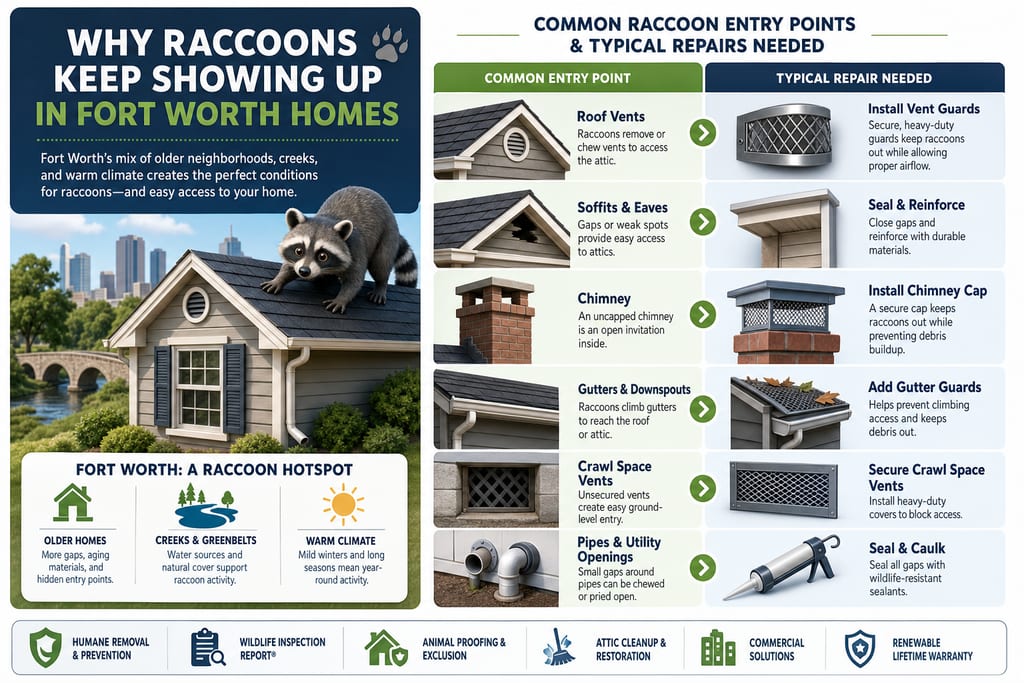
Fort Worth's older neighborhoods have homes with aging roof lines, loose flashing, and vents that were never fitted with guards. Add in the creeks and green spaces that run through the city, Trinity Park, Oakland Lake, the stretches along the West Fork, and you get a steady path from wooded cover straight to a backyard fence line.
Raccoons get into houses through a handful of weak points, and most homes have at least one:
- Roof vents with torn or missing screens
- Chimneys without a cap
- Gaps under soffits where wood has warped
- Cracks or openings along the foundation
A raccoon only needs an opening about four inches wide to pull itself through, so small gaps matter as much as big ones.
Signs You Have a Raccoon Problem
Raccoons leave a different footprint than squirrels or mice, and the details matter before you decide who to call. The sounds come at night, since raccoons are active after dark, and they tend to sound like heavy footsteps or dragging rather than the quick scurry of a rodent.
Outside, look for torn vents, bent flashing, or shingles pulled up near the roofline, since raccoons use their paws and body weight to widen an opening rather than gnaw through it. Droppings are another clue: raccoon scat is tubular, often an inch or more long, and shows up in one spot near the attic entrance with a strong musky smell.
- Thumping or rolling sounds at night, not quick scratching
- Torn screens, bent flashing, or shingles pulled back near the roof edge
- Large tubular droppings clustered in one spot
- Raccoons spotted near trash cans or chimneys at dusk
- A musky odor coming from the attic or soffit area
If you see two or more of these at once, it is worth treating the attic as occupied rather than waiting to confirm it with your own eyes.
How Our Raccoon Trapping Process Works
The process starts with a full inspection, not a trap set on a guess. A technician walks the roofline, attic, and foundation and documents every weak point in a Wildlife Inspection Report, so the homeowner sees exactly where the raccoon got in before any work begins.
Humane traps go in at the entry point or inside the attic, set to remove the raccoon without harming it, then the crew moves to exclusion work. That means vent guards, a chimney cap if needed, and sealing any gap a raccoon could reuse. Attic cleanup follows once the animal is out, since raccoon waste carries health risks and left-behind insulation keeps the smell around.
- Inspect the property and log entry points
- Place humane traps and remove the raccoon
- Install vent guards, caps, and sealant at every gap found
- Clean and sanitize the attic, replacing damaged insulation
Skipping the last step is the most common reason a raccoon problem comes back within a few months.
What Affects the Cost of Raccoon Removal
No two raccoon jobs cost the same, because the price follows the damage, not a flat rate. A single attic entry with minor insulation damage costs far less to fix than a home with three open gaps and soaked, torn insulation from weeks of occupancy.
Exclusion work adds to the scope when foundation gaps or a capless chimney need repair on top of trapping. Attic cleanup and insulation replacement are priced apart from removal, since they depend on how much area was contaminated.
- Number of entry points found during inspection
- Square footage of attic affected by droppings or torn insulation
- Type of exclusion repair needed, vent guard versus chimney cap versus foundation work
- Whether cleanup and sanitizing are needed on top of trapping
Paying for trapping alone without exclusion often means paying again later, while a renewable lifetime warranty on the exclusion work covers you if a raccoon finds a new way in.
Why Fort Worth Homeowners Choose Wildlife X Team
Homeowners in Fort Worth and the surrounding towns want the raccoon gone without it getting hurt, and that is the standard the work is held to here. Humane trapping protects the animal while the exclusion work protects the house, which is the difference between a one-time fix and a long-term solution.
Coverage runs across Fort Worth, Denton, Granbury, Weatherford, Southlake, Grapevine, Colleyville, and nearby towns, so the same crew handles a job whether it is a city lot or a property near Possum Kingdom Lake. Mark Thompson's experience sums up what most customers report: the raccoons were removed and the attic was sealed against future invasions, not just cleared out once.
- Humane removal methods that do not harm the animal
- Service coverage across Fort Worth, Denton, Granbury, and nearby cities
- Exclusion work backed by a renewable lifetime warranty
- Real customer results like sealed attics and no repeat raccoons
That combination of humane work and a warranty that carries forward is what keeps the same customers from calling back about the same raccoon twice.
Trap Only, or Trap and Seal the Gap
A homeowner can hire someone to pull a raccoon out of the attic and stop there. That costs less up front, but the den is still open, and a raccoon picks a spot because it is warm, dry, and already proven safe. Another one moves in within weeks, sometimes days, and the whole cycle starts over.
The other choice is paying for exclusion along with the trapping, which means vent guards, a capped chimney, and sealed gaps so nothing can walk back through the same hole. This costs more at the time of service, but it is the only choice that actually ends the problem instead of pausing it. Unsealed entry points do not just invite a second raccoon, they also mean a second service call and a second repair bill for damage that keeps happening in the same spot.
A renewable lifetime warranty only applies to the exclusion work, not to trapping on its own, so the choice between the two options also decides whether a second raccoon costs the homeowner anything at all. Anyone weighing a cheaper trap-only quote against a full exclusion quote is really weighing one bill now against repeat bills later.
Ready to Get the Raccoon Out This Week
Pick up the phone and call (817) 799-8686 to schedule an inspection. That single call sets the whole process in motion, from the first walk around the roofline to the final seal on the attic. Wildlife X Team covers Fort Worth, Denton, Granbury, and the towns around them, so a tech can reach a house near downtown or one out by Possum Kingdom Lake on the same schedule. The approach does not change for a business either, the same inspection, trapping, and sealing steps apply to a commercial attic or crawl space as they do to a home. Make the call before the scratching gets worse.
Raccoon Trapping Questions in Fort Worth
Is it legal for me to trap a raccoon myself in Fort Worth?
Texas requires a trapping permit for relocating raccoons, and releasing one in a new area without one can create legal problems for you and health risks for the raccoon. Most homeowners do not have the permit or the training to handle a raccoon safely once it is caged. A licensed technician already carries the right permits and knows how to move the animal without anyone getting hurt.
What happens to the raccoon after it's trapped?
Once a raccoon is caught, it is removed from the property and relocated away from homes, following state wildlife guidelines for humane handling. The animal is not harmed during the process, and the crew checks the trap on a regular schedule so it is not left sitting for long periods. The goal is getting it out fast and keeping it safe until release.
Can a raccoon get back into my attic after one is removed?
Yes, if the entry point is never sealed. Raccoons remember a den that worked once, and the same opening that let one in will let another one in later, sometimes within days. That is why trapping alone does not end the problem, and why sealing every gap found during inspection matters as much as the trapping itself.
Do you remove baby raccoons separately from the mother?
No, Wildlife X Team keeps mother and babies together during removal whenever possible. Separating them causes stress for the animals and often leaves young raccoons stuck in the attic after the mother is gone, which creates a worse problem than the original one. Technicians check for a litter before trapping so the whole family is handled at once.