
Raccoon Scat Identification, Health Risks, and Safe Cleanup
Raccoon roundworm eggs can hang around in soil for years, just waiting for a pet or curious kid to come along. That's why knowing what raccoon scat looks like, and what it can do to your health, matters more than most people think. This post covers how to spot it, the risks it carries, and the right way to clean it up without making things worse.
Table of Contents
- What Raccoon Scat Actually Looks Like
- Spotting a Raccoon Latrine on Your Property
- The Real Health Risks Hiding in Raccoon Droppings
- Safe Cleanup Steps If You Find Raccoon Scat
- Why Cleanup Alone Won't Solve the Problem
- Wrap-up Protecting Your Home from Raccoon Waste
- Frequently Asked Questions About Raccoon Scat
What Raccoon Scat Actually Looks Like
Raccoons don't just poop wherever they feel like it. They actually pick certain spots and use them over and over again, which builds up piles called latrines. Once you know what to look for, spotting raccoon scat gets a lot easier. It's usually tube shaped with blunt, rounded ends, kind of like a fat cigar. The color ranges from dark brown to black, and fresh droppings often have a shiny, wet look before they dry out and crumble.
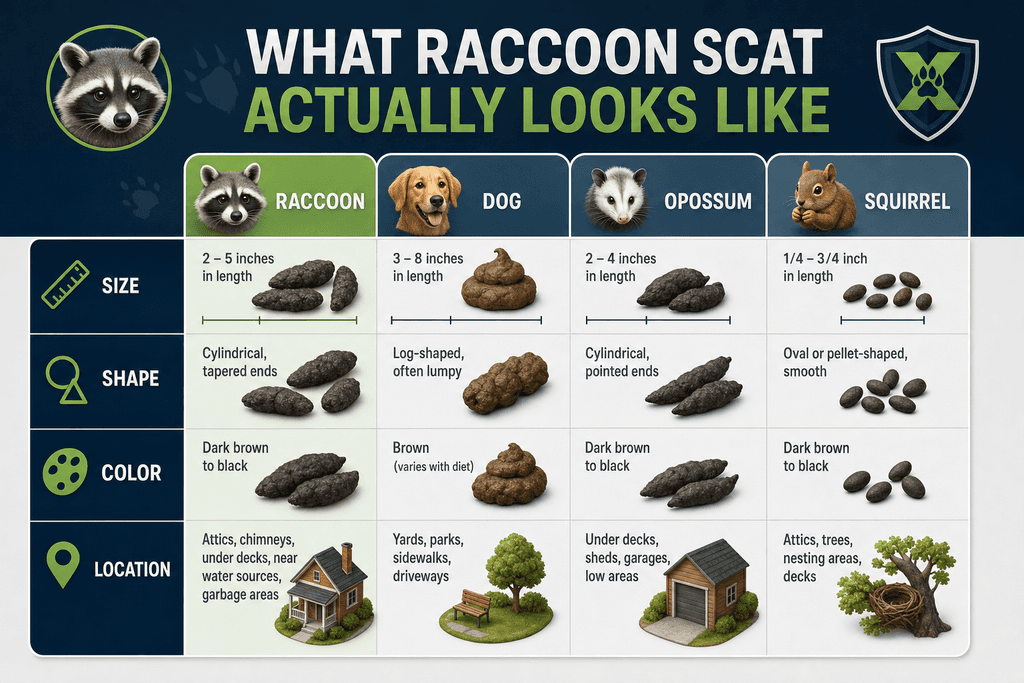
Size matters here too. Most raccoon droppings run about 2 to 3 inches long and roughly half an inch to three quarters of an inch thick. That's bigger than what you'd see from a squirrel, but smaller than most dog breeds leave behind. Since raccoons eat all kinds of stuff, from berries to bugs to garbage, you might notice seeds, undigested food bits, or shiny pieces mixed in.
Location is a huge clue too. Raccoons like to use the same bathroom spot repeatedly, so if you find a pile instead of scattered droppings, that's a big hint. Common latrine spots include:
- Attics and crawl spaces where they've made a den
- Chimneys, especially ones without a cap
- Bases of trees in the yard
- Flat sections of roofs
- Decks and porches, particularly under the boards
Since a bunch of animals leave droppings that can look kind of similar at first glance, it helps to compare them side by side.
Here's how raccoon scat stacks up against other critters you might find around a Fort Worth or Denton property:
- Raccoon - tube shaped, blunt ends, 2 to 3 inches long, found in piles at latrine sites like attics or tree bases
- Dog - similar size or larger, often tapered or curled at one end, scattered around the yard rather than piled
- Opossum - lumpy and irregular shaped, lighter in color, usually smaller and less uniform than raccoon droppings
- Squirrel - tiny pellets, less than half an inch, often found scattered near nests or along beams
Getting this identification right matters, because raccoon scat carries some health risks that other droppings don't always share. That's actually the part homeowners need to understand next.
Spotting a Raccoon Latrine on Your Property
A raccoon doesn't just go wherever it feels like. These animals pick one spot and stick with it, which is why finding raccoon scat in the same place over and over is such a common problem. This habit is called a latrine site, and once a raccoon claims one, it keeps coming back to use it like a bathroom. That's convenient for the raccoon but not so great for you, especially if that spot happens to be your attic or the corner of your porch.
Common latrine locations include:
- Attic corners near the entry point they used to get in
- Chimney tops or the flat area around a chimney cap
- Woodpiles stacked near the house
- Base of trees in the yard, especially ones raccoons climb
Telling old droppings from an active site matters. Fresh scat looks dark, moist, and has a strong smell. Older piles dry out, crumble, and turn lighter in color. If you're seeing a mix of both, that's a sign the site is still in use and more is coming.
The Real Health Risks Hiding in Raccoon Droppings
Raccoon scat isn't just gross to look at, it can actually make you sick. The biggest concern is a parasite called Baylisascaris procyonis, a roundworm that lives in raccoon intestines and gets released through their droppings. The eggs are microscopic, so you won't see them, but breathing in dust from dried scat or touching contaminated soil is enough to get infected. In rare but serious cases, this roundworm can cause damage to the brain and eyes, especially in children who might play near a latrine site without knowing what it is.
Leptospirosis and salmonella are two more risks tied to raccoon droppings. Both can spread through contact with contaminated water, soil, or surfaces, and both cause symptoms like fever, vomiting, and stomach cramps.
One thing that surprises a lot of people is that you don't need to touch the droppings directly to get sick. Sweeping, vacuuming, or even walking near dried scat can kick tiny particles into the air, and breathing that in is enough.
Roundworm eggs can survive in soil for years and shrug off most household disinfectants, which is part of why cleanup isn't as simple as spraying some bleach and calling it done.
Kids, pets, and anyone with a weaker immune system face higher risks here. A dog sniffing around a latrine site or a toddler playing in the backyard can pick up the parasite without anyone noticing until symptoms show up later.
Safe Cleanup Steps If You Find Raccoon Scat
Finding raccoon scat in your attic or yard means it's time to be careful, not quick. A lot of people make the mistake of grabbing a broom or vacuum right away, but that's actually one of the worst things you can do since it stirs up roundworm eggs into the air where you can breathe them in. The safer approach takes a bit more prep work but it protects you from the health risks we just went over. Here's what a safe cleanup actually looks like.
Before touching anything, gear up properly:
- N95 respirator or better, not just a regular dust mask
- Disposable rubber gloves, thick enough to avoid tears
- Disposable coveralls or clothes you can wash right after
Once you're geared up, follow these steps:
- Dampen the droppings first with water, never sweep or vacuum dry scat
- Scoop the waste into a plastic bag using a shovel or scraper, not your hands
- Double bag it and seal tight before tossing in the trash
- Disinfect the surface with a bleach solution, letting it sit for the recommended contact time
- Wash gloves and reusable tools thoroughly, then wash your hands even though you wore gloves
If the latrine site is large, tucked deep in the attic insulation, or you're finding new droppings every few days, that's usually a sign there's still a raccoon coming and going. At that point, DIY cleanup won't fix the root problem. This is where Wildlife X Team comes in, since our attic cleanup and restoration service handles the contaminated material, disinfects the space properly, and seals up the entry point so the raccoon can't just come back and start a new latrine somewhere else in your attic.
Why Cleanup Alone Won't Solve the Problem
Here's something a lot of homeowners don't realize: raccoons are creatures of habit. Once a raccoon picks a spot in your attic as its bathroom, it will keep coming back to that exact same latrine site over and over, even after you've scrubbed it clean. So if you spend your Saturday scooping up raccoon scat and disinfecting the area, but you don't close off the hole the raccoon used to get in, you've basically just tidied up a bathroom that's still open for business. The raccoon (or its buddies) will be back within days, and you'll be right back where you started. This is one of the biggest mistakes we see people make, and it's why cleanup by itself is only half the job.
Contaminated insulation is another piece people tend to underestimate. Once raccoon scat has been sitting in your attic insulation, it's not really something you can just spot clean.
- Raccoon scat can carry roundworm eggs that survive for a long time
- Soaked or matted insulation loses its ability to keep your home energy efficient
- Odor from waste often lingers in insulation even after visible mess is gone
- Mold can start growing in damp, contaminated insulation
This is where a full Attic Cleanup & Restoration matters more than a quick wipe down. It's also why we always start with our Wildlife Inspection Report, so we know every single entry point before any cleanup begins. Skipping that step is basically guessing, and guessing doesn't keep raccoons out.
DIY Cleanup vs Professional Restoration
- Pros of DIY: costs less upfront, can be done on your own schedule, gives you a sense of control
- Cons of DIY: exposure to health risks, missed entry points, insulation often not fully replaced, no long-term guarantee
- Pros of professional service: full exclusion work, proper disinfecting, insulation replacement, backed by a Renewable Lifetime Warranty
- Cons of professional service: higher cost than doing it yourself, requires scheduling a visit
Compared to some competitors who focus mainly on trapping or one-time cleanup, this combined approach of inspection, removal, and restoration is what actually breaks the cycle instead of just delaying it.
Wrap-up Protecting Your Home from Raccoon Waste
So here's the deal with raccoon scat. It's dark, tube-shaped, and usually shows up in piles called latrines, often near tree bases, rooflines, or in your attic. Once you know what you're looking for, it's not too hard to spot. But spotting it is only half the battle.
The other half is dealing with it the right way. Raccoon droppings can carry roundworm eggs, and those eggs can make people pretty sick if breathed in or accidentally swallowed. That's not something to shrug off, especially with kids or pets running around the yard or house.
Here's a quick recap of what matters most:
- Raccoon scat looks different from dog or cat waste, mainly in shape and where you find it
- Roundworm eggs in the droppings are the biggest health concern
- Small amounts might be manageable with the right gear, but large latrines are a different story
- Attic infestations often mean there's more waste hidden than you'd think
If you've found a raccoon latrine tucked away in your attic insulation, that's usually a sign the raccoon problem is bigger than just cleanup. That's when it's worth calling in someone who handles this stuff regularly instead of guessing your way through it.
Wildlife X Team serves Fort Worth, Denton, Granbury, and the surrounding areas, and handles everything from the raccoon removal itself to the attic cleanup afterward. Figuring out how the raccoon got in and keeping it from happening again is really the last piece of the puzzle, and that's a whole topic on its own.
Frequently Asked Questions About Raccoon Scat
Raccoon poop questions come up a lot more than you'd think, probably because most people have never had a reason to study animal droppings until one shows up in their attic. Here's a quick rundown of what folks usually want to know, from health risks to what it costs to make the problem go away for good.
Can you get sick from touching raccoon poop
Yes. Raccoon scat can carry raccoon roundworm, plus bacteria like salmonella and leptospirosis. Even just breathing in dust from dried droppings can make you sick, so gloves and a mask are the bare minimum if you're anywhere near it.
How do I tell raccoon poop from dog poop
Raccoon scat is usually tubular, dark, and has blunt ends, and it often contains bits of undigested food like berry seeds or pet food chunks. It also tends to show up in piles called latrines, which dog poop typically doesn't do.
What kills raccoon roundworm eggs
Roundworm eggs are tough little things. Regular soap and water won't do it, and even a lot of household cleaners fail. Here's what actually works:
- Boiling water poured directly on hard surfaces
- Propane torching on non-flammable surfaces (used carefully)
- Full removal and replacement of contaminated insulation
This is part of why attic cleanup after a raccoon problem isn't a quick wipe-down job.
Should I call a professional for attic cleanup
If there's raccoon scat in your attic, calling a professional is the safer route. Companies like Wildlife X Team handle the disinfecting, insulation replacement, and entry point sealing so you're not the one breathing in roundworm dust with a mask from the hardware store.
How much does raccoon removal cost
Cost depends on how bad the infestation is, how much damage was done, and whether cleanup or repairs are needed too. Wildlife X Team doesn't publish flat rates online since every job is different, but they'll walk you through pricing after a proper inspection so there aren't surprises later.