
Possum Poop Images to Identify Droppings on Your Property

Possum droppings are usually 3/4 of an inch to an inch and a half long, shaped like a short tube with rounded, blunt ends, and if you want a possum poop image to compare against what you found in your yard or attic, look for dark brown or black pellets that sometimes have bits of seed, berry skin, or fur stuck in them. The color darkens as the droppings age, so fresh scat can look almost reddish brown before it dries out. Size and shape are the fastest way to tell possum from raccoon, since raccoon droppings tend to be longer and more uniform, with smoother, straighter segments.
Here is the part that catches most people off guard: possums, properly called opossums, are the only marsupial native to North America. That odd biology does not change what their droppings look like, but it does explain why their scat gets mixed up so often with raccoon or even house cat waste. All three are roughly tube shaped and dark colored, which is exactly why a size comparison next to a ruler or a coin helps more than a verbal description ever will.
Table of Contents
Possum Droppings Photo Comparison Chart
A side-by-side look at possum, raccoon, squirrel, cat, and rat droppings makes spotting the difference much faster than reading a description. Lay a photo of each next to a coin or a ruler and the size gap jumps out right away. Squirrel pellets are tiny, about the size of a grain of rice, and show up in small scattered piles near nut stashes or attic corners.
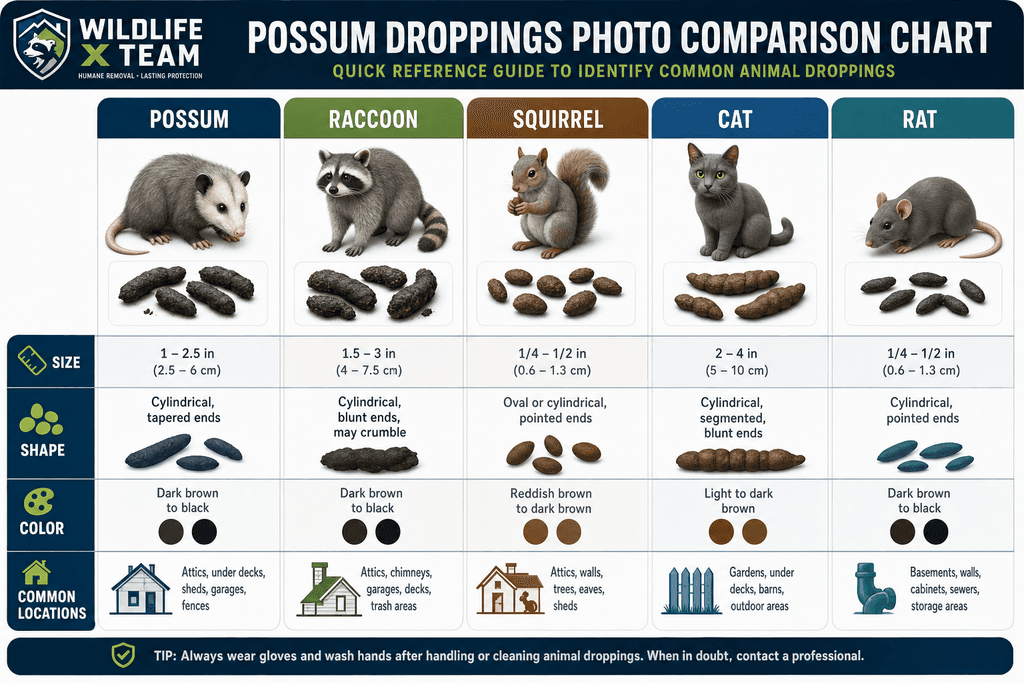
Cat droppings look similar in width to possum scat but usually come with a strong smell and get buried in loose soil or litter-like material. Rat droppings are much smaller, thin and pointed on the ends, and turn up in long trails along walls or baseboards. Possums tend to leave their droppings in one spot, often near a food source or a den entrance, rather than scattered across a wide area like raccoons do.
Lighting changes how dark or light a dropping looks in a photo, and diet can shift the color too, so do not rely on shade alone. Size, shape, and location tell you more than color ever will. A possum pellet found tucked in an attic corner or along a fence line, matching the size range already described, is your best confirmation.
Size Shape And Texture Clues To Look For
Texture tells you almost as much as size once you know what you are looking at. Fresh scat looks dark, slightly shiny, and a little moist, while anything older than a day or two dries out and turns gray or chalky on the outside. Break a dropping apart with a stick and you will usually find plant fiber, seed hulls, or small bits of fur mixed in, since possums are scavengers that eat whatever a yard or trash can offers.
The tip shape is the detail most people miss. Rounded, blunt ends are the possum signature, while rat and squirrel droppings taper to a point on one or both sides. Use this short check before you decide what animal you are dealing with:
- Press gently to check if it crumbles or holds together
- Look for seed, berry skin, or fur fragments inside
- Check the ends for rounded versus pointed tips
- Note whether the surface is moist or dried and chalky
These four checks work faster than trying to match a photo from memory, especially in dim attic light where color is hard to judge.
Possum Poop Versus Squirrel And Rat Droppings
A photo comparison showing possum, squirrel, and rat droppings side by side at the same scale clears up most confusion in seconds. Squirrel droppings are small, oval, and lighter brown, and they tend to show up in little clusters near stashed nuts or along attic rafters. Rat droppings run even smaller, pointed on both ends, and they scatter along the same travel paths night after night, usually hugging baseboards or wall edges.
Possum droppings are bigger than both and show up in a looser, more random pattern instead of neat piles or tight trails. Run through this quick comparison when you are not sure which animal left the mess:
- Squirrel scat sits near food stashes, not travel routes
- Rat scat lines walls and baseboards in repeat trails
- Possum scat is larger and less predictable in placement
If the droppings you found do not fit a tight cluster or a wall-hugging trail, a possum is the more likely source.
Possum Poop Versus Cat And Raccoon Droppings
Cats and raccoons are the two animals people mix up with possums most often, since all three leave dark, tube-shaped scat close in size. A side-by-side photo at matching scale shows the real differences fast. Cat droppings are segmented and firmer, and most cats, even strays, will scratch dirt or mulch over the spot when they are done.
Raccoons tend to pick one latrine site and return to it again and again, so you will often find a repeated pile rather than a single dropping. Possum scat is almost never buried and shows up loose along fence lines, porch steps, or scattered through attic insulation. A few quick checks help narrow it down:
- Check if the dropping is covered with dirt or mulch (cat)
- Look for a repeat pile in the same exact spot (raccoon)
- Note if it is sitting exposed with no attempt to cover it (possum)
Location and whether it was buried tell you more than the dropping itself in these two comparisons.
Common Spots Possums Leave Droppings On A Property
Possums do not dig a den or bury waste, so their droppings turn up wherever they have been resting or feeding. Attic insulation, crawl spaces, and the area right around a chimney opening are the most common indoor finds, since possums favor warm, enclosed spots once they get inside. Outdoors, check fence lines, the space under a deck, and anywhere near trash cans or pet food bowls left out overnight.
Possums don't use a single communal latrine the way raccoons do, so scattered droppings in several spots usually point to one, not several visits from different animals. A property walk-through should cover these areas:
- Attic corners and insulation near roof vents
- Crawl space entry points and foundation gaps
- Fence lines and the perimeter under a deck
- Trash can areas and outdoor pet food stations
Droppings clustered near a crawl space vent or a torn piece of soffit usually mean a den is active close by, and that spot is where any fix needs to start.
Handle It Yourself Or Call For Help
Gloves and a trash bag handle a single pile of possum droppings on a porch step, but that is the limit of a safe do-it-yourself cleanup. Possum scat can carry salmonella and leptospirosis, so bare-hand contact or sweeping it dry into the air is a real risk, not a small one. Bleach water and a mask cover the basic job once you are sure of what you are looking at.
The harder call is when the droppings might not be possum at all. Mistaking a raccoon latrine for possum scat is the costly version of this mistake, since raccoon droppings carry roundworm eggs that need steam cleaning and specialized disposal, not a wipe-down. Guessing wrong here means handling waste that needs a different level of protection than what most households keep on hand.
If the droppings keep showing up in the same attic corner week after week, that points to an active den rather than a one-time visit, and insulation and framing can take damage fast once that is the case. A Wildlife Inspection Report® from Wildlife X Team traces the droppings back to the actual entry point instead of leaving you to guess at which gap or vent is letting the animal in. That step matters most when the pile keeps growing or you are not confident which animal left it.
When To Schedule A Professional Inspection
One dropping on a porch step is a visitor passing through. The same pile showing up week after week in an attic corner or along a fence line is a den, and dens do not resolve on their own. Insulation soaked with scat and urine has to be pulled out and replaced, and that cost climbs the longer the animal stays put. Wildlife X Team covers Fort Worth, Denton, Granbury, and the surrounding area with humane removal and attic cleanup built for exactly this situation. Call (817) 799-8686 and get an inspection scheduled before a single pile turns into a full attic job.
Possum Poop Cleanup Questions
Can I just hose down possum droppings myself or do I need special cleaner?
A hose alone is not enough. Water spreads the bacteria around instead of killing it, and spraying dry droppings can knock particles into the air where you can breathe them in. Put on gloves and a mask, spray the pile with a bleach and water mix first to soak it, then wipe it up and bag it. Let the area dry fully before anyone walks through it.
Does possum poop smell different from other animal droppings?
Possum scat usually has a milder smell than cat or raccoon droppings, especially right after it is left. The odor gets stronger as it sits and breaks down, particularly in an enclosed attic where airflow is poor. A sharp, strong smell that builds up over days points more toward a den with urine soaking into insulation than a single passing visit.
How many droppings usually mean a possum is actually living on my property versus just passing through?
One or two scattered pellets found once is likely a possum that wandered through overnight. Repeated piles in the same spot over several days, especially near a crawl space vent, attic corner, or torn soffit, point to an animal that has settled in. A Wildlife X Team inspection can confirm which one you are dealing with and find the entry point feeding it.
Is it safe for my kids or pets to be near an area with possum droppings while I wait for an inspection?
Keep kids and pets away from the spot until it is cleaned up. Possum scat can carry salmonella and leptospirosis, and curious pets will sniff or lick a pile before you notice. Block off the area with a chair, a gate, or anything that keeps them from wandering over, and clean it up with gloves as soon as you can instead of waiting on the inspection alone.