
Nearby Snake Control for Removal and Long-Term Prevention
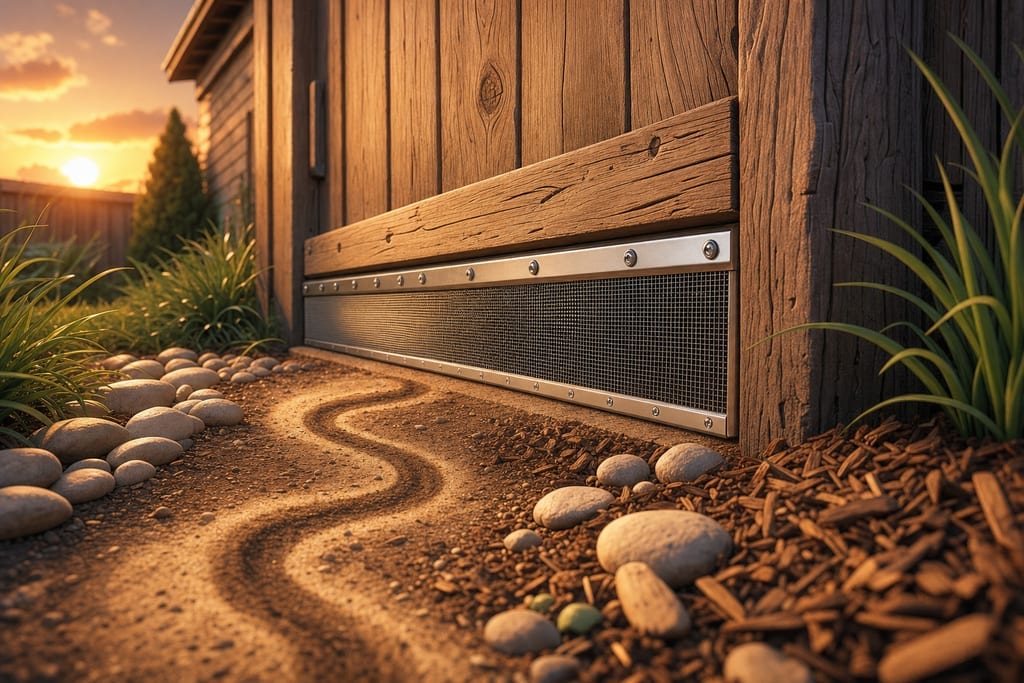
If you are searching for snake control near me, the short answer is yes, help is close by in Fort Worth, Denton, and Granbury, and it works best when the same visit covers both removal and sealing up the house. A snake can slide through a gap smaller than a quarter. That means a crack by a pipe, a dryer vent with a torn flap, or a gap under a garage door is plenty of room for one to get inside. Pulling the snake out of the house solves today's problem, but it does nothing about that opening, so another one shows up in a week or a month.
Fast response matters here too. A snake inside a wall or a garage is stressful to live with, and the longer it stays, the more places it can move to. Crews working the local area know the common entry points on homes in this part of Texas, from foundation gaps to chimney caps, and can get someone out quickly instead of leaving a homeowner to wait days for a callback.
Table of Contents
Why DFW Properties See So Many Snakes
North Texas gives snakes exactly what they need: warm weather most of the year, open fields next to subdivisions, and plenty of cover. Fort Worth, Denton, and Granbury all sit in that rural-to-suburban mix, so a backyard can back right up to a creek bed, a pasture, or undeveloped land where snakes already live.
Rodents are the bigger draw than most people realize. A mouse problem in a garage or shed pulls in the snakes that hunt them, and a woodpile, a dense flower bed, or a pond with frogs and water features gives snakes a reason to stick around close to the house.
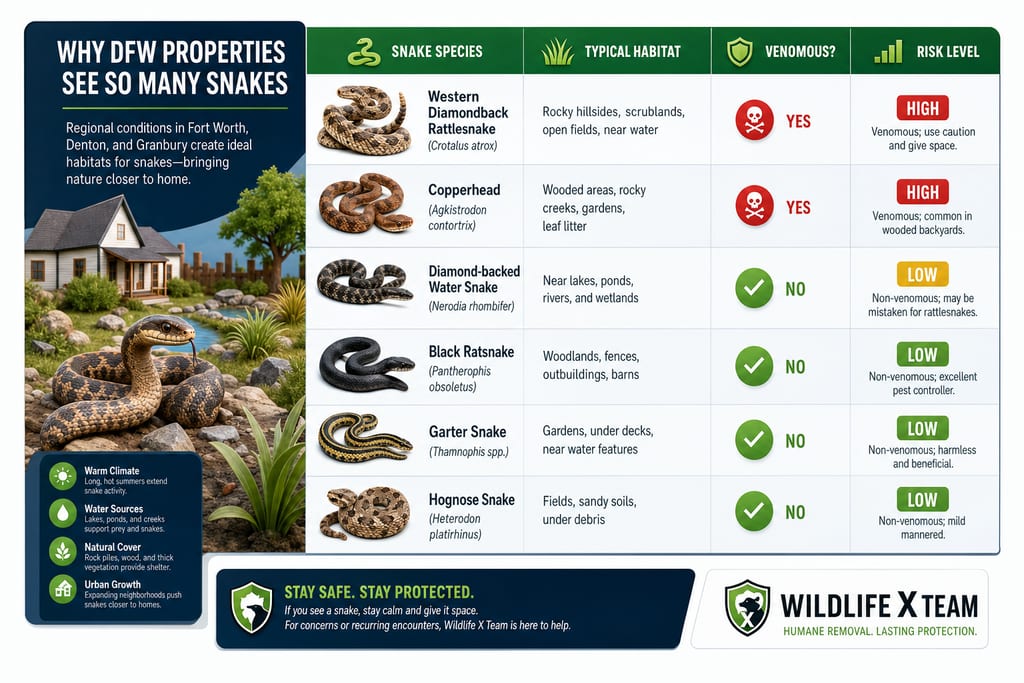
Most of what shows up near a DFW home is non-venomous, rat snakes and garter snakes mostly, but copperheads do turn up in this region. None of them should be grabbed or handled by hand, since even a harmless species can bite if it feels cornered.
A few species account for most local calls. Rat snakes and garter snakes are common and low risk, water snakes show up near ponds and creeks and can be mistaken for something more dangerous, and copperheads are the one venomous species homeowners actually need to watch for in this part of Texas.
Spotting the Signs Before a Snake Becomes a Surprise
A snake usually leaves clues before anyone sees one in person. Checking for these signs on a regular basis beats finding a snake coiled up in the garage.
Shed skins near a foundation, a woodpile, or a garage corner are the clearest giveaway, since a snake sheds several times a year and leaves the old skin right where it rubbed free. Rodent droppings that suddenly stop showing up can mean a snake moved in and cleared the area out. A thin trail through dust, mulch, or light snow is easy to walk past, but it usually leads straight to where the snake is hiding.
Check these spots on a regular walk around the property:
- Base of exterior walls and foundation cracks
- Woodpiles, stacked lumber, or stone edging
- Garage corners and storage boxes on the floor
- Mulch beds and tall grass near the house
- Vents, crawl space openings, and gaps under doors
A gap the width of a pencil is enough for most local species to squeeze through, so small openings deserve the same attention as big ones.
What Happens When a Pro Handles the Removal
A technician's first job on site is identifying the species, since that decision shapes every step that follows. A rat snake gets handled differently than a copperhead, and guessing wrong is how people get bitten.
Once the species is confirmed, the technician uses humane capture tools built to avoid hurting the snake or tearing up the property, snake hooks and tongs rather than anything that traps or crushes. The visit does not stop at the one snake found in plain sight, because snakes often travel with others nearby during certain seasons.
A typical removal visit includes:
- Species identification before any handling starts
- Capture using tools built for safe, low-stress handling
- A check of nearby gaps, voids, and hiding spots for more snakes
- Relocation away from the property
- Notes on entry points found during the search
Skipping the search for a second snake is the most common reason people call back within weeks.
Sealing Up the Yard So Snakes Stop Coming Back
Removing one snake does not fix the opening it used to get in, so sealing the property is the part that actually ends the problem. This is where exclusion work, caulking, foundation repair, and vent guards, pays off longer than any single removal visit.
Watch this for a look at closing off the common entry points yourself before deciding whether to bring in help:
Clearing woodpiles, cutting back tall grass, and hauling off debris removes the cover a snake needs to feel safe moving around a yard. Rodent control matters just as much, since a yard with no mice or rats gives a snake no reason to stick around in the first place.
Work that closes a property off for good usually covers:
- Caulking and sealing gaps around pipes, wires, and siding
- Foundation repair where cracks have opened up
- Vent guards on crawl space and attic openings
- Yard cleanup to remove hiding spots
- Rodent control to cut off the food source
One missed gap is all it takes to undo the rest of the work, which is why a full walk of the property matters more than patching the obvious spot.
Picking the Right Snake Control Near You
Distance matters more with snake calls than with most pest issues, since a snake loose inside a house or garage is not something anyone wants to wait on. A provider working Fort Worth, Denton, and Granbury already knows the local entry points and can usually get someone out the same day.
A written inspection report is worth asking for before hiring anyone, since it lays out exactly where a property is vulnerable instead of leaving the homeowner guessing. Wildlife X Team backs its exclusion work with a renewable lifetime warranty, which matters because sealing work loses value fast if it is not guaranteed to hold up over the years.
Before hiring anyone for snake work, ask about:
- How fast they can get someone on site
- Whether they provide a written inspection report
- What the warranty covers and for how long
- Whether removal and sealing are handled in the same visit
- Experience with the specific species found on the property
A provider that will not put the inspection findings in writing is one to skip, since that report is what holds the exclusion work accountable later.
Removal Alone or Removal Plus Sealing
Hiring someone to pull one snake out of a garage or wall costs less up front than a full exclusion job. That lower price buys a narrower result: the animal is gone, but the house is exactly as open as it was before the call. For a homeowner who just wants that one snake out and is willing to gamble on whether another shows up, removal alone is the cheaper, faster choice.
That gamble gets worse the longer the gaps and the rodent activity stay in place. An open vent flap or a mouse problem in the garage will pull in another snake within weeks or months, not years, so the cheaper visit often turns into two or three visits over a season. Pairing removal with sealing costs more at the start but is the better bet for anyone who does not want to keep making that same call.
Commercial properties do not really have the option to gamble. A snake spotted by a customer or an employee is a liability problem on top of a wildlife problem, and that risk alone usually justifies paying for the sealing work rather than betting on removal visits to keep pace.
Book the Inspection Instead of Guessing at the Gaps
A homeowner can patch the one gap they find, but a trained eye will spot the two or three they walk past every day, under a porch step, behind a hose bib, inside a chimney seam. That gap between what you can see and what a technician checks is why a professional inspection beats a DIY patch job almost every time. Wildlife X Team covers Fort Worth, Denton, Granbury, and the surrounding towns, and a call to (817) 799-8686 puts a local team on the schedule today instead of leaving a homeowner to guess which crack let the snake in.
Snake Removal Questions People Still Ask
Will mothballs or sulfur actually keep snakes off my property?
No, there is no solid proof either one works. Snakes do not have the kind of nose that reacts to those smells the way people assume, and most studies on mothballs and sulfur as repellents come back inconclusive. Closing gaps and cutting off rodent activity does far more than any granule or ball spread around the yard.
What should I do if I find a snake inside my house right now?
Leave the room, shut the door if you can, and keep kids and pets away from the area. Do not try to trap it under a box or push it outside with a broom, since that is how most bites happen. Call a removal service and wait somewhere else in the house until someone arrives.
Can sealing my home trap a snake that's already living inside the walls?
Yes, that is why removal always comes before sealing, not after. A technician checks wall voids, attic spaces, and crawl areas for any snake already inside before closing a single gap. Sealing a house with a snake still trapped inside just turns one problem into a worse one.
Does a snake removal visit also check for the rodents that attracted it?
Yes, Wildlife X Team looks at rodent activity as part of the same visit, since mice and rats are usually what pulled the snake onto the property. Spotting droppings, gnaw marks, or nesting material tells the technician whether the real fix is removing the snake alone or also cutting off its food source.