
Nearby Dead Animal Removal With Odor Cleanup and Sanitizing

If you are searching for dead animal removal near me, here is the short answer: call someone local who can get to the carcass fast, because the smell alone will not tell you where it is. A single dead mouse or rat can stink up an entire room in about 48 hours, and in a Texas attic with no air flow it can happen even quicker. The odor spreads through ducts and wall cavities long before anyone finds the body, so by the time you smell it, the problem has already traveled past the spot where you first noticed it.
That is why so many homeowners end up pulling up insulation or cutting into drywall chasing a smell that keeps moving. The nose is a bad map. A trained technician uses the scent as a starting point, then checks crawl spaces, soffits, and wall voids to find the actual source, pull it out, and treat the area so the odor does not come back. Fast, local response matters here more than people expect, because the longer a carcass sits in a hot attic, the more it contaminates insulation, wood, and ductwork around it.
Table of Contents
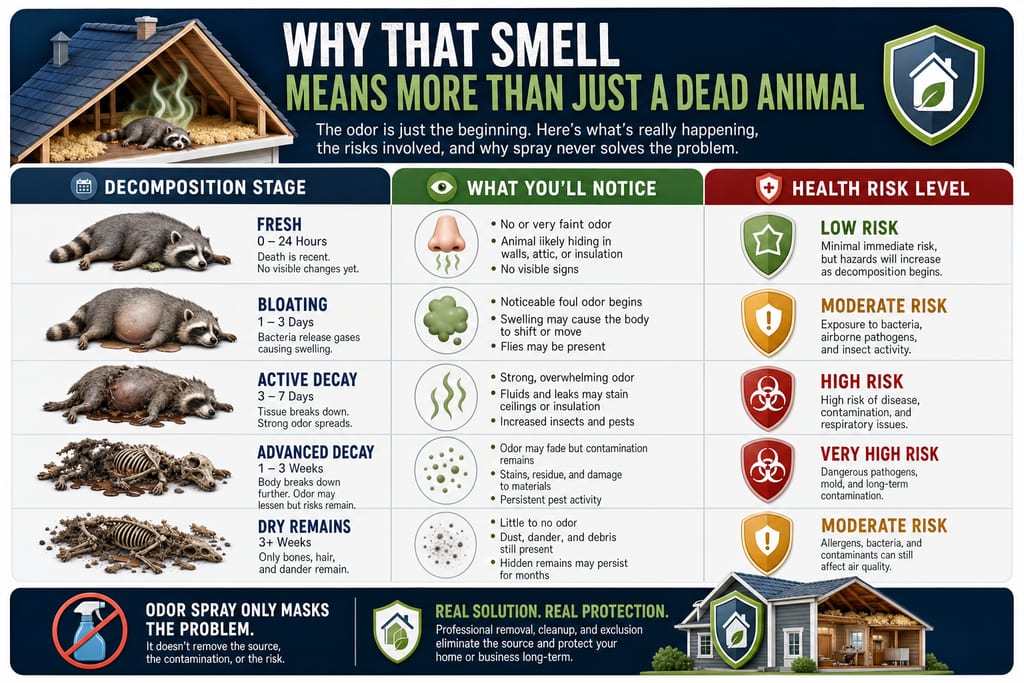
Why That Smell Means More Than Just A Dead Animal
A dead animal is not a clean problem that goes away once the smell fades. As the body breaks down, bacteria release gases and fluids that soak into wood, drywall, and insulation, which is why spraying air freshener never fixes anything. The fluids stain and rot the material they touch, so the source has to come out before any cleaning actually works.
Flies find a carcass within a day or two, and maggots usually follow within a week. That draws in more flies, plus other pests looking for an easy meal, which turns one dead animal into a bigger bug problem if nobody deals with it.
Decomposition moves through stages, and each one brings a different sign in the house.
- Early stage: faint odor, bloating, first flies arrive
- Active stage: strong smell, fluid staining on surfaces, maggots visible
- Advanced stage: odor fades some, but staining and bacteria remain in the material
- Dry stage: little smell left, mostly just skeletal remains and old stains
Health risks go beyond the smell too. Bacteria from decomposition can trigger respiratory irritation, and contaminated insulation often has to be pulled out and replaced rather than cleaned.
Same-Day Dead Animal Removal Near Fort Worth and Denton
Once a carcass is confirmed, a fast response keeps the damage from spreading into insulation, drywall, and ductwork. Wildlife X Team covers Fort Worth, Denton, Granbury, Weatherford, Southlake, Grapevine, Colleyville, North Richland Hills, and the surrounding towns, with licensed and insured technicians who go out as soon as a job comes in.
If the smell is already noticeable, call (817) 799-8686 directly instead of waiting to see if it clears on its own. It will not clear on its own, and every extra day in a hot Texas attic makes the cleanup bigger.
Towns in the regular service area include:
- Fort Worth and Denton
- Granbury and Glen Rose
- Southlake, Grapevine, and Colleyville
- North Richland Hills, Roanoke, and Trophy Club
- Flower Mound, Azle, Saginaw, Haslet, Watauga, and Argyle
Technicians arrive with the equipment needed to find the carcass and start cleanup the same visit in most cases, rather than scheduling a separate trip for inspection and another for removal.
Finding The Carcass Before The Smell Gets Worse
Locating the body is the hard part, since smell alone drifts through a house and points to the wrong room as often as the right one. Technicians trace three things together: where the odor is strongest, where flies are gathering, and where staining shows up on ceilings, walls, or subfloor.
Attic insulation, wall cavities, chimneys, and the space under a deck are the spots that come up again and again on calls in this area. A Wildlife Inspection Report documents the exact location of the carcass along with the gap or vent the animal used to get inside in the first place.
That second part matters because removal without finding the entry point just sets up a repeat call. A full inspection covers:
- Odor intensity mapped room by room
- Fly and insect activity near suspected areas
- Staining on drywall, ceiling tile, or wood
- Gaps in the foundation, roofline, or vents
Once the source is pinpointed, the team can tell the homeowner what has to be opened up versus what can be treated without demolition.
Odor Removal That Actually Kills The Smell At Its Source
Masking a smell with spray or a candle never solves anything, because the bacteria causing it are still in the material. Enzyme-based cleaners work differently: they break down the proteins in the fluids themselves instead of covering the scent on top.
If insulation, drywall, or subflooring has absorbed those fluids, it usually has to come out rather than get scrubbed clean. Soaked insulation almost never gets saved, since the bacteria stay active inside it even after the surface dries.
A typical cleanup follows this order:
- Remove the carcass and any nesting material around it
- Pull and bag contaminated insulation or debris
- Apply enzyme treatment to break down remaining residue
- Disinfect the area to kill bacteria left by fluids and insects
- Replace insulation where it was removed
Skipping the disinfecting step is a common mistake with DIY cleanup, since bacteria can linger even after the smell itself fades.
Sealing The Entry Point So It Never Happens Again
A carcass removal that stops at cleanup leaves the door open for the next animal, since whatever let the first one in is still there. Foundation gaps, loose chimney caps, and unscreened vents are the most common ways animals get into a house and sometimes die where they cannot be reached easily.
Exclusion work closes those gaps with caulking, vent guards, chimney caps, and foundation repair, matched to whatever the inspection found. This is where a renewable lifetime warranty comes in, backing the sealing work against future entry rather than just the one removal job.
Common repairs after a dead animal job include:
- Sealing foundation and siding gaps with caulk or mesh
- Installing a chimney cap or screen
- Adding vent guards to attic and crawl space openings
- Repairing damaged soffit or fascia where animals climbed in
Pairing the fix with the removal is what keeps the same spot from turning into a repeat call a year later.
Spray And Pray Or Find And Fix
A can of odor spray buys a few hours, maybe a day if the room has good airflow. It never buys more than that, because the fluids causing the smell are still sitting in the insulation or soaked into the framing. Once the spray wears off, the smell comes back exactly as strong as before.
Bleach has the same problem from a different angle. It works on hard, flat surfaces, but it cannot reach fluid that has already soaked a few inches into wood framing or batted into insulation fibers. Wiping down a ceiling tile with bleach while the actual source sits above it in the attic just delays the next bad smell by a week or two.
The real choice is between a quick mask and a real fix. Removal plus sealing costs more up front and takes a visit from someone who knows where to look, but it closes the gap that let the animal in. Skip the sealing step and a lot of homeowners find themselves dealing with a second carcass within a few months, usually in the same spot, because nothing changed about how the house let the first one in.
Call Today Instead Of Living With It Another Week
Every day a carcass sits in the heat, bacteria work deeper into whatever it touched, and that means more material gets thrown out instead of cleaned. A single visit from Wildlife X Team handles the removal, the enzyme treatment, and the sealing work in one trip, so you are not scheduling three separate appointments while the smell gets worse in the meantime. Fort Worth, Denton, and the surrounding towns are covered on a same-day basis in most cases. Call (817) 799-8686 now and get it done before the weekend instead of after it.
Dead Animal Removal Questions
How much does it cost to get a dead animal removed?
Wildlife X Team does not post set prices because every job is different depending on where the carcass is and how much material got contaminated. A dead mouse in an attic costs less to handle than a raccoon that died inside a wall cavity. Call (817) 799-8686 and a technician can give a clearer number after seeing the site.
Can I just remove the dead animal myself to save money?
You can, but it is riskier than it looks. Decomposing animals carry bacteria that can get into cuts or get breathed in through dust, and finding the exact spot without pulling up half the attic is harder than it sounds. Most homeowners who try it end up calling someone anyway once they realize the smell has already spread past where they were digging.
Does homeowners insurance cover dead animal removal?
Some policies cover damage caused by wildlife, like chewed wiring or soaked insulation, but they rarely cover the removal service itself. Coverage depends on the policy and the insurance company, not on the removal company, so the homeowner needs to call their insurer directly to ask. Keep photos of any damage in case a claim is possible later.
What towns does Wildlife X Team actually cover for this kind of call?
The service area includes Fort Worth, Denton, Granbury, Glen Rose, Weatherford, Possum Kingdom Lake, Southlake, Grapevine, Colleyville, North Richland Hills, Roanoke, Trophy Club, Flower Mound, Azle, Saginaw, Haslet, Watauga, and Argyle. If your town is near any of those, the chances are good it is covered. Call (817) 799-8686 to confirm before scheduling.