Local Wildlife Removal Services Near You for Homes and Businesses

Scratching sounds in your attic at 2 AM or discovering raccoon droppings in your crawl space means you've got uninvited guests that won't leave on their own. Many Keller homeowners try DIY traps or store-bought repellents, only to find the problem gets worse or the animals return within weeks. Wildlife X Team at 11833 Katy Rd in Keller provides humane removal and permanent exclusion services that address both the immediate problem and prevent future intrusions across Fort Worth, Denton, and surrounding areas.
Table of Contents
Wildlife Problems in the Dallas-Fort Worth Area
Keller sits right in the middle of where city life meets wild spaces, and that creates a perfect storm for wildlife problems. The Dallas-Fort Worth area has grown fast over the past twenty years, pushing neighborhoods right up against forests, creeks, and natural habitats where animals have lived for generations. When you build houses where raccoons used to hunt for food, those raccoons don't just leave - they adapt. Your attic becomes their new den, and your trash cans become their grocery store.
North Texas geography makes wildlife intrusions even more common than in other parts of the state. The region has a mix of prairies, woodlands, and water sources that support lots of different animal species. When searching for wildlife removal services near me, Keller residents often discover they're dealing with the same few troublemakers that plague the entire area.
Common Wildlife Invaders in Keller
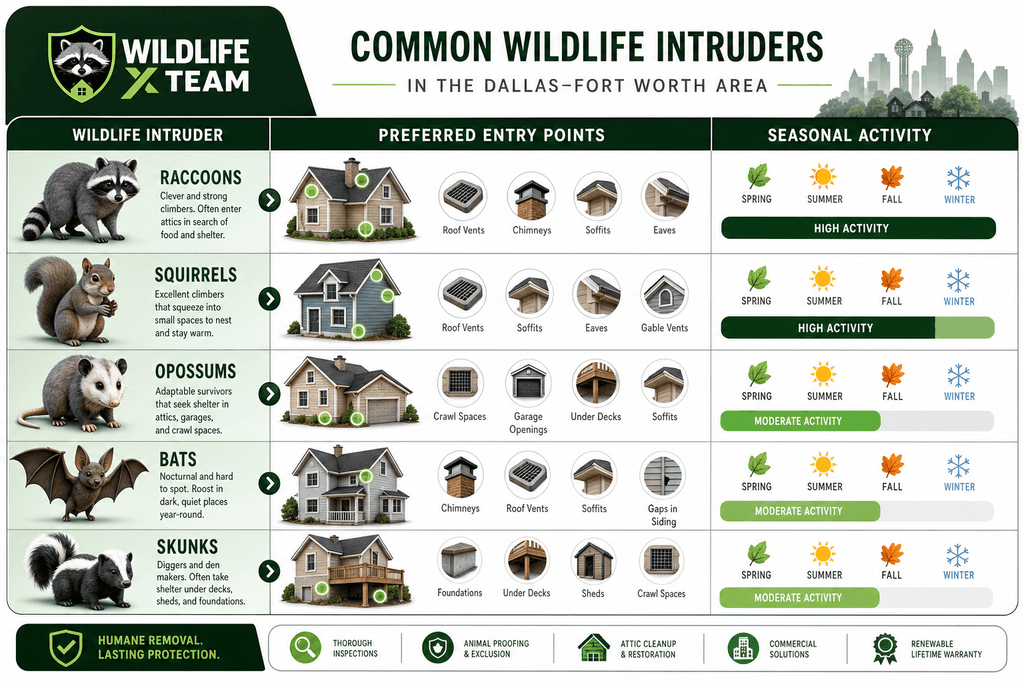
Three animals cause most of the headaches for homeowners in Keller and surrounding areas. Each one has different habits and preferred entry points, which is why Wildlife X Team conducts thorough inspections before starting any removal work.
- Raccoons are the strongest and most destructive, often tearing through roof vents and soffit areas to get inside attics
- Squirrels are the most common invaders, squeezing through gaps as small as two inches around roof lines and chimneys
- Opossums typically enter through foundation gaps, crawl space vents, and damaged areas near the ground
- Rats and mice can fit through holes the size of a quarter, making them the hardest to keep out completely
Understanding how professionals approach wildlife removal pricing helps homeowners know what to expect when they need help. The video above breaks down the factors that go into wildlife removal costs, which vary based on the type of animal, severity of the infestation, and amount of damage repair needed.
Seasonal Patterns You Should Know
Wildlife doesn't invade homes randomly throughout the year. Animals follow predictable patterns based on breeding seasons, weather changes, and food availability. Spring and fall are the busiest times for wildlife removal service near me searches in the Keller area.
- Spring (March-May) brings pregnant females looking for safe nesting spots to raise babies
- Summer (June-August) means young animals are growing and making more noise in attics
- Fall (September-November) triggers animals to find warm shelter before winter hits
- Winter (December-February) sees animals already settled in, causing ongoing damage
Raccoons typically have babies between March and May, which is why so many homeowners hear scratching sounds in their attics during spring. Squirrels actually have two breeding seasons - one in late winter and another in summer - making them a year-round problem.
Risks from Wildlife in Your Home
Having animals in your house isn't just annoying - it's actually dangerous for your family and expensive for your property. The longer wildlife stays in your attic or walls, the worse the damage gets. Most homeowners don't realize how serious the problem is until they see the inspection report.
- Health risks include rabies, leptospirosis, histoplasmosis from droppings, and parasites like fleas and ticks
- Property damage includes chewed electrical wires (fire hazard), destroyed insulation, and contaminated areas
- Structural issues develop when animals tear through wood, drywall, and roofing materials
- Odor problems from urine and feces can soak into insulation and require complete replacement
Wildlife X Team's Wildlife Inspection Report® identifies all these risks during the initial visit. The inspection covers entry points, damage assessment, and contamination levels so homeowners understand exactly what they're dealing with before any work begins.
| Animal | Preferred Entry Points | Peak Activity Season | Main Risks |
|---|---|---|---|
| Raccoons | Roof vents, soffits, chimneys | Spring (March-May) | Rabies, severe property damage, aggressive behavior |
| Squirrels | Roof edges, fascia boards, attic vents | Year-round (two breeding seasons) | Chewed wires, fire hazards, noise |
| Opossums | Foundation gaps, crawl spaces, deck areas | Fall (September-November) | Parasites, odor, contamination |
| Rats/Mice | Any gap larger than a quarter, utility lines | Fall and Winter | Disease transmission, food contamination, rapid reproduction |
The table above shows why a professional inspection matters so much. Different animals need different removal strategies and exclusion methods. What works for keeping out squirrels won't necessarily stop raccoons, and missing even one entry point means animals will get back in after removal.
Complete Wildlife Inspection and Removal Process
Most homeowners who try to seal up wildlife entry points on their own miss about half of the actual openings. That's because animals like raccoons and squirrels can squeeze through gaps as small as two inches, and these spots aren't always where you'd expect them. The Wildlife Inspection Report® that Wildlife X Team provides at their Keller location goes way beyond what you can see from the ground. This detailed inspection covers everything from your foundation to your roofline, identifying every possible entry point that could let wildlife into your home.
The inspection process starts with a thorough walk-around of your property. Trained specialists check common problem areas like roof vents, chimney caps, and foundation cracks, but they also look for the sneaky spots that most people never notice.
- Roof-to-wall junctions where materials meet and create small gaps
- Soffit and fascia boards that may have rotted or pulled away slightly
- Plumbing and electrical penetrations where pipes enter your home
- Attic vents and gable vents without proper screening
- Damaged or missing shingles that create access points
Once the inspection is complete, the removal process begins using humane techniques that prioritize animal welfare. Different animals require different approaches. Squirrels might need one-way exclusion doors that let them leave but not return, while raccoons with babies require careful hand removal to relocate the entire family safely. The team at 11833 Katy Rd in Keller handles everything from attics to crawl spaces, and they often provide same-day service for urgent situations.
Jesse Bernard's experience shows exactly why professional inspection matters. When squirrels moved into his attic, he spotted one obvious entry point and almost sealed it himself. The Wildlife X Team found several additional openings he never would have discovered, which would have meant the problem kept coming back. Months later, his home is still squirrel-free because all the entry points were properly addressed.
Animal Proofing and Exclusion That Lasts
Removing the animals is only half the job. Without proper exclusion work, new wildlife will find those same entry points within weeks or even days. This is where many wildlife removal services near me fall short, but it's also where long-term protection really happens. Animal proofing means making your home physically impossible for wildlife to enter, using materials and techniques that hold up against determined animals with sharp claws and teeth.
Foundation work addresses gaps where your home meets the ground. Crawl space vents get heavy-duty screening that animals can't tear through. Chimney caps do more than just keep out rain - they need to be the right design to prevent raccoons from treating your chimney like a cozy den.
The exclusion process covers your entire home from bottom to top. Here's what gets protected:
- Foundation sealing with cement or metal flashing to close gaps
- Chimney protection systems with properly fitted caps and screens
- Vent guards made from materials animals can't chew through
- Caulking and sealing of smaller penetrations and cracks
- Roof edge protection to prevent animals from prying up shingles
The difference between exclusion and simple removal is like the difference between fixing a leak and just mopping up water. You can remove animals all day long, but if the doors are still open, someone else will move in. Wildlife X Team's approach in the Fort Worth and Denton areas focuses on permanent solutions rather than temporary fixes.
Their renewable lifetime warranty backs up this commitment. If wildlife finds a way back in through an area they've sealed, they come back and fix it. That kind of guarantee only makes sense when you're confident in the quality of your exclusion work.
Attic Cleanup and Full Property Restoration
After wildlife leaves your attic, what's left behind isn't just unpleasant - it's actually dangerous. Animal waste carries diseases like histoplasmosis, leptospirosis, and raccoon roundworm that can become airborne when disturbed. Contaminated insulation loses its effectiveness, which means higher energy bills on top of health risks. The smell alone can be overwhelming, but the real problems are the ones you can't see or smell right away.
Professional cleanup involves more than just scooping out droppings. The entire affected area needs proper disinfection using commercial-grade products that kill pathogens. Contaminated insulation has to be removed carefully to avoid spreading particles through your home's air system.
- Complete removal of soiled insulation and nesting materials
- Disinfection and sanitization of all surfaces using professional products
- Odor elimination that addresses the source, not just masks smells
- Air quality restoration to remove airborne contaminants
- Insulation replacement to restore energy efficiency
This isn't optional work that you can put off. The longer contaminated materials sit in your attic, the more the damage spreads and the higher the health risks become. Some homeowners think they can handle cleanup themselves, but without proper protective equipment and disposal methods, you're putting yourself at serious risk.
Commercial properties face even bigger challenges because wildlife contamination can affect business operations and create liability issues. Wildlife X Team handles restoration for businesses throughout Southlake, Grapevine, and Colleyville, working around business hours when needed to minimize disruption.
The restoration process brings your property back to pre-infestation condition. New insulation goes in, entry points get sealed one final time, and the space becomes livable again. When you're searching for wildlife removal service near me, make sure whoever you choose offers complete restoration, not just animal removal. The team serving Keller and surrounding areas at (817) 799-8686 handles the entire process from inspection through final cleanup, which means you're not coordinating between multiple contractors or leaving any steps unfinished.
Your Local Wildlife Solution in Keller
Dealing with wildlife in your home or business isn't something you want to handle alone. From the initial inspection to the final warranty, Wildlife X Team covers every step of the process. The Wildlife Inspection Report helps identify exactly where animals are getting in, while the animal proofing services make sure they can't come back. And if your attic needs cleanup after an invasion, that's handled too.
What makes a difference is having someone local who knows the area. The team at 11833 Katy Rd in Keller, TX serves not just Keller but also Fort Worth, Denton, Granbury, Southlake, Grapevine, and plenty of other nearby communities. When you call (817) 799-8686, you're getting people who understand the wildlife problems specific to North Texas.
The humane approach matters because nobody wants animals hurt in the process. But it also matters that the job gets done right the first time. That's where the combination of removal, prevention, and the renewable lifetime warranty comes in.
Most people searching for wildlife removal services near me just want their problem solved quickly and permanently. They don't want to deal with the same raccoons or squirrels six months later. The comprehensive service model addresses that concern head-on, which is probably why customers like Jesse Bernard are still squirrel-free months after the initial work.
If you're hearing scratching in your walls or seeing signs of animal activity, the next step is pretty straightforward. But you might have some questions about how the process works or what to expect.
Common Questions About Wildlife Removal
When you've got critters in your attic or walls, you probably have a lot of questions running through your mind. Most homeowners in Keller TX want to know the same things about wildlife removal services near me, and we're here to give you straight answers. These are the questions we hear most often from folks dealing with unwanted wildlife guests.
How quickly can someone remove wildlife from my property?
Most wildlife removal service near me companies can respond within 24 to 48 hours of your call. Wildlife X Team often starts work the same day for urgent situations, especially when animals pose immediate risks to your family or property. The actual removal time depends on the type of animal and how many entry points need to be sealed, but many jobs are completed within a few hours to a couple of days.
Is the removal process safe and humane for the animals?
Yes, humane removal methods are the standard for professional wildlife services in the Dallas-Fort Worth area. Wildlife X Team uses ethical techniques that don't harm the animals while ensuring they're relocated safely away from your property. This approach protects both the wildlife and your family, unlike some older methods that other companies might still use.
What does the lifetime warranty actually cover?
The renewable lifetime warranty covers the specific areas that were repaired and sealed during your service. If animals get back in through those same spots that were professionally treated, the company will return to fix the problem at no additional cost. It's worth noting that this doesn't cover new damage to different areas of your home, but it does give you peace of mind for the work that was done.
Do you serve Keller and surrounding areas?
Wildlife X Team serves Keller TX along with the entire Dallas-Fort Worth region, including Denton, Granbury, and surrounding communities. They cover both residential and commercial properties throughout the area, so whether you're in the heart of Keller or on the outskirts, help is available.
What happens if animals come back after removal?
If animals return through the same entry points that were sealed, the warranty covers additional service calls. However, the best prevention is proper exclusion work from the start, which includes sealing all potential entry points and installing barriers. The Wildlife Inspection Report helps identify every vulnerability so animals don't find their way back in through spots that weren't addressed.
Can wildlife removal services help commercial properties?
Absolutely, and commercial wildlife removal actually requires specialized approaches that differ from residential work. Businesses face unique challenges like maintaining operations during removal, meeting health codes, and protecting their reputation. Wildlife X Team offers tailored commercial solutions that minimize disruption while keeping your property safe from wildlife damage and the health risks they bring.