
How to Identify Skunk Feces by Size, Shape, and Location
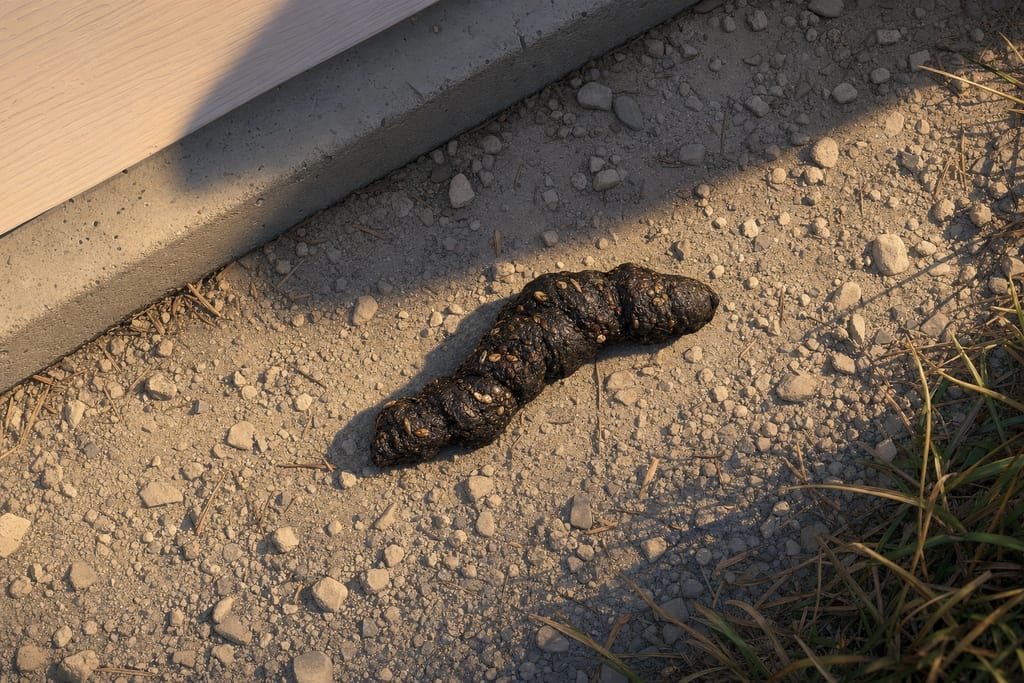
Skunk feces looks like a small dark tube, usually two to three inches long, packed with shiny bits of beetle shell or soft berry seeds depending on what the skunk has been eating. The shape holds together better than raccoon droppings and it is thinner than most dog waste, which is one of the easiest ways to tell them apart at a glance. Color runs from dark brown to black, and fresh droppings have a strong, musky smell even without the spray.
Where you find it matters as much as what it looks like. Skunks leave their droppings close to the den opening, often in a small cluster near a porch step, a gap under a shed, or a hole along a foundation, not scattered across the yard the way some animals do. Walking past a few tube-shaped droppings near a gap in the siding and writing it off as nothing is how an active den gets missed until there are babies under the house and a much bigger problem to deal with.
Table of Contents
Why Scat Is the First Clue Skunks Leave Behind
Skunks sleep through most of the day and only come out after dark, so a homeowner almost never sees the animal itself. Droppings are often the only sign something has moved in, which is why learning to read them matters before you start sealing up a yard or attic.
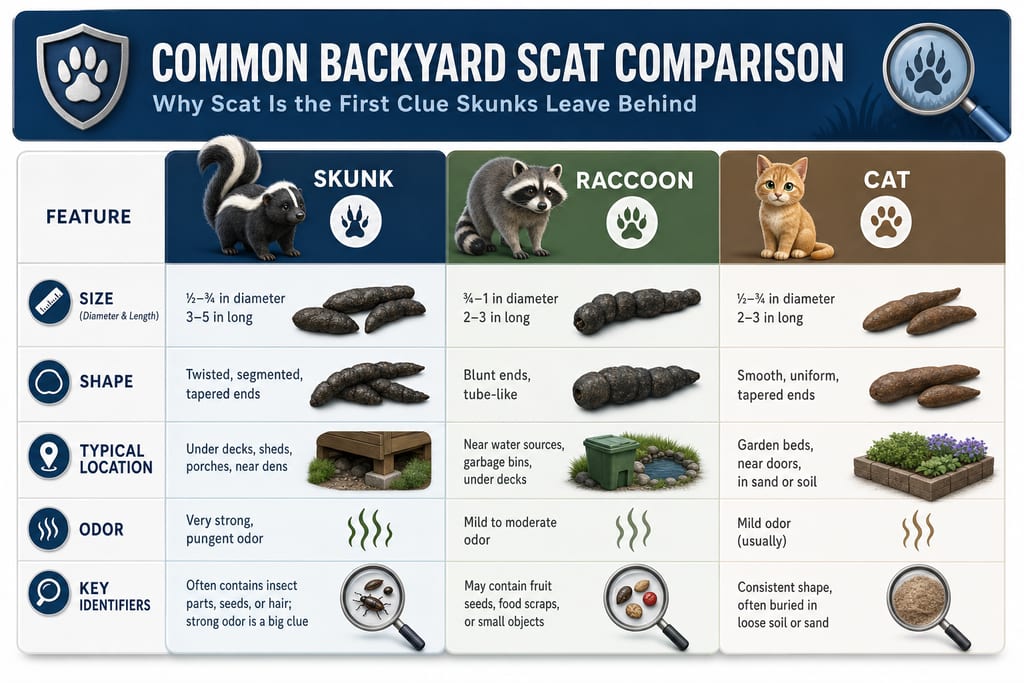
Where you find the scat tells you whether a skunk is just passing through or living on the property. A single dropping near a garden bed usually means a skunk foraged there one night and kept moving. A cluster building up in the same spot day after day points to an active den close by.
Raccoon droppings help make sense of this by comparison, since the two animals share yards often. Raccoon scat tends to be longer, around three to four inches, with blunt ends and a crumbly texture, and it shows up on flat surfaces like roof edges, deck rails, or tree branch forks rather than tucked against a den opening.
Cat droppings get mistaken for both at times, but cats bury their waste or leave it in loose piles in mulch and garden soil, almost never in a tight repeating cluster. A quick look at raccoon scat side by side with the real thing helps the comparison click faster than any description.
What Skunk Droppings Look Like Up Close
A skunk dropping measures about two to three inches long and roughly as wide as a pencil, which is the fastest way to rule out larger animals like raccoons. The shape is tubular, with ends that are blunt or rounded rather than pointed, and some pieces look curled or broken into short segments instead of one straight tube.
Color shifts with diet, running from dark brown after a summer of beetles to almost black when a skunk has been eating more plant matter. Texture is the detail most people miss: fresh scat holds together, but once it dries out in the sun it turns crumbly and falls apart if you nudge it with a stick.
A short comparison against the animals most often confused with skunks:
- Skunk scat: two to three inches, pencil width, tubular with rounded ends
- Raccoon scat: three to four inches, blunter and thicker, often on flat surfaces
- Dog waste: wider and softer, with no segmented look
- Cat waste: usually buried or loose, rarely tube shaped
What's Inside the Droppings Can Tell You More
Look closely at a dropping and the diet clues inside it confirm what's been feeding near the house. In warmer months, skunks eat heavily on grubs and beetles, so the scat is full of small, shiny exoskeleton fragments that catch light even after the pile has dried.
By fall, the same skunk shifts to fruit and the droppings fill with seeds and bits of berry skin instead. Fur or small bone fragments mean the skunk found eggs or a small animal to eat, which happens more often than most homeowners expect.
- Beetle shells and insect fragments point to warm-season foraging
- Seeds and berry skins show up once fruit is in season
- Fur or bone bits mean eggs or small prey were on the menu
- A shiny, wet-looking surface means the dropping is likely a day or two old at most
That last point matters most if you're trying to figure out whether a den is still active or just an old leftover.
Where You'll Usually Find It Around a Property
Skunks leave their droppings in the same handful of spots, which makes a property check faster than searching the whole yard. Check under sheds, decks, and porches first, since these cover den entrances and gaps in the foundation that skunks prefer for shelter.
Fence lines and the edges of garden beds are the next place to look, since skunks forage along them at night and tend to leave scat as they move. Unlike cats, skunks cluster their droppings into one latrine spot near the den rather than spreading them evenly across the yard.
- Den entrances: under sheds, decks, porches, foundation gaps
- Fence lines and garden bed edges from nighttime foraging
- One tight latrine cluster rather than scattered piles
- Fresh piles stacked near a hole usually mean an active den, not a passing animal
Finding that last pattern is the clearest sign a skunk has settled in rather than just wandered through.
Signs That Mean More Than Just Droppings
Scat rarely shows up alone, so other clues around the yard help confirm what's living there. Shallow, cone-shaped holes in the lawn are a telltale sign, left behind when a skunk digs for grubs just under the surface of the grass.
A faint musky smell lingering near a den opening is another marker, even on days when nothing has sprayed. Small tracks with five toes and visible claw marks in soft dirt or mud back up what the scat already suggests.
- Cone-shaped digging holes scattered across the lawn
- A faint musky smell near the den even without spraying
- Five-toed tracks with claw marks in soft ground
- Several fresh scat piles in one spot, which often means a mother with kits has moved in
That last sign is worth acting on quickly, since a den with young skunks tends to stay put and grow rather than move on by itself, and a company like Wildlife X Team can confirm it with a full inspection before deciding on next steps.
Watch the Yard or Call for an Inspection
One or two old droppings near a fence line is usually a skunk that passed through one night and moved on. Monitoring is enough here: check the spot again in a week and see if anything new has piled up. No digging, no fresh scat, no smell means the yard can go back to normal.
A pile that keeps growing in the same corner is a different decision. That pattern means a den has settled in, and it will not thin out or wander off just because the weather changes. Waiting another month only gives the skunk more time to dig deeper under the foundation, which turns a simple exclusion job into a repair bill for structural gaps.
If the scat is fresh, clustered, and sitting near a den opening, that is the point to bring in someone who can confirm what is actually under the house. Wildlife X Team's Wildlife Inspection Report maps the exact entry points before any removal work starts, so the fix addresses the den itself instead of just the pile of droppings sitting outside it.
Deciding Whether That Pile Means a Den Nearby
Once you've matched fresh, clustered droppings to a gap in the foundation or a hole under a shed, resist the urge to seal that opening right away. A den that still has an animal inside gets trapped the moment the entrance is closed, and a trapped skunk under a house is a far worse problem than the one you started with. The safer move is to confirm what's actually back there before any patch work begins. Wildlife X Team checks the entry point and the space behind it first, then closes it up once it's clear the den is empty, so the repair actually solves the problem instead of creating a new one.
Skunk Scat Questions People Still Ask
Can skunk droppings make my pet sick if they roll in or sniff them?
Yes. Skunk scat can carry roundworms and leptospirosis, both of which spread to dogs that sniff, lick, or roll in a fresh pile. Roundworm eggs survive in soil for months, so even an old, dried-out dropping can pass on infection. If your pet gets into a pile, wash their mouth and paws and call your vet to ask about deworming.
Why do I keep finding fresh piles in the same exact spot every few days?
That pattern means a skunk has claimed that spot as its latrine and is denning nearby, not just passing through. Skunks return to the same few feet of ground night after night instead of spreading waste around the yard. If the pile keeps refilling within a week, the den is active and close enough to need a real inspection rather than more watching.
Is it possible to mistake a young skunk's droppings for a small rodent's?
It happens, but the size gives it away. Rodent droppings are short, pointed pellets under half an inch long, while even a young skunk's scat keeps the tubular, blunt-ended shape and runs closer to an inch or more. Location helps too, since rodent droppings show up along walls and in cabinets, not clustered near a den opening outdoors.
What should I do if I find droppings but never actually see a skunk?
Not seeing the animal is normal, since skunks are nocturnal and stay hidden during the day. The droppings themselves are usually all the proof you need to act on. Wildlife X Team can inspect the property, confirm whether the den is active, and handle removal and sealing once it's clear the space is empty.