
Fort Worth Rats in the Attic Signs, Risks, and Next Steps
The Unwelcome Guests Above Your Head
That scratching sound above your bedroom ceiling at 2 AM isn't your imagination, and it's probably not just one rat. A single female rat can produce up to 60 offspring per year when she finds the warm, undisturbed environment of your Fort Worth attic, and our year-round mild climate means these rodents breed continuously without seasonal breaks. Understanding the warning signs of rats in attic spaces helps homeowners take action before a minor problem becomes a full-blown infestation that threatens both your family's health and your home's structural integrity.
Table of Contents
- The Unwelcome Guests Above Your Head
- Why Fort Worth Attics Attract Rats
- Warning Signs You Have Rats in Your Attic
- Health Risks and Property Damage from Attic Rats
- Professional Removal and Prevention Steps
- Why DIY Rat Removal Usually Fails
- Taking Action Protects Your Fort Worth Home
- Common Questions About Rats in Fort Worth Attics
Why Fort Worth Attics Attract Rats
Fort Worth homeowners deal with rats in attic spaces more than most other parts of the country, and it's not just bad luck. The combination of our local climate, typical home construction, and natural landscape creates the perfect storm for rat infestations. While northern states get a break during harsh winters when rat populations naturally decline, Fort Worth's mild temperatures mean these pests breed and thrive all year long. Understanding why your attic is so appealing to rats is the first step in keeping them out for good.
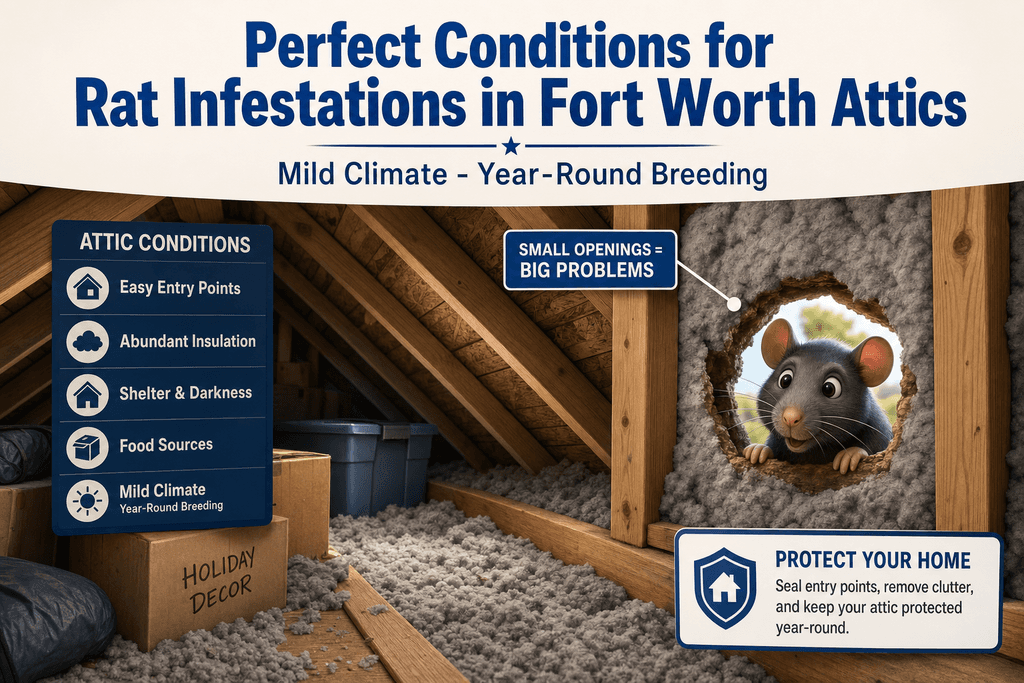
Fort Worth Climate Perfect for Year Round Breeding
The weather in North Texas gives rats a huge advantage. Our winters rarely drop below freezing for extended periods, which means rats never really slow down their breeding cycles. A single pair of rats can produce up to 2,000 descendants in just one year under ideal conditions.
Rat populations in Fort Worth can breed year-round, with females producing 5-10 litters annually in the mild Texas climate.
Unlike cities in colder regions where winter provides natural population control, Fort Worth attics stay warm enough for rats to remain active and comfortable. They don't need to migrate or hibernate. Your attic insulation keeps them cozy while they raise litter after litter throughout the year.
Common Construction Features Create Easy Entry
Most homes in the Fort Worth area were built with features that accidentally welcome rats inside. Roof returns, soffit vents, and gaps around utility lines are like open doors for these persistent rodents. Many local homes have brick veneer construction with weep holes that rats can squeeze through with ease.
This video shows exactly how roof rats exploit common construction gaps to enter attics. These entry points exist on thousands of Fort Worth homes, and most homeowners have no idea they're there until it's too late.
Here are the most common entry points in local homes:
- Roof returns and decorative trim gaps where rats can slip through openings as small as a quarter
- Damaged or missing soffit vents that provide direct access to attic spaces
- Gaps around plumbing vents, electrical lines, and HVAC penetrations through the roofline
- Deteriorated weather stripping around attic access doors and pull-down stairs
- Broken or missing ridge vent screens along roof peaks
Roof Rats Dominate North Texas
The specific type of rat causing problems in Fort Worth attics is usually the roof rat, also called the black rat. These athletic climbers prefer living above ground, which is why they target attics instead of basements or crawl spaces. Roof rats are the most common species in North Texas, and they're perfectly adapted to our urban and suburban environments.
Roof rats can jump up to 4 feet vertically and 8 feet horizontally, making even second-story attics easily accessible.
These rats are smaller and more agile than Norway rats. They have excellent balance and can walk across power lines, tree branches, and fence tops without any trouble. Once they reach your roofline, getting into the attic is usually simple.
Key characteristics of roof rats include:
- Dark brown or black fur with a lighter-colored belly
- Long, thin tails that are longer than their body length
- Large ears and eyes compared to other rat species
- Adult weight of 5-9 ounces, making them light enough to navigate thin branches
Trees and Vegetation Provide Natural Highways
Fort Worth's beautiful tree-lined streets and mature landscaping create perfect pathways for rats to reach your roof. Oak trees, pecan trees, and other large shade trees are common throughout the area, and their branches often hang directly over homes. Rats use these branches like highways, traveling from yard to yard and easily accessing rooflines.
The problem gets worse when trees aren't properly trimmed. Branches that touch or hang within six feet of your roof give rats a direct route to potential entry points. Even power lines and fence tops serve as convenient travel routes for these acrobatic pests.
- Mature trees with overhanging branches provide direct roof access
- Dense shrubs and ivy against home exteriors create protected climbing routes
- Woodpiles, storage sheds, and outdoor equipment offer stepping stones to higher levels
- Utility lines connecting to homes serve as aerial pathways from trees to rooflines
Wildlife X Team regularly helps Fort Worth homeowners identify these natural access points during our Wildlife Inspection Report® process. We look at your entire property to understand how rats are reaching your attic and what's making your home attractive to them in the first place. The goal isn't just removing the rats you have now, but making sure new ones can't follow the same path inside.
A single roof rat can contaminate 10 times more food than it eats through droppings and urine, creating serious health risks in attic spaces.
The combination of climate, construction, and landscape makes Fort Worth attics incredibly vulnerable to rat infestations. But understanding these factors means you can take targeted action to protect your home. The next step is recognizing the warning signs that rats have already moved in.
Warning Signs You Have Rats in Your Attic
Most Fort Worth homeowners don't realize they have rats in their attic until the problem gets serious. Rats are sneaky creatures that prefer to stay hidden, but they leave behind plenty of clues if you know what to look for. The first sign most people notice is noise, especially after the sun goes down. You might hear scratching, scurrying, or even squeaking sounds coming from above your bedroom ceiling.
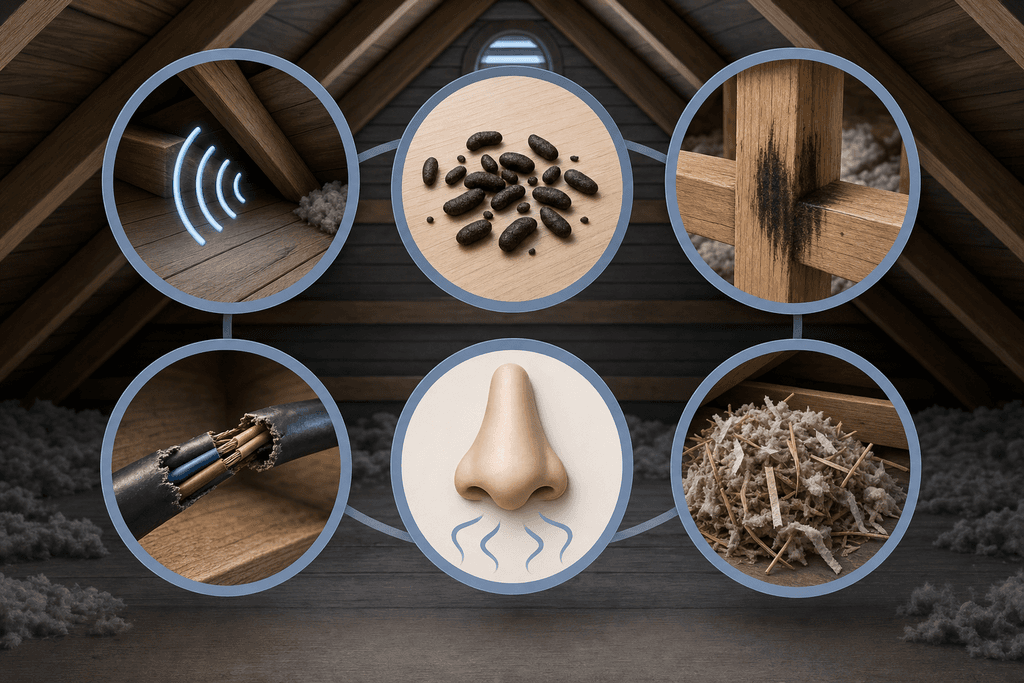
Nighttime activity is the biggest giveaway since rats are nocturnal animals. They spend their days sleeping in hidden spots and come out to search for food when your house gets quiet.
- Dark droppings that look like rice grains scattered in corners and along beams
- Greasy rub marks along walls and rafters from their oily fur
- Chewed wires, damaged insulation, and gnawed wood or cardboard
- Strong ammonia smell from urine buildup
- Nesting materials made from shredded insulation and paper
The droppings are usually one of the easiest things to spot during an inspection. Fresh rat droppings look dark and moist, while older ones turn gray and crumbly. You'll typically find them concentrated in areas where rats travel most often.
Those greasy marks along your walls and beams happen because rats follow the same paths over and over. Their fur contains oils that rub off on surfaces, creating dark streaks that get more visible over time.
The smell is something you can't ignore once it builds up. That sharp ammonia odor comes from rat urine soaking into your insulation and wood. If you notice any of these signs, it's worth getting a professional inspection before the situation gets worse.
Health Risks and Property Damage from Attic Rats
Rats in your attic aren't just annoying. They create real health hazards for your family and can cause thousands of dollars in damage to your home. These rodents carry diseases like hantavirus and leptospirosis that spread through their droppings and urine. When contaminated dust gets pulled into your HVAC system, it circulates throughout your entire house. The parasites they bring along, including fleas, mites, and ticks, add another layer of problems you definitely don't want.
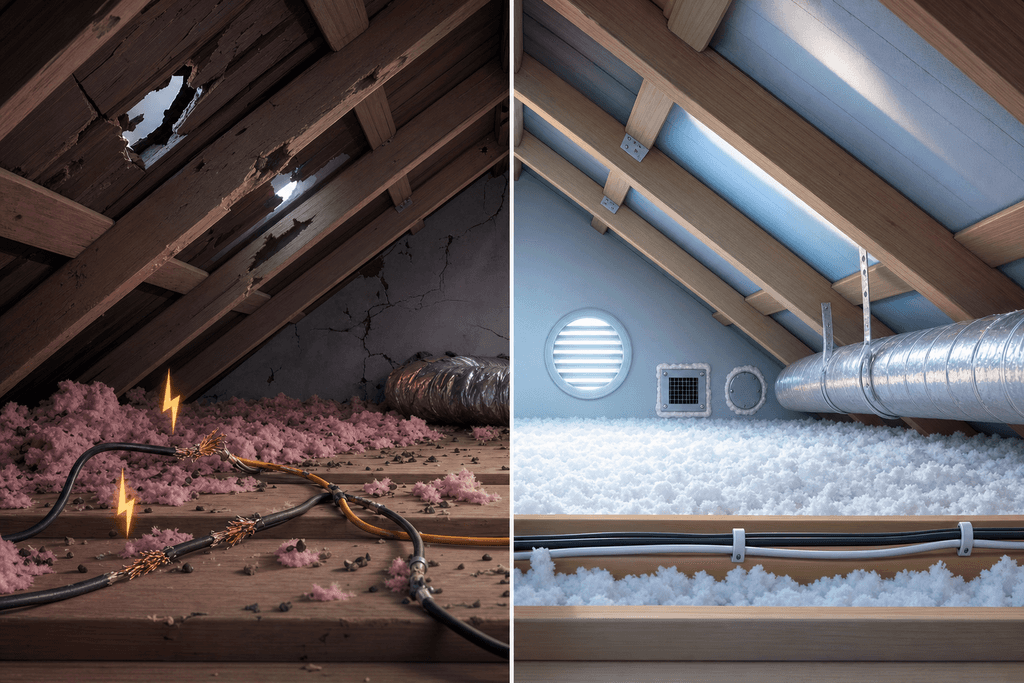
The fire risk alone should make any homeowner nervous. Rats constantly gnaw on things to keep their teeth from growing too long, and electrical wiring is one of their favorite targets.
- Chewed wiring creates serious fire hazards in your attic space
- Destroyed insulation reduces energy efficiency and raises utility bills
- Damaged wooden beams and roof decking compromise structural integrity
- Contaminated insulation spreads allergens through your home's air system
The structural damage can sneak up on you. Rats chew through wood, drywall, and even plastic pipes. They'll destroy your insulation to build nests, leaving bare spots that let heat escape in winter and enter during summer. Your energy bills go up while your home's protection goes down.
A minor infestation might only affect one area of your attic, but a severe problem can require complete insulation replacement and extensive repairs. Some homeowners in the Fort Worth area have faced repair costs running into thousands of dollars after letting a rat problem go unchecked for too long.
The longer rats stay in your attic, the more damage they cause. What starts as a few droppings and some chewed insulation can turn into contaminated spaces, ruined electrical systems, and weakened roof structures. Wildlife X Team has seen cases where homeowners waited too long and ended up needing major restoration work.
Professional Removal and Prevention Steps
Getting rid of rats in your attic takes more than just setting a few traps from the hardware store. A proper solution requires finding every entry point, removing all the rats, cleaning up the mess they left behind, and making sure they can't get back in. That's where professional help makes a real difference. At Wildlife X Team, we start with a detailed inspection to figure out how bad the problem is and where the rats are getting inside. Rats can squeeze through openings as small as a quarter inch, so finding all those spots takes experience and the right tools.
The removal process uses humane trapping methods that follow local Fort Worth regulations. We don't use poison because it can cause rats to die in your walls where you can't reach them, creating an even worse smell problem.
- Complete property inspection to identify entry points and assess damage
- Humane trapping and removal of all rats from the attic space
- Exclusion work sealing every potential entry point
- Contaminated insulation removal and proper disposal
- Sanitization and deodorization of affected areas
- Insulation replacement and structural repairs as needed
The exclusion work is probably the most important step. We seal up every hole, gap, and crack that rats could use to get back inside. This includes foundation repairs, chimney protection, vent guards, and careful caulking around pipes and wires. Missing even one entry point means the whole problem can start over again.
Attic cleanup involves removing contaminated insulation, sanitizing all surfaces, and replacing damaged materials. The goal is to get your attic back to a clean, safe condition. Our approach at Wildlife X Team covers inspection, removal, exclusion, and cleanup with warranty protection, so you don't have to worry about rats coming back.
Many homeowners across Fort Worth, Denton, and Granbury have dealt with rats in their attics. The difference between a quick fix and a lasting solution comes down to doing the job completely. That means addressing the root cause, not just the symptoms you can see and hear.
Why DIY Rat Removal Usually Fails
Most homeowners who discover rats in attic spaces head straight to the hardware store for traps and poison, thinking they can solve the problem over a weekend. What they don't realize is that rats are colony animals, and catching one or two barely makes a dent in the population living above their heads. The real issue isn't just removing the rats you can see, but finding all the ways they're getting in and addressing the damage they've already caused. Without professional training, most people end up spending more money and time on failed attempts than they would have on proper removal from the start.
The Trap and Poison Problem
Store-bought traps might catch a few rats, but they're designed for individual rodents, not entire colonies. A typical attic infestation involves multiple rats, and catching one or two doesn't stop the breeding cycle or address the dozens of others hiding in your walls.
- Basic snap traps only work if placed in the exact paths rats travel
- Poison creates a worse problem when rats die inside walls or under insulation
- Dead rats in inaccessible spaces cause terrible odors and attract flies
- Homeowners often use too little poison or the wrong type for roof rats
Missing the Hidden Entry Points
The biggest mistake in DIY rat removal is focusing on the rats themselves instead of how they're getting inside. Rats only need a hole the size of a quarter to squeeze through, and most homeowners spot the obvious gaps while missing the real entry points.
- Roof vents, soffit gaps, and pipe penetrations are commonly overlooked
- Foundation cracks and gaps around utility lines provide easy access
- Damaged chimney caps and loose flashing create perfect entry spots
- Without proper inspection tools, hidden vulnerabilities stay hidden
Professional vs DIY Approaches
The difference between professional and DIY rat removal comes down to completeness. Wildlife X Team's Wildlife Inspection Report identifies every vulnerability in your property, something a weekend warrior simply can't match with a flashlight and some traps.
DIY Approach Limitations
- Addresses visible rats but misses the colony
- Leaves contaminated insulation and droppings behind
- Fails to seal all entry points properly
- No warranty or guarantee of results
- Risk of disease exposure during cleanup
Professional Removal Advantages
- Complete colony removal with trained inspection methods
- Full attic cleanup and contamination removal
- Comprehensive exclusion work seals every entry point
- Renewable lifetime warranty protects your investment
- Safe handling of biohazards and proper disposal
The reality is that incomplete removal just invites new rats to move into the same space. Without proper exclusion work and cleanup, you're basically running a revolving door for rodents.
Taking Action Protects Your Fort Worth Home
The moment you spot signs of rats in attic spaces, the clock starts ticking. What begins as a few droppings or scratching sounds can turn into a full-blown infestation in just weeks. Rats breed fast and cause damage even faster, which means waiting only makes the problem worse and more expensive to fix.
Getting professional help isn't just about removing the rats you can see. It's about finding every entry point, cleaning up contaminated areas, and making sure they can't come back. Most homeowners miss hidden access points that rats use, which is why DIY solutions often fail within months.
Wildlife X Team handles the entire process for Fort Worth homeowners, from the initial inspection to long-term prevention. Our services cover removal, exclusion work, attic cleanup, and restoration, all backed by a renewable lifetime warranty. We serve Fort Worth, Denton, Granbury, and surrounding areas with the same humane approach that's worked for thousands of local properties.
The difference between a minor rat problem and major structural damage often comes down to how quickly you act. Professional removal addresses both the immediate issue and the underlying vulnerabilities that let rats in.
If you're hearing sounds in your attic or noticing any of the signs we've covered, don't wait to see if it gets worse. Call Wildlife X Team at (817) 799-8686 to schedule an inspection. The sooner you address rats in attic spaces, the less damage they'll cause and the easier they'll be to remove for good.
Common Questions About Rats in Fort Worth Attics
Dealing with rats in your attic brings up a lot of questions, especially if it's your first time facing this problem. Most Fort Worth homeowners want to know what they're up against before making any decisions. The answers below cover the most common concerns we hear from people dealing with rats in attic situations. Understanding these basics helps you make smarter choices about protecting your home.
How quickly do rats multiply in an attic?
Rats can have up to 12 babies per litter and produce 5-10 litters each year, which means a small problem becomes a major infestation in just a few months. A single pair of rats can turn into dozens within half a year if left unchecked. This is why acting fast matters more than most people realize.
Can I just seal the holes myself to keep rats out?
Sealing holes yourself seems like a good idea until you accidentally trap rats inside your attic, which creates an even worse situation. Rats can chew through most materials homeowners use, and they'll find entry points you didn't even know existed. Professional exclusion services identify all entry points and use materials rats can't penetrate, plus they make sure all animals are removed first. Wildlife X Team's animal proofing services include foundation repair, chimney protection, and vent guards that actually work long-term.
What's the average cost of professional rat removal in Fort Worth?
Professional rat removal in Fort Worth typically ranges from a few hundred to several thousand dollars depending on the severity of the infestation and damage. The cost includes trapping, exclusion work, and cleanup, which is usually less expensive than repairing the damage rats cause if you wait. Getting a detailed inspection first helps you understand exactly what you're paying for.
How long does the removal process take?
Most rat removal projects take 1-3 weeks from start to finish, though severe infestations might need longer. The timeline depends on how many rats you have, how much exclusion work is needed, and whether attic restoration is required. Some companies can start work the same day they inspect, which helps stop the problem from getting worse.
Will rats come back after professional removal?
Rats won't come back if all entry points are properly sealed and exclusion work is done correctly. This is why choosing a company that offers warranties matters so much. Wildlife X Team provides a Renewable Lifetime Warranty on their work, which means you're protected against future invasions without paying for the same service twice.
Is rat removal covered by homeowners insurance?
Most homeowners insurance policies don't cover rat removal or damage caused by rodents because it's considered a preventable maintenance issue. Some policies might cover sudden damage if rats chewed through wiring and caused a fire, but the removal itself usually comes out of pocket. Checking your specific policy before assuming coverage saves disappointment later.