
Critter Control Near Fort Worth for Attics, Walls, and Yards

When Uninvited Guests Move Into Your Home
Scratching sounds in your attic at 2 AM usually mean one thing: you've got unwanted roommates who didn't ask permission to move in. Fort Worth area homeowners are dealing with more wildlife intrusions than ever before, with raccoons, squirrels, and opossums treating suburban homes like their personal hotels. The good news is that catching these problems early can save you thousands in repairs and protect your family from serious health risks.
Table of Contents
- When Uninvited Guests Move Into Your Home
- Why Fort Worth Homes Attract Wildlife
- Spotting the Signs of Wildlife in Your Attic and Walls
- The Real Damage Wildlife Causes to Your Property
- How Professional Critter Control Works
- Protecting Your Yard from Wildlife Problems
- Why DIY Critter Control Usually Fails
- Taking Action on Wildlife Problems
- Common Questions About Critter Control
Why Fort Worth Homes Attract Wildlife
Fort Worth sits right where city life meets wild Texas countryside, and that creates a perfect storm for wildlife problems. As neighborhoods spread out into areas that used to be forests and prairies, animals like raccoons, squirrels, and opossums find themselves with fewer natural homes. Instead of moving away, these smart critters have learned that human houses make pretty good substitutes for hollow trees and underground dens. The Dallas-Fort Worth area has grown by over 20% in the last decade, pushing more wildlife into direct contact with homes and businesses every single year.
How Urban Growth Pushes Animals Into Neighborhoods
When construction crews clear land for new subdivisions, the animals that lived there don't just disappear. They adapt and move into the closest available shelter, which often means your attic, crawl space, or chimney. Fort Worth's rapid development has created what experts call "edge habitats" where wild areas bump right up against residential streets.
These transition zones are especially attractive to wildlife because they offer the best of both worlds. Animals can find natural food sources in nearby parks and creeks, then retreat to the warmth and safety of human structures. Your home becomes a wildlife hotel without you ever sending an invitation.
- New construction displaces animals from their natural dens and nesting sites
- Suburban yards provide easy access to food through gardens, pet food, and garbage
- Mature trees near homes create natural highways for squirrels and raccoons
- Reduced predator populations in urban areas make neighborhoods safer for small animals
Seasonal Patterns That Bring Critters to Your Door
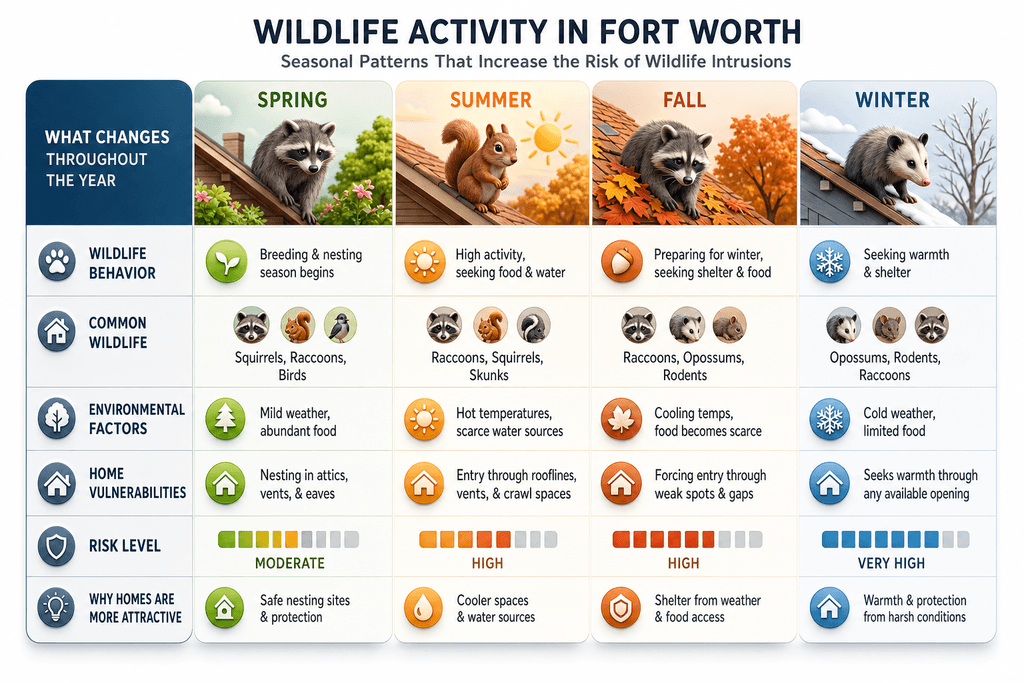
Wildlife activity around Fort Worth homes follows predictable patterns throughout the year. Understanding when animals are most likely to seek shelter helps homeowners stay one step ahead. Different seasons trigger different behaviors, and knowing what to expect can help you spot problems before they get serious.
Spring brings baby season, when mother animals desperately search for safe, warm places to raise their young. Your attic checks all the boxes with its insulation, protection from predators, and stable temperature. Fall triggers another wave of activity as animals prepare for winter by seeking out cozy spots to wait out the cold months.
| Season | Primary Wildlife Activity | Common Animals | Why They Enter Homes |
|---|---|---|---|
| Spring (March-May) | Nesting and birthing | Squirrels, raccoons, birds | Looking for safe places to raise babies |
| Summer (June-August) | Seeking cool shelter | Bats, snakes, opossums | Escaping extreme heat |
| Fall (September-November) | Winter preparation | Mice, rats, raccoons | Storing food and finding warm spots |
| Winter (December-February) | Hibernation and warmth-seeking | Squirrels, opossums, rodents | Staying warm during cold snaps |
Weak Spots in Typical Fort Worth Homes
Most Fort Worth homes were built with people in mind, not wildlife prevention. That means there are dozens of potential entry points that animals can exploit. A gap that looks tiny to you might be a wide-open door to a determined raccoon or squirrel.
Older homes in established neighborhoods often have the most vulnerabilities because materials deteriorate over time. But even newer construction can have problems if builders didn't pay attention to wildlife-proofing details. When searching for "critter control near me," homeowners often discover issues they never knew existed.
- Roof vents without proper screening or guards
- Gaps where different building materials meet, especially around chimneys
- Damaged or missing soffit and fascia boards
- Foundation cracks and gaps around utility line entry points
- Uncapped chimneys that serve as perfect den sites
Wildlife X Team's inspection process identifies these vulnerable spots before animals find them. The company's Wildlife Inspection Report® examines every potential entry point, giving homeowners a clear picture of where their property needs protection.
How Fort Worth Weather Affects Wildlife Behavior
Texas weather plays a huge role in when and why animals invade homes. Fort Worth's hot summers and unpredictable winter cold snaps create two distinct pressure points that drive wildlife indoors. During July and August, when temperatures regularly hit the high 90s, attics might seem like the last place an animal would want to be, but they're actually cooler than being exposed outside.
Winter brings a different challenge. While Fort Worth doesn't get brutally cold like northern states, sudden temperature drops and ice storms send animals scrambling for shelter. A warm attic filled with insulation becomes prime real estate when the temperature drops below freezing.
- Summer heat drives animals to seek shade and cooler microclimates inside structures
- Heavy spring rains flood natural burrows and dens, forcing animals to higher ground
- Winter cold snaps trigger urgent shelter-seeking behavior
- Drought conditions push wildlife closer to human water sources
The combination of urban expansion, seasonal breeding patterns, structural vulnerabilities, and weather extremes makes Fort Worth homes particularly attractive to wildlife. Understanding these factors helps homeowners recognize why professional critter control services aren't just helpful but often necessary for long-term protection.
Spotting the Signs of Wildlife in Your Attic and Walls
Most homeowners in the Fort Worth area don't realize they have unwanted guests until the problem gets serious. The truth is, wildlife can live in your attic or walls for weeks before you notice anything unusual. Raccoons, squirrels, and other critters are surprisingly good at staying hidden during the day. But they always leave clues behind if you know what to look for. Learning these warning signs can save you thousands in repair costs down the road.

Strange noises are usually the first giveaway. You might hear scratching, scurrying, or thumping sounds coming from your ceiling or walls. These noises often happen at specific times, like early morning or dusk when animals are most active.
- Scratching and scurrying sounds in the attic or walls, especially at dawn or dusk
- Droppings and urine stains in corners, along walls, or near entry points
- Foul odors that smell like ammonia or decay
- Damaged insulation that looks torn, matted, or pushed aside
- Chewed wires and torn ductwork that could pose fire hazards
- Grease marks along walls, rafters, or near holes where animals travel
- Nesting materials like shredded paper, leaves, or insulation clumped together
The smell is another dead giveaway that something's wrong. Animal urine and droppings create a strong ammonia-like odor that gets worse over time. If you notice dark stains on your ceiling or walls, that's often urine seeping through from above.
Visual damage tells the whole story. Check your attic for torn insulation, chewed electrical wires, or damaged ductwork. Animals need to gnaw constantly to keep their teeth from growing too long, which means they'll chew on just about anything in your home.
The Real Damage Wildlife Causes to Your Property
The financial hit from wildlife damage adds up faster than most people expect. What starts as a small hole in your soffit can turn into thousands of dollars in repairs within just a few months. Beyond the money, there are serious health risks that come with having wild animals living in your home. The team at Wildlife X Team's Keller location sees these problems every day across Fort Worth, Denton, and surrounding areas.

Chewed electrical wiring creates a real fire hazard. Squirrels and rats love gnawing on wires, which can spark electrical fires inside your walls or attic. Insurance companies report that rodents cause about 25% of house fires with unknown origins.
- Electrical fire risks from exposed or damaged wiring
- Insulation damage that reduces your home's energy efficiency by up to 30%
- Structural damage to wood beams, drywall, and roofing materials
- Health hazards from droppings that carry diseases like histoplasmosis and salmonella
- HVAC contamination when droppings and debris get into your air system
Your insulation takes a beating when animals move in. They compress it, tear it apart for nesting, and contaminate it with urine and feces. This can cut your home's energy efficiency significantly, leading to higher heating and cooling bills.
The health risks are even more concerning than the property damage. Animal droppings carry parasites, bacteria, and diseases that can make your family sick. When these contaminants get into your HVAC system, they spread throughout your entire home every time the air kicks on.
Repair costs vary depending on how long the problem goes unnoticed. Minor exclusion work might run a few hundred dollars, but extensive attic restoration with insulation replacement can cost several thousand. The longer you wait, the more expensive it gets.
How Professional Critter Control Works
Searching for "critter control near me" brings up plenty of options, but not all wildlife removal services work the same way. Some companies just trap the animal and leave, which doesn't solve the real problem. The animals either come back or new ones move into the same entry points. A complete solution needs to address removal, cleanup, and prevention all together. That's where a thorough process makes all the difference.
Everything starts with a detailed inspection. Wildlife X Team uses their Wildlife Inspection Report® to check every vulnerable spot on your property. This isn't a quick walk-around. Technicians examine your roof, soffits, vents, foundation, and other areas where animals commonly enter.
- Complete property inspection to find all entry points
- Humane trapping and removal methods specific to each species
- Exclusion barriers installed at every access point
- Attic cleanup with contaminated insulation removal
- Disinfection and odor elimination
- Repairs to damaged areas like soffits, vents, and roofing
Removal techniques vary based on what type of animal you're dealing with. Raccoons need different handling than squirrels or bats. Professional teams know the behavior patterns of each species and use humane methods that don't harm the animals.
After removal comes the prevention work. This means sealing every entry point with materials animals can't chew through. The team at 11833 Katy Rd in Keller installs vent guards, repairs foundation gaps, and adds chimney caps to keep wildlife out for good.
Attic restoration is the final step that many companies skip. Contaminated insulation needs to come out completely. Then the space gets disinfected to eliminate disease risks and odors. Fresh insulation goes in to restore your home's energy efficiency. Wildlife X Team backs this work with a renewable lifetime warranty, which means if animals find a way back in, they'll come fix it at no extra cost.
Protecting Your Yard from Wildlife Problems
Your yard is usually where the problem starts. Animals don't just randomly pick houses to invade. They're looking for food, water, and shelter, and your property might be offering all three without you realizing it. A few simple changes to your outdoor space can make your home a lot less attractive to wildlife. The goal is to remove the invitation before critters start looking for ways inside.
Trash cans are like a buffet for raccoons and opossums. Use bins with locking lids and keep them in your garage until pickup day if possible. Even a small amount of accessible food waste will bring animals back night after night.
- Secure all trash cans with locking lids
- Remove pet food bowls from outside after feeding
- Trim tree branches at least 6 feet away from your roof
- Clear brush piles and yard debris where animals hide
- Fix leaky outdoor faucets and remove standing water
- Install fencing around gardens and compost bins
Tree branches that touch your roof are basically highways for squirrels. They'll use these branches to access your attic through small gaps in your soffits or roof vents. Keeping vegetation trimmed back removes their easiest access route.
Standing water attracts more than just mosquitoes. Wildlife needs water sources, and a leaky hose or clogged gutter provides exactly that. Fix these issues and you remove another reason for animals to hang around your property.
Sometimes yard wildlife becomes a home intrusion risk faster than you'd think. A family of raccoons living under your deck will eventually start exploring your attic. Wildlife X Team serves the entire Fort Worth area, including Southlake, Grapevine, and Flower Mound, with outdoor prevention services that address these risks before they become indoor problems. You can reach them at (817) 799-8686 to discuss what your property needs.
Why DIY Critter Control Usually Fails
Most homeowners who search for "critter control near me" have already tried fixing the problem themselves at least once. The reality is that about 70% of DIY wildlife removal attempts fail within the first three months, leading to frustrated homeowners and repeat invasions. What seems like a simple fix often turns into a costly cycle of temporary patches and ongoing animal problems. The gap between what looks like the obvious solution and what actually works long-term is where most people lose time and money.
The Hidden Entry Point Problem
When you spot a raccoon entering through a damaged vent, it's natural to think fixing that one spot will solve everything. But wildlife rarely uses just one entrance. Animals create backup routes that aren't visible from the ground or obvious during a quick inspection.
- Squirrels can squeeze through holes as small as 1.5 inches in diameter
- Roof intersections and soffit gaps are nearly impossible to inspect without proper equipment
- Foundation cracks and crawl space vents often go unnoticed until damage spreads
- Animals create secondary entry points while you're sealing the primary one
Wildlife X Team's inspection process identifies an average of 3-4 entry points per property, while homeowners typically only find one. That's why their Wildlife Inspection Report® examines every vulnerable area before any work begins.
Safety and Legal Concerns
Handling wild animals without training puts you at serious risk. Raccoons carry rabies at higher rates than most people realize, and their bites require immediate medical attention that costs far more than professional removal.
- Texas law restricts how and when you can trap or relocate certain wildlife species
- Improper handling can result in fines up to $500 per violation
- Animal waste in attics contains harmful bacteria that require protective equipment to clean safely
- Mother animals separated from babies often cause more damage trying to reunite
DIY Versus Professional Services
The cost comparison between DIY attempts and professional critter control near me services often surprises homeowners. While a trap from the hardware store costs $40-60, most people end up spending $200-400 on multiple attempts before calling professionals anyway.
DIY Approach
- No guarantee animals won't return
- Risk of personal injury or legal violations
- Incomplete solutions that address symptoms, not causes
- No warranty or follow-up support
- Average total cost after multiple attempts: $300-600
Professional Service
- Comprehensive inspection finds all entry points
- Humane removal by trained specialists
- Complete exclusion work prevents future problems
- Renewable Lifetime Warranty from Wildlife X Team
- One-time investment with guaranteed results
The warranty alone makes professional service worth considering. When animals return after DIY fixes, you're back to square one with no recourse. Companies like Wildlife X Team stand behind their work, which means if wildlife finds a way back in, they handle it at no additional cost.
Taking Action on Wildlife Problems
When you hear scratching in your attic or spot droppings in your crawl space, waiting usually makes things worse. Wildlife problems don't fix themselves, and the longer animals stay in your home, the more damage they cause to insulation, wiring, and structural components. What starts as a small hole can turn into thousands of dollars in repairs if you put it off.
Getting professional help means the job gets done right the first time. Wildlife X Team handles everything from the initial inspection to sealing up entry points so animals can't come back. The team serves Fort Worth, Keller, Denton, Granbury, and surrounding areas, so if you're searching for critter control near me, you're already in the right place.
The humane approach matters too. These animals are just looking for shelter, but that doesn't mean they belong in your house. Professional removal keeps everyone safe and makes sure the problem actually gets solved instead of just moving the animals around.
Most homeowners don't realize how many entry points their property has until someone trained knows where to look. That's where the detailed inspection comes in handy. You can reach Wildlife X Team at (817) 799-8686 or visit their location at 11833 Katy Rd, Keller, TX 76244.
The sooner you address wildlife issues, the less you'll spend on repairs and cleanup. But you probably have some questions about how the whole process works and what to expect.
Common Questions About Critter Control
When you hear scratching in your attic at 2 AM, you probably have a lot of questions running through your mind. Wildlife problems can feel overwhelming, especially when you're not sure what you're dealing with or how quickly you can get help. Most homeowners in the Fort Worth area deal with similar concerns when they discover unwanted critters have moved in. Here are the answers to the most common questions we hear from people searching for critter control near me.
How fast can you respond to a wildlife emergency?
Wildlife X Team typically responds to emergency calls within 24 hours, and in many cases, we can arrive the same day. Our team understands that wildlife in your home isn't something you want to wait around for, especially if animals are causing damage or creating health risks. We serve the Fort Worth, Denton, and Granbury areas with quick response times that beat many competitors who might make you wait several days for an appointment.
What animals are most common in Fort Worth attics?
The three most frequent uninvited guests in Fort Worth attics are raccoons, squirrels, and opossums. Squirrels tend to be the noisiest, often waking homeowners with their daytime activity and chewing sounds. Raccoons are the most destructive, tearing up insulation and creating large entry points. Opossums are quieter but can still cause significant damage and leave behind contamination that requires professional cleanup.
Is wildlife removal safe for pets and children?
Yes, our humane removal methods are completely safe for your family and pets. We don't use poisons or harmful chemicals that could put your loved ones at risk. Wildlife X Team focuses on exclusion techniques and safe trapping methods that remove animals without creating secondary hazards in your home. This approach sets us apart from some pest control companies that rely heavily on chemical treatments.
How long does the removal process take?
Most wildlife removal projects are completed within a few days to a week, depending on the severity of the infestation. The initial removal often happens quickly, sometimes even on the first visit. The complete process includes sealing entry points and animal-proofing your home, which takes additional time but prevents future problems. Attic restoration, if needed, may add extra days to the timeline.
What does your warranty cover?
Our Renewable Lifetime Warranty covers the specific areas we've treated and sealed against future wildlife entry. If animals get back in through the spots we've secured, we'll come back and fix the problem at no additional cost. This warranty gives you long-term peace of mind that your investment is protected, which is something not all wildlife removal companies offer.
Do you handle commercial properties?
Absolutely. Wildlife X Team provides specialized commercial wildlife removal services for businesses throughout the Fort Worth area. We understand that wildlife problems at a business location require discretion and fast resolution to avoid disrupting your operations or alarming customers. Our commercial services include the same thorough inspection, removal, and prevention strategies we use for homes, just tailored to business needs.