
Copperheads in Texas Around Homes and When to Call for Help
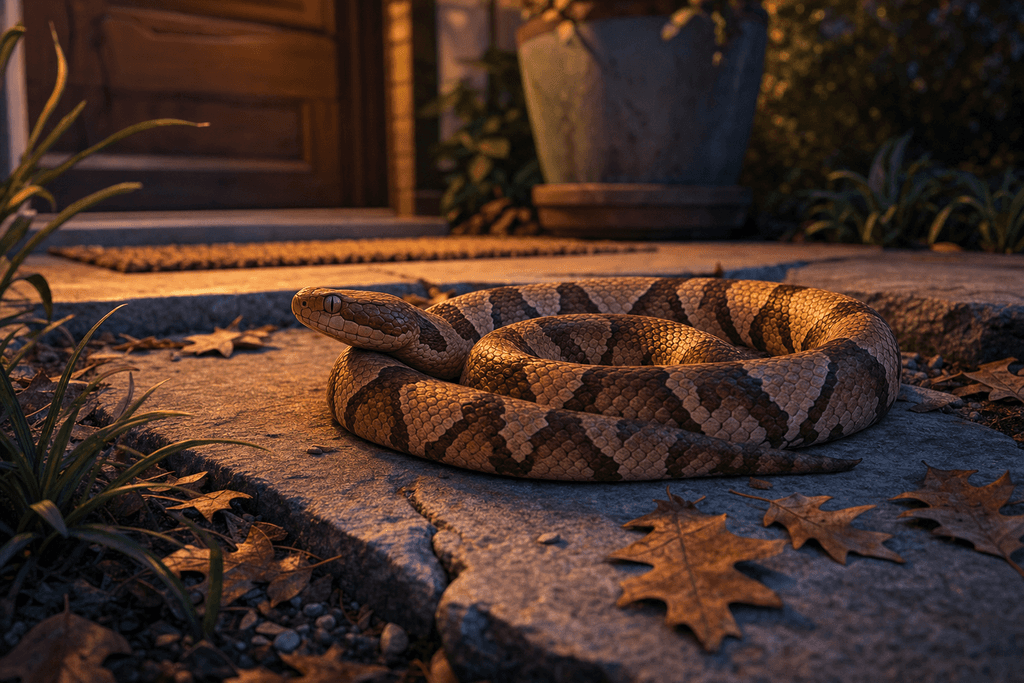
Copperhead in Texas yards is one of the most common venomous snake calls homeowners make across the Dallas-Fort Worth area, especially from spring through fall. These snakes are built to disappear against dead leaves, mulch, and tree bark, which is exactly why most bites happen when someone steps too close without ever seeing the snake first. A copperhead would almost always rather stay hidden than strike, but their coloring makes that easy to pull off right next to a patio, woodpile, or garden bed.
They like it cool, quiet, and cluttered. Stacked firewood, thick ground cover, stone walls, and crawl spaces under a deck all make good hiding spots, and those spots tend to sit a lot closer to the back door than people expect. Knowing what draws them in and what they look like close up makes it a lot easier to spot trouble before anyone gets hurt.
Table of Contents
Where Copperheads Live Across Texas
Texas has three copperhead subspecies, and where you live decides which one you might find. The Southern Copperhead sticks to East Texas, favoring piney woods and river bottoms with thick leaf litter. The Broad-banded Copperhead covers Central and North Texas along with the Hill Country, which includes Ft. Worth, Denton, and Granbury.
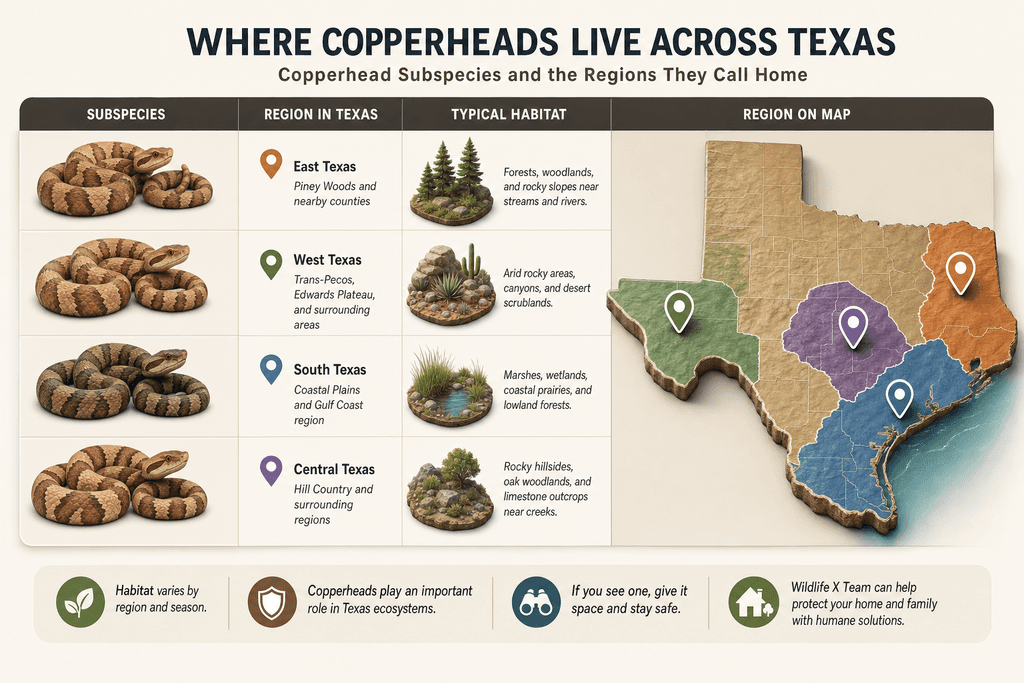
The Trans-Pecos Copperhead lives out in far West Texas, tucked into rocky canyons and arid terrain far from any of the other two ranges. Each one has its own look, with the Broad-banded showing wider, more distinct crossbands than its eastern cousin, but all three share the same habits once they're near a home.
No matter the subspecies, copperheads show up in yards that offer the same basic cover: wood edges, creek banks, and loose rock piles. A homeowner in Granbury and one in East Texas are dealing with different snakes, but the same warning signs.
Knowing which subspecies is local helps with identification, but it doesn't change what to do if one turns up near the house. The habitat clues matter more day to day than the exact pattern on the snake's back.
How to Spot a Copperhead at a Glance
A copperhead has an hourglass pattern that runs across its back, narrow on the spine and wide where it meets the belly. From above, that same band can look more like a saddle or a blob, which is one reason people miss it in dead leaves.
The head is coppery, tan, or pinkish with no stripes running through it, and the body is thick for its length with a triangular head and vertical pupils. Watersnakes and rat snakes get killed by mistake all the time because people see "brown snake" and assume the worst.
- Hourglass bands narrow on top, wide on the sides, not round blotches
- Solid-colored head, no stripes running front to back
- Triangular head wider than the neck
- Vertical, slit-like pupils instead of round ones
- Thick, heavy body compared to the slimmer build of a rat snake
The single biggest mix-up is vertical pupils versus round ones, since that one trait rules out almost every harmless lookalike in a Texas yard.
Yard Spots Where Copperheads Like to Hide
Copperheads look for cover that stays cool and holds a little moisture, which is why mulch beds, leaf piles, and woodpiles are the first places to check. A stacked woodpile against the garage or a thick mulch ring around a tree gives them shade and easy access to the rodents they hunt.
Rock walls, garden borders, and loose stone edging work the same way, with gaps between stones acting like a hallway system. Under decks, porches, sheds, and low shrubs stay shaded most of the day, and compost piles or the ground near bird feeders draw in mice and rats, which draw in the snakes hunting them.
- Woodpiles and mulch beds within 20 feet of the house
- Rock walls, stone borders, and loose edging with visible gaps
- Space under decks, sheds, and porches
- Compost bins and the ground under bird feeders
Check these spots at dusk, since that's when copperheads are most likely to be out and moving between them.
How Risky Is a Copperhead Encounter
Copperhead venom causes serious pain and swelling, but it's rarely fatal, especially compared to the venom of a rattlesnake. Most bites happen when someone steps on a snake hidden in leaves or reaches into a woodpile without looking first.
A bite still needs emergency care right away, and the risk goes up fast for kids, pets, and older adults whose bodies handle the venom load differently. Activity climbs at night and during warm months, which lines up with more yard work and more chances for a surprise encounter.
- Call emergency services or go to an ER immediately after any bite
- Keep the bitten limb still and below heart level while getting help
- Skip the tourniquet, ice, and cutting the wound, none of that helps
- Watch pets closely since a bite to the face or neck can swell fast
The low fatality rate doesn't mean a bite is minor. It still means a trip to the hospital, not a wait-and-see approach at home.
What to Do the Moment You Spot One
Back away slowly and put distance between yourself and the snake. Never try to catch, trap, or kill it, since most bites happen during exactly that kind of attempt.
Get kids and pets inside until someone has checked the area, and try to remember the exact spot where you saw it, near the woodpile, under the deck stairs, along the back fence line. That detail helps a removal team find it and check nearby cover for others.
- Step back and keep people and pets away from the area
- Do not attempt to handle or kill the snake yourself
- Note the exact location for whoever comes to remove it
- Call a removal team to clear the snake and check for more nearby
Wildlife X Team handles that kind of call directly, removing the snake and checking the yard for other spots where one could be hiding. That second check matters, since copperheads rarely travel alone when a yard has good cover and a steady food source.
One Removal or a Rodent Fix Too
Snake removal alone solves today's problem, not next spring's. Copperheads show up where mice and rats are already active, so a yard with squirrels in the attic or raccoons in the shed usually has the same clutter and food sources that snakes want. Clearing one copperhead out of a woodpile without touching the rodent activity nearby means another one, or the same one, can move right back in.
The choice comes down to spot treatment versus a full fix. Spot treatment costs less upfront and takes less time, and it's fine if this is a one-off sighting with no rodent signs anywhere else on the property. A full fix costs more in labor, since it means sealing gaps around the foundation, clearing brush piles, and dealing with any rodent nests that are drawing the snakes in, but it's the better call for anyone who's seen chewed wires, droppings, or scratching in the attic along with the snake.
Skipping the rodent side to save money is the trade-off that tends to backfire. A yard that still feeds mice will keep drawing copperheads no matter how many times someone pulls one out from under the deck.
When to Handle It and When to Make the Call
Spotting the hourglass pattern and vertical pupils from a safe distance is one skill. Deciding what happens next is another, and that decision should come down to comfort, not confidence. Being sure it's a copperhead doesn't make it safe to move, trap, or spray on your own, and that's where most bites happen. If there's any rodent activity nearby, or you just don't want to find out how many are hiding in that woodpile, Wildlife X Team covers Fort Worth, Denton, Granbury, and the surrounding area for exactly this kind of job. A call to (817) 799-8686 settles it faster than standing in the yard trying to decide for yourself.
Copperhead Questions Texas Homeowners Ask
Do copperheads come into garages or houses, not just yards?
Yes, though it's less common than a yard sighting. A copperhead following rodent trails can slip through a gap under a garage door, a foundation crack, or a torn weep hole screen. If mice or rats are already getting inside, the snake has a reason to follow. Sealing those entry points matters as much outside as it does in the yard.
What should I do if my dog gets bitten by a copperhead?
Get your dog to a vet right away, the same way a person would go to an ER. Keep your dog calm and carry it instead of letting it walk, since movement speeds how fast venom spreads. Don't apply ice or try to suck out venom. Swelling around the face or neck can affect breathing fast, so treat it as an emergency, not a wait-and-see situation.
Does killing one copperhead mean others are nearby too?
Killing a snake doesn't answer that question, and it isn't the recommended move either way. A yard with good cover and active rodents can hold more than one copperhead at a time, regardless of what happens to the first one. Checking woodpiles, stone edging, and crawl spaces nearby tells you more than removing one snake ever will.
Can moth balls or home repellents actually keep copperheads away?
No, there's no solid evidence that moth balls, sulfur, or similar store-bought repellents keep copperheads out of a yard. Snakes don't avoid smells the way these products claim. What actually works is removing cover and food sources, then sealing gaps a snake could use to get closer to the house. Wildlife X Team handles that kind of exclusion work directly, instead of relying on products with no real track record.