Compare Wildlife Pest Removal Services for Attics and Walls
Wildlife pest removal companies in the Fort Worth area do not all follow the same rules, and some skip the part where they actually seal up your attic once the animal is gone. A raccoon or squirrel job can look finished when the critter is caught, but if nobody closes the entry point, you get a repeat visitor in a few months. Most homeowners in Keller, Southlake, or Grapevine call one number, book the first appointment, and never find out what a second or third company would have charged or done differently.
That matters because the work varies a lot. Some outfits trap and leave. Others inspect the whole structure, patch vents and chimney gaps, clean the insulation the animal ruined, and back the repair with a warranty. The price difference between a quick trap job and full exclusion work can be significant, and you usually cannot tell which one you are getting until the technician is already on your roof.
Table of Contents
What Attic and Wall Wildlife Jobs Usually Involve
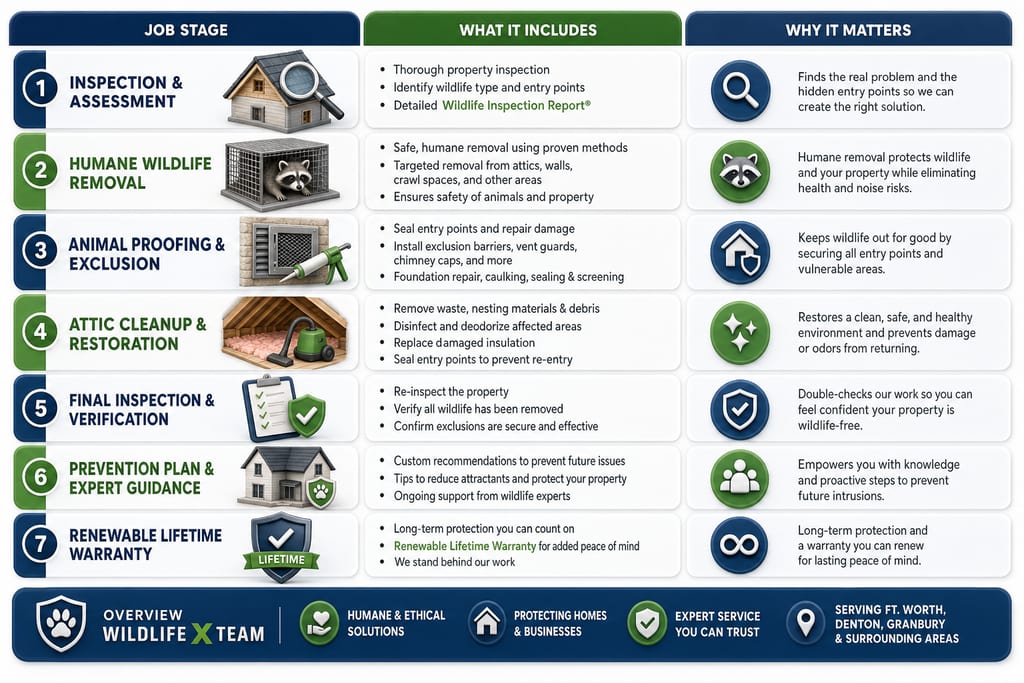
Any attic or wall job breaks down into four stages: inspection, removal, exclusion repairs, and cleanup. Skipping any one of these is how an animal gets back in or how a homeowner ends up with ruined insulation and no idea why the smell won't go away.
In Keller, Fort Worth, Denton, and the rest of North Texas, the animals causing most of this trouble are squirrels, raccoons, and possums. Squirrels chew through soffit vents and roof edges, raccoons tear open larger gaps near rooflines and chimneys, and possums tend to find foundation and crawl space openings.
Here is what each stage should cover, and what a written quote ought to spell out before work starts:
- Inspection: find every entry point, not just the obvious one, and note existing damage
- Removal: trap or safely extract the animal without harming it or the structure
- Exclusion repairs: seal vents, gaps, and chimney openings so nothing gets back in
- Cleanup: remove waste, disinfect the space, and replace insulation the animal ruined
If a quote only mentions one or two of these, ask what happens to the other stages, because leaving one out is usually where the job falls apart.
Checking If a Company Truly Uses Humane Methods
Ask the technician directly whether they use lethal traps, glue boards, or poison, and listen for a straight answer. A company that hesitates or changes the subject is telling you something. Humane handling means live capture and release that follows state wildlife guidelines, not a quick kill to save time.
Ask what happens to the animal once it is caught and where it gets released. A reputable provider explains the whole process, inspection, capture, exclusion, before they ever climb a ladder, not after the invoice is written. Wildlife X Team lays out its removal and prevention approach up front, which is the kind of transparency worth expecting from anyone you let into your attic.
Before you sign anything, run through these questions with the provider:
- Do you ever use poison or glue traps on this property
- What species-specific relocation rules do you follow
- Will I see the entry points you found before repairs start
- Is the removal method different for a raccoon than a squirrel
A company that cannot answer all four without pausing is not one you want deciding what happens in your walls.
Verifying Licensing, Insurance, and Real Experience
Ask for proof of a wildlife control license and current liability insurance before any technician steps on your roof or opens an attic hatch. Insurance matters because removal work sometimes means pulling back insulation, cutting into soffits, or walking on roofing that was not built for foot traffic. If something cracks or tears, you want the company's policy covering it, not your homeowner's claim.
Years in business and local reviews from Fort Worth, Denton, or Granbury residents tell you whether a company sticks around to handle warranty callbacks. Confirm the person coming to your house is a trained technician, not a subcontractor the company hired for the day. That distinction affects whether exclusion repairs actually match what was promised in the quote.
Before signing anything, request these documents:
- Current wildlife control license number
- Proof of liability insurance, dated within the year
- References from at least two local jobs
- Written confirmation of who performs the work
Skipping this step is how homeowners end up with uninsured labor on a roof and no recourse if it goes wrong.
Comparing Quotes Side by Side Before You Decide
Line up every quote against the same four categories: inspection detail, exclusion work included, warranty length, and total price. A number by itself means nothing until you know what it buys. A $300 quote that only covers trapping is not cheaper than a $600 quote that seals every entry point, because the $300 job usually comes back.
Ask each company for a written scope of work, not a number given over the phone. A verbal estimate can change once the technician is on your roof and finds damage nobody mentioned. Wildlife X Team's Wildlife Inspection Report documents every vulnerability found on the property, which gives you something concrete to compare against a competitor's one-line estimate.
When you have quotes in hand, check each one for:
- A written list of every entry point found, not just the main one
- Exclusion materials specified, not just "repairs included"
- Warranty length stated in months or years, in writing
- Cleanup and insulation replacement spelled out separately
A quote missing two or more of these is incomplete, no matter how low the price looks.
What a Warranty Should Actually Cover
A warranty is only useful if it names what it protects. Ask whether it covers just the entry points that got sealed or the entire structure, because an animal that finds a new gap six inches away should not void your coverage on a technicality.
Renewable lifetime warranties, like the one Wildlife X Team offers, signal that a company expects its exclusion work to hold up for years, not just through the first season. Check whether follow-up visits are included at no extra charge if an animal gets back in, or whether you pay a service fee every time. Get every term in writing, including what voids the warranty, before you sign.
Compare warranty offers on these points:
- Structure-wide coverage versus entry-point-only coverage
- Renewable lifetime terms versus a fixed one or two year window
- Free follow-up visits versus paid service calls
- Written terms versus a verbal promise at close of job
A warranty that only exists in conversation is not a warranty you can hold anyone to.
Paying Once Versus Paying for the Same Job Twice
A trap-only job and a full exclusion job solve different problems. Trapping gets rid of the animal in your attic right now. Exclusion keeps the next one from moving in once the first one is gone, which is the part a cheap quote usually leaves out.
Skip the repair stage and the odds of a repeat call within a few months go up sharply, since squirrels and raccoons return to the same soft spots on a roofline over and over. A Keller homeowner who had squirrels removed without any vent or roof-edge repair found a second litter in the same attic less than a year later, because the original entry point was never closed, just cleared out.
Insulation and cleanup are not cosmetic. Attic insulation soaked with animal waste holds bacteria and odor that spread into the living space through the ductwork, so leaving it in place after removal is a health issue, not just an eyesore.
Paying three separate contractors for inspection, removal, and repair almost always costs more than one company doing all three, since each new visit means a new service call fee on top of the work itself.
Choosing Who Gets Into Your Attic
Before any technician starts work, get the scope and warranty terms in writing, not a verbal summary at the door. Ask for the license number, insurance date, and a list of every entry point they plan to seal, then hold the paperwork against what actually gets done. Homeowners in Keller, Southlake, Colleyville, and the rest of North Texas have a local option in Wildlife X Team, based at 11833 Katy Rd in Keller and serving towns out to Granbury and Glen Rose. Picking a company this way protects two things at once: your attic from a repeat visitor, and the animal from a method you never agreed to.
Wildlife Removal Questions Keller Homeowners Ask
What if two companies give completely different diagnoses for the same attic noise?
Get both opinions in writing and ask each one to show you the entry point they found, not just describe it. A real diagnosis points to a specific gap, chew mark, or droppings pile you can see yourself. If one company names a spot and the other can't, trust the one who showed proof on the roof or in the attic.
Should I get a second opinion if a company recommends trapping without an inspection report?
Yes. Trapping without a full inspection only solves half the problem, since it doesn't tell you how the animal got in or whether more are still inside. A written inspection report, like the one Wildlife X Team provides, documents every vulnerability on the property so you know what you're paying for before work starts.
Can I negotiate warranty terms before signing a contract?
You can ask, but most companies set their warranty length and coverage as a standard policy rather than a line item to haggle over. What you can negotiate is clarity, ask the company to put the exact coverage terms in writing before you sign, including what voids it. A company unwilling to put terms on paper is not one to sign with.
What happens if new animals get in after the warranty period ends?
You'll likely pay for a new inspection and repair, since most warranties stop covering new entry points once the term expires. This is why renewable lifetime coverage matters more than a one or two year window, it keeps protection going instead of leaving you back at square one. Ask upfront whether renewal requires a new service call or just a continuation of the existing terms.