Compare Wildlife Damage Repair and Exclusion Services
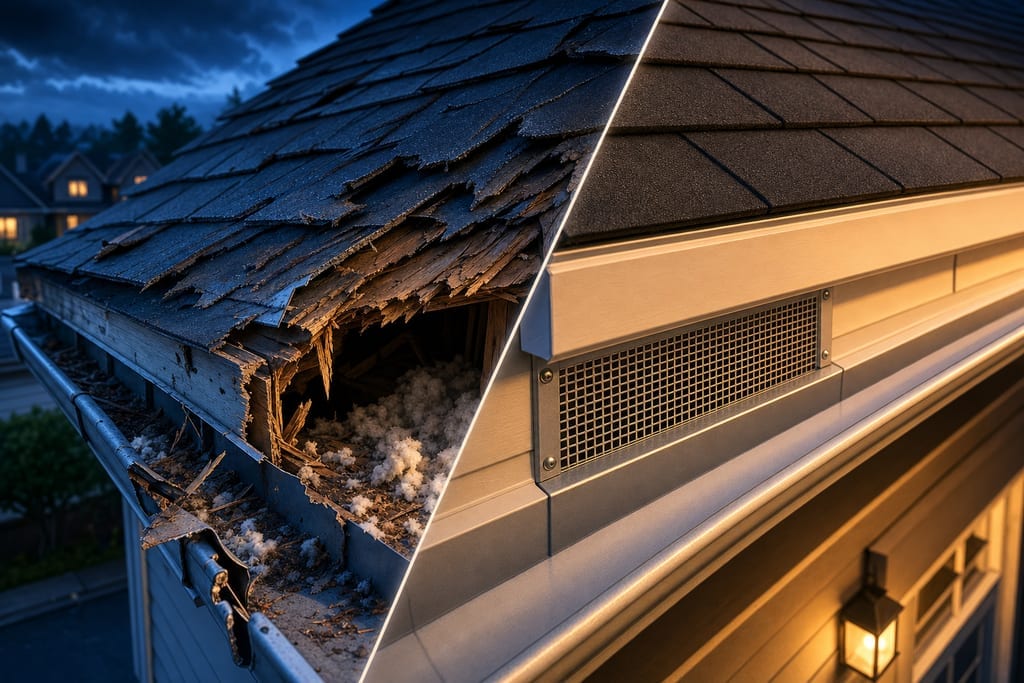
Most wildlife damage repair jobs that fail do so for one reason: the crew patched the hole the animal made but missed the one it actually came in through. Raccoons and squirrels rarely use a single opening, and a repair that covers the obvious spot while leaving a second gap under a soffit or behind a chimney flashing just buys you a few quiet months before the noise in the attic starts again. For homeowners around Keller, Fort Worth, Southlake, or out toward Granbury and Weatherford, that repeat call usually costs more than getting it right once would have.
Picking the cheapest bid on a repair job almost never saves money once you count a second visit. The companies worth comparing are the ones that document every entry point before they repair anything, and back the work with a guarantee that actually covers a reinvasion instead of just the labor. That is the real comparison to make, not who quotes the lowest number first.
Table of Contents
Repair Versus Exclusion and Why It Matters
Repair and exclusion solve two different problems, and a lot of homeowners in Keller, Southlake, or Grapevine assume one covers the other. Repair fixes what the animal already broke: chewed wood trim, soiled attic insulation, torn soffit vents, cracked fascia boards. Exclusion stops the next animal from getting in, through sealing gaps, metal barriers, vent guards, and chimney caps.
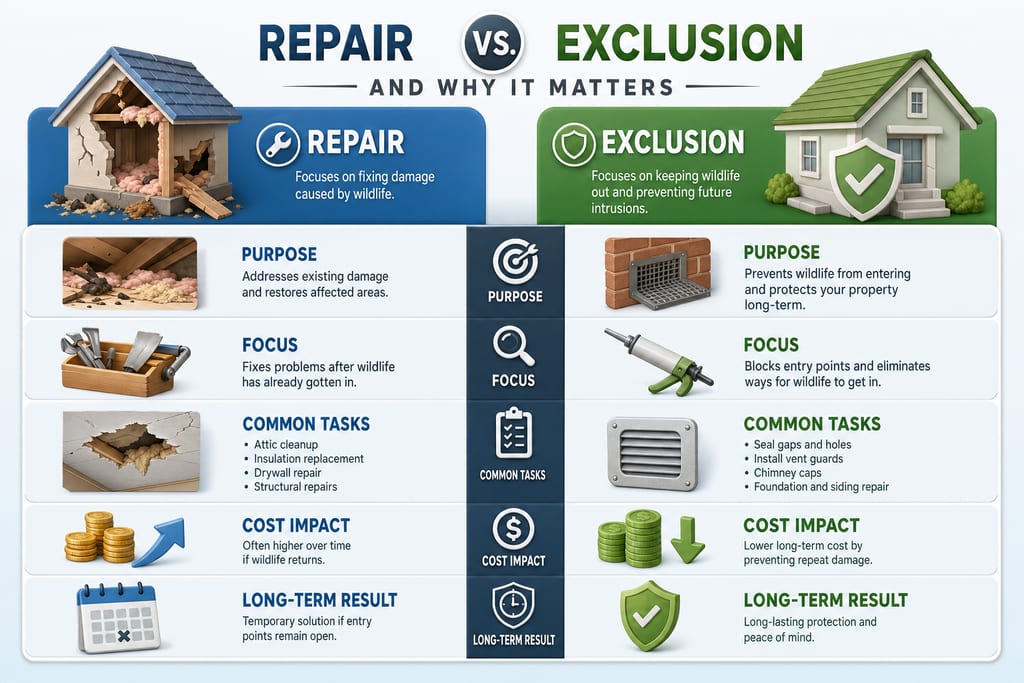
A crew that only repairs will patch the damage and leave the structure just as open as before, so another raccoon or squirrel finds its way back in within a season. A crew that only excludes might seal the house tight but leave soiled insulation and chewed framing behind, which keeps smelling and attracting new animals anyway. Ask any company you're comparing which parts of the job they actually do themselves.
Here is a quick way to tell the two apart when you're reading a quote:
- Repair: replaces or fixes damaged material, insulation, vents, framing
- Exclusion: blocks future entry with caps, mesh, sealant, and barriers
- Full job: covers both, usually inspected and documented before work starts
Cost is usually the first question homeowners ask, and it is worth hearing how a national company breaks that down before you compare local quotes.
If a bid only lists one side of the job, ask directly whether the other half is included or billed separately. That answer tells you more about the final price than the number on the first page of the quote.
Types of Companies You'll Find in a Search
A search for wildlife damage repair near Keller turns up three different kinds of businesses, and they are not interchangeable. Local wildlife specialists handle removal, repair, and exclusion as one job, which matters because the same crew that pulls the raccoon also seals the gap it used. National pest control chains are built around insects and chemical treatments, so wildlife calls often get routed to a subcontractor, and exclusion repairs may not be part of the package at all.
General contractors can patch drywall or replace fascia boards, but most are not set up for live animal handling or humane removal protocols, and they will tell you that upfront if you ask. Mixing providers, one company for trapping and another for the repair, creates a gap where nobody documents the full set of entry points, which is the exact failure pattern homeowners in Southlake and Grapevine run into most.
- Local wildlife specialist: removal, repair, exclusion, one crew, one warranty
- National pest chain: strong on insects, wildlife often subcontracted
- General contractor: good at drywall and framing, no animal handling license
The rule that matters here is simple: whoever removes the animal should be the same company sealing the hole it came through, not a handoff between two invoices.
Criteria That Actually Separate Good Companies
Four things separate a company worth hiring from one that just shows up with a trap. Start with licensing, insurance, and whether the technicians follow a humane-removal certification, since Texas requires a nuisance wildlife control permit for a reason. Next, ask whether a written inspection report is part of the estimate, something that documents every entry point on the property instead of just the one the animal is currently using.
Warranty terms matter just as much as the repair itself. A one-time warranty that expires after 90 days protects you for a season, while a renewable lifetime warranty keeps covering the property as long as you keep the service active. Last, get the scope of work in writing, and confirm it names both removal and the physical exclusion repairs, not just "pest control services" as a vague line item.
- Ask to see the state or local nuisance wildlife permit
- Request the written inspection report before work starts
- Confirm warranty length and whether it renews
- Get repair and exclusion listed as separate line items on the quote
What Pricing Differences Usually Mean
A low bid and a higher bid for the same wildlife job are rarely pricing the same work. Low bids often skip exclusion entirely, charge extra for insulation replacement, or quietly drop any follow-up visit if the animal comes back. Mid-range to higher quotes usually bundle the inspection, the repair, the exclusion barriers, and a lifetime warranty into one number, which is why they look bigger on paper but often cost less over a two or three year span.
Ask every company for a line-item breakdown before comparing numbers, so you know you're pricing the same scope of work, not a stripped-down version against a full one. Wildlife X Team does not publish flat rates online because attic size, entry point count, and damage vary by house, so a written estimate that separates repair costs from exclusion costs is the only way to compare it fairly against another bid.
- Exclusion-only jobs often run cheaper than combined repair plus exclusion packages
- Ask what happens, in writing, if the animal returns within 30 days
- Confirm insulation replacement is priced in, not billed as a surprise add-on
One thing worth hearing straight from a technician is what a warranty is actually supposed to cover once the work is done.
Shortlisting Wildlife Damage Repair Near Keller and Fort Worth
Narrowing down options works better as a short process than a long search. Look for companies that list both repair and exclusion explicitly on their site, not just trapping or removal, since that wording usually reflects what they actually do on the job. Read reviews for mentions of technicians finding and sealing multiple entry points, not just reviews that say the animal was removed, because that distinction tells you whether the company treats the whole house or just the symptom.
Confirm the service area covers your town specifically. Companies serving Keller, Fort Worth, Denton, Granbury, Weatherford, Southlake, Grapevine, Colleyville, and nearby towns like Roanoke or Flower Mound should say so directly rather than leaving it vague. Book two or three estimates and compare the written scope side by side, since that is the only way to see whether one bid is actually cheaper or just missing a repair step the other one included.
- Confirm the company lists repair and exclusion, not just trapping, on its site
- Search reviews for "entry point" or "sealed" language, not just "removed"
- Check that your town is named in their service area
- Collect two or three written estimates before deciding
One Crew or Two, Who Carries the Risk
Hiring one specialist and one repair contractor separately feels like it should save money, since each quote looks smaller on its own. The catch shows up later, if the animal gets back in. The repair company says the opening wasn't their job, the trapper says the hole wasn't theirs to seal, and you're stuck re-explaining the whole problem to a third crew.
A single provider that handles removal and exclusion under one renewable lifetime warranty puts that risk in one place. There's nobody to call twice, and no argument about which invoice covers the new noise in the attic. That matters more than the upfront price difference, especially for a two or three year window where a reinvasion is likely if a gap gets missed.
Written inspection reports are the other piece worth asking about directly. A dated record of what was found and what got sealed gives you something to hold a company to later, not just a verbal promise. Jesse Bernard's attic job is a good example: a DIY patch would have covered the obvious hole and left two others open, the kind of gap a documented inspection is built to catch.
For a small property with one clear entry point, hiring separately might work fine and cost less. For an older home with multiple animals or a chimney and soffit both compromised, one provider covering the whole job is the safer bet.
Deciding Which Quote to Trust
When the estimates are sitting in front of you, set the price aside first and read what each one actually promises to do. A number without a written scope tells you nothing about whether the repair and the exclusion are both covered, or whether the warranty renews or just expires after one season. Pick the quote that names both jobs and backs them with one warranty, not the one that happens to be lowest. If you're in Keller or anywhere nearby and want that written estimate to compare against, Wildlife X Team at 11833 Katy Rd, Keller, TX can put one together, or you can call (817) 799-8686 and ask what the inspection turns up before anyone touches a tool.
Wildlife Repair Company Questions
Can I hire a general contractor to do the exclusion work myself?
You can, but most general contractors are not licensed to handle live animals, so you would still need a separate wildlife removal company first. The risk is coordination. If the contractor seals a gap before every entry point is confirmed closed, an animal already inside can get trapped in the wall or attic, which creates a bigger problem than the one you started with.
What happens if the repair fails within the first year?
That depends entirely on what the warranty actually covers, which is why the written terms matter more than the price. A one-time warranty may only cover the original labor, not a new entry point the animal finds somewhere else on the house. A renewable warranty is built to cover repeat reinvasion, which is the scenario homeowners actually run into.
Do commercial properties get a different quote process than homes?
Yes, commercial jobs are scoped separately because the building size, number of entry points, and health code concerns are usually bigger than a single-family home. Wildlife X Team handles commercial wildlife removal as its own service line, with the same inspection-first approach used on residential jobs, but priced against the specific building rather than a flat residential rate.
Is a renewable lifetime warranty worth paying more for than a one-year guarantee?
For most homes in Keller, Southlake, or Grapevine with more than one potential entry point, yes, because a one-year guarantee runs out right around the time a second animal tries the same route in. A renewable warranty keeps covering the property as long as the service stays active, which matters more over a three or four year span than the upfront difference in price.