Compare Animal Removal Services for Homes and Businesses
About a third of animal removal services calls turn into repeat visits within a year, and almost every time it is because the first company trapped the animal but never closed the hole it came in through. That single miss is the difference between a one-time job and a yearly headache. Homeowners usually end up choosing between three kinds of providers: national pest chains that bundle wildlife work into a broader service list, independent local trappers who know the area but may not offer a warranty, and regional franchises like Wildlife X Team that build exclusion and inspection into every job.
Each type handles price, warranty terms, and inspection quality in its own way, and those differences show up fast once an animal gets back into the same attic. A trapper who charges less up front may not check the roofline, the chimney cap, or the foundation vents for other gaps. A national chain might offer a broad warranty but send a generalist instead of someone who specializes in wildlife entry points. Knowing what each option actually covers before you sign anything saves a second call a few months later.
Table of Contents
- What Fort Worth Area Property Owners Are Dealing With
- National Chains vs Local Specialists vs Franchises
- Why the Inspection Step Separates Good Services from Bad Ones
- How Warranty Length Changes What You're Really Paying For
- Matching the Service Type to Homes vs Businesses
- Which Provider Type Actually Fits Your Situation
What Fort Worth Area Property Owners Are Dealing With
Raccoons, squirrels, and opossums cause most of the attic calls across Fort Worth, Denton, and Granbury. They get in through roof gaps, loose vents, and chimney openings, and they tear up insulation while they're in there. Winter pushes more of them indoors looking for warmth, so attic noises tend to pick up starting in late fall.
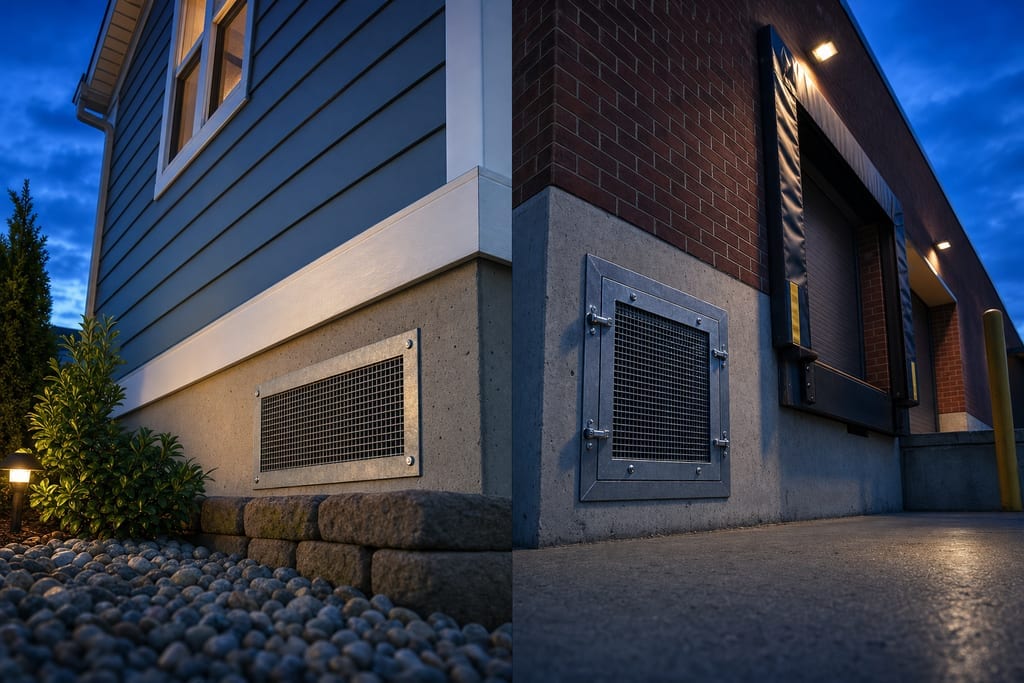
Businesses face a different set of problems. A raccoon in a restaurant's crawl space or a bird nest blocking a commercial vent can trigger a health code violation, not just property damage. Structural issues also show up faster in commercial buildings because of larger roof systems and more entry points to check.
Before picking a company, it helps to see how an inspection should actually work.
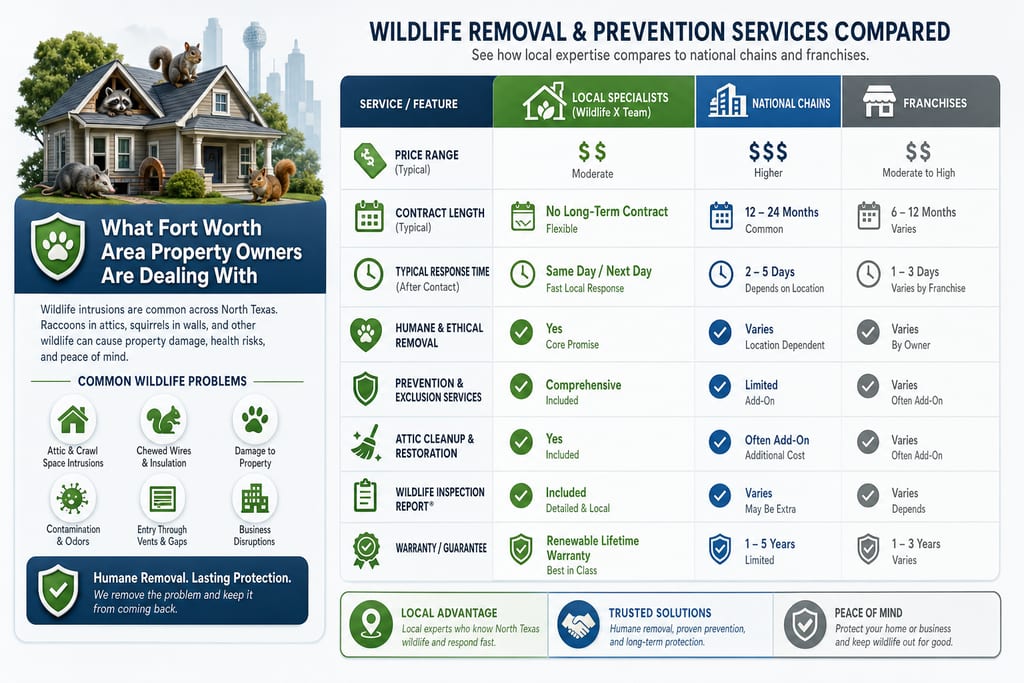
Service categories also split along a few clear lines. National chains tend to focus on removal and offer limited follow-up on sealing entry points. Local independent trappers often handle removal well but may skip a full property inspection. Regional specialists built around wildlife work typically combine removal, exclusion, and a written inspection report in one visit, which cuts down on repeat calls.
National Chains vs Local Specialists vs Franchises
Each provider type handles the job differently, and that affects price, speed, and what happens after the animal is gone. A national pest control chain usually sends whoever is on the schedule that day, someone trained on bugs and rodents who also handles wildlife calls. That generalist approach can mean less focus on entry points specific to raccoons or squirrels.
Independent local trappers often charge less and know the neighborhood's wildlife patterns well. What they may skip is a standardized inspection process, since many work solo without a documented reporting system. Franchise operators like Wildlife X Team sit in between: local technicians who answer to company-wide standards, including a written Wildlife Inspection Report on every visit.
- National chains: broad service list, wildlife is one offering among many
- Local trappers: lower cost, inspection quality depends on the individual
- Franchise specialists: standardized reports plus local technicians
- Response time: often fastest with local or franchise options
- Documentation: strongest with franchise-level reporting systems
The right fit depends on whether you need fast removal only or removal plus proof the job is actually closed up.
Why the Inspection Step Separates Good Services from Bad Ones
A thorough inspection is what keeps the animal from coming back, not just the trap itself. A basic company pulls the visible animal out and leaves, often without checking the rest of the roofline or foundation for other openings.
A detailed inspection looks past the obvious hole. One customer, Jesse Bernard, expected to close up a single entry point himself, but the inspection turned up a couple more holes he never would have found on his own. That kind of check is what a documented process catches and a quick visual scan does not.
- Ask if the inspection covers the roofline, chimney, and foundation vents
- Ask whether you get a written report or just a verbal summary
- Ask if the technician checks for more than one entry point
- Ask what happens if a second hole turns up after the job starts
A written report also gives you something to point to later if an animal gets back in and you want to know what was actually sealed.
How Warranty Length Changes What You're Really Paying For
Warranty length tells you how much risk you're still carrying after the invoice is paid. Some independent trappers offer no written guarantee at all, so if the animal returns in three months, you're paying for a second visit out of pocket.
Pest chains commonly offer a standard one-year warranty, which covers a return visit within that window but nothing after. A renewable lifetime warranty, the kind Wildlife X Team offers, keeps protection active year after year as long as you renew it, rather than cutting off after twelve months.
- No warranty: you cover any repeat visit yourself
- One-year warranty: covered for twelve months, then you're on your own
- Renewable lifetime warranty: coverage continues as long as it's kept active
Before signing anything, ask exactly what voids the warranty, since gaps like a new roof vent or a storm-damaged chimney cap can reopen the house to wildlife even after sealing work is done.
Matching the Service Type to Homes vs Businesses
Homes and businesses need different scopes of work, and matching the provider to the job matters more than price alone. A house usually needs attic, wall, and crawl space work focused on a handful of likely entry points.
A commercial building needs property-wide exclusion, since loading docks, roof HVAC units, and larger attics give wildlife more ways in. Commercial jobs also carry higher stakes, since a raccoon found during a health inspection or a bird nest blocking a vent can trigger violations that cost a business far more than the removal itself.
- Ask if the provider has handled restaurant, warehouse, or office properties before
- Ask how they document findings for health inspectors or property managers
- Ask how fast they can respond if wildlife shows up during business hours
- Ask whether their exclusion work covers loading docks and rooftop units, not just attics
A provider with real commercial experience will have answers ready for all four, not a generic residential pitch repeated for a bigger building.
Which Provider Type Actually Fits Your Situation
A single quick trap job with low stakes, like one squirrel in a garage with no attic access, is a fair match for a national chain. You pay for a visit, the animal leaves, and if it never comes back you got what you needed at a lower hassle level.
Local independent trappers are a bigger gamble. The savings are real, but you're trusting one person's habits with no written process behind them. That's fine if you can watch the inspection yourself and confirm they checked the roofline, chimney, and vents, but most people can't verify that in the moment.
Franchise operators built around wildlife work, Wildlife X Team among them, tend to hold up better over time because the inspection report and the exclusion work are standardized rather than left to one technician's memory. That consistency matters most for attics that have already had a repeat intrusion, and for commercial buildings around Fort Worth, Denton, and Granbury where a missed vent or loading dock gap can turn into a health code problem later.
The trade-off is upfront cost. Franchise pricing usually runs higher than a solo trapper's flat rate, and you're paying for the documentation and warranty terms, not just the removal.
Deciding Between a Cheap Trap Job and a Sealed, Warrantied Fix
Before you book anyone, decide which problem you're actually solving. A single trap visit might clear the animal, but if nobody checks the roofline, chimney, or vents, you're just waiting for the next hole to get found by a raccoon instead of a technician. A documented exclusion job costs more up front, but you're not paying twice for the same attic. Wildlife X Team serves Fort Worth, Denton, Granbury, and surrounding areas at (817) 799-8686, and backs its exclusion work with a renewable lifetime warranty, so the coverage doesn't stop after twelve months like most pest chain policies do. That's the real choice sitting in front of you.
Wildlife Removal Questions Homeowners Still Ask
Will my homeowners insurance cover any part of the wildlife removal cost?
Most homeowners policies do not cover the removal itself, since it falls under pest and wildlife exclusions on most standard plans. Some policies do cover damage caused by the animal, like chewed wiring or a collapsed vent, once the source is gone. Call your insurance agent before the work starts and ask them to read the exclusions section out loud.
What happens if the company traps the animal but leaves babies behind in the attic?
A company following humane practices checks for a nest and young animals before sealing anything, since trapping the mother and leaving babies behind creates a bigger mess and a bad smell within days. Wildlife X Team looks for nests during the inspection and handles removal of the whole litter together, not just the adult that gets spotted first.
Can someone come out the same day if I already hear scratching in the wall right now?
Call and ask directly, since same-day response depends on how many calls are already on the schedule that day. Scratching in a wall usually means the animal is active and close to an entry point, so describe exactly where you hear it when you call, since that helps the technician bring the right tools on the first trip.
Do commercial properties need a different inspection process than a house?
Yes, a commercial inspection covers more ground, including loading docks, rooftop HVAC units, and larger roof systems that a house inspection does not have to check. The report should still name every entry point the way a home inspection does, but a technician without commercial experience may miss spots unique to warehouses or restaurants, like grease vents or dock seals.