
Bird Control Services: Protecting Your Fort Worth Commercial Property

A single pigeon can produce up to 25 pounds of droppings each year, and when dozens nest on your Fort Worth commercial property, that waste quickly becomes a costly nightmare. Bird infestations don't just create unsightly messes—they trigger health code violations, corrode building materials, and drive away customers who notice the problem. Understanding why birds target commercial buildings in Fort Worth and what damage they cause is the first step toward protecting your business investment.
Table of Contents
- Understanding Bird Problems in Commercial Settings
- Property Damage Birds Cause to Commercial Buildings
- Health and Safety Risks Birds Bring to Your Business
- Professional Bird Control Solutions That Actually Work
- Why Fort Worth Businesses Choose Professional Bird Control
- Protecting Your Commercial Property Starts Now
- Common Questions About Commercial Bird Control
Understanding Bird Problems in Commercial Settings
A single pigeon can produce up to 25 pounds of droppings per year, and when you multiply that by a flock of 50 birds roosting on your commercial property, you're looking at over half a ton of corrosive waste damaging your building. Fort Worth commercial properties face unique challenges when it comes to bird control because these buildings offer everything birds need: high perches, sheltered nesting spots, and often easy access to food sources. Unlike residential homes where a few birds might go unnoticed, commercial buildings attract larger flocks that can quickly turn into serious problems affecting your business operations and bottom line.
Common Bird Species in Fort Worth
The Dallas-Fort Worth area deals with several bird species that prefer commercial structures over other locations. Pigeons top the list as the most common nuisance, followed closely by sparrows and starlings. Each species brings its own set of challenges to property managers.
- Pigeons seek out flat roofs, loading docks, and building ledges where they can nest undisturbed
- Sparrows squeeze into small openings in building facades and HVAC systems
- Starlings gather in massive flocks during fall and winter months
- Grackles create noise problems in parking lots and outdoor dining areas
These birds don't just show up randomly. They're drawn to commercial properties because of consistent food sources from dumpsters, outdoor eating areas, and landscaping. The problem gets worse when one or two birds discover your property and signal to others that it's a safe spot.
Seasonal Patterns in North Texas
Bird activity in Fort Worth follows predictable patterns throughout the year. Spring brings nesting season when birds become aggressive about defending their chosen spots. Summer sees young birds leaving nests and exploring new areas, often leading to population growth on your property.
- March through June marks peak nesting season when birds are most territorial
- July and August bring fledgling birds that increase overall population numbers
- September through November sees migrating birds joining resident populations
- Winter months push birds to seek sheltered areas on heated buildings
Understanding these patterns helps explain why a minor bird problem in January can explode into a full infestation by May. Many property managers make the mistake of ignoring a few birds during winter, only to find dozens of nests come spring.
Why Commercial Buildings Attract More Birds
Commercial properties offer advantages that residential homes simply can't match from a bird's perspective. Large flat roofs provide perfect nesting grounds away from ground predators, while building ledges and architectural features create dozens of protected roosting spots. The constant activity around commercial buildings actually makes birds feel safer because predators like hawks avoid areas with lots of human movement.
- Loading docks and covered entryways offer shelter from weather and predators
- HVAC units provide warmth during cold months
- Parking lot lights attract insects that birds feed on
- Multiple entry points in larger buildings are harder to monitor and secure
- Food waste from restaurants, break rooms, and outdoor areas creates reliable food sources
At Wildlife X Team, we've seen how quickly birds can take over a commercial property once they establish a foothold. The difference between a few birds and a serious problem often comes down to how fast property managers respond.
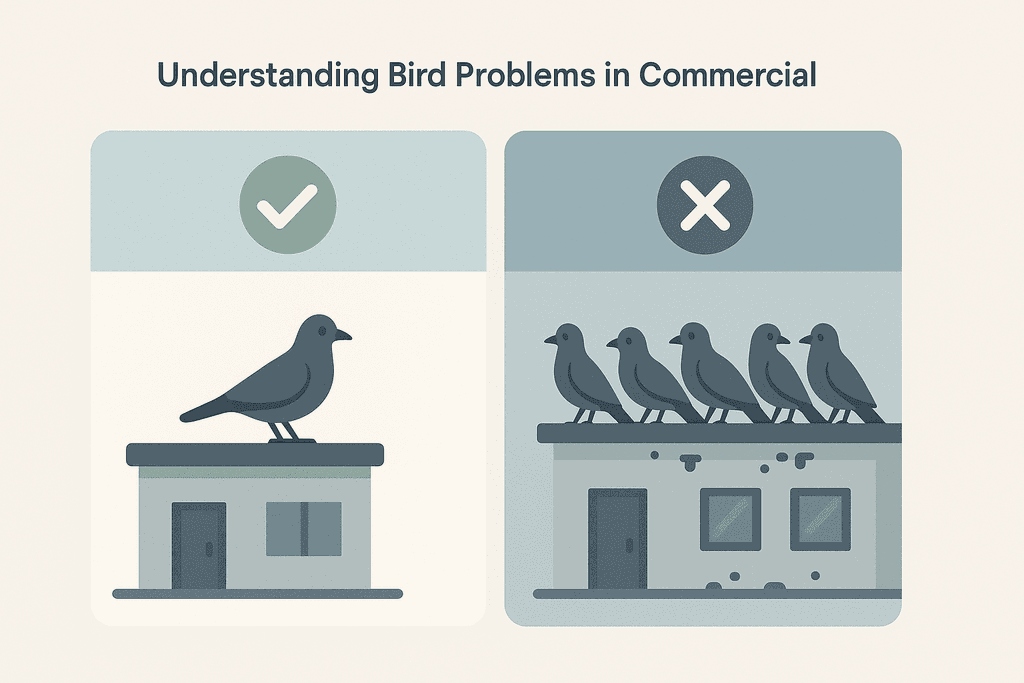
Minor Presence Versus Full Infestation
Knowing the difference between a minor bird issue and a full-blown infestation helps you decide when to call for professional help. What starts as a couple of pigeons on your roof can turn into a health hazard affecting your employees and customers within just a few months.
Signs of Minor Bird Presence vs. Serious Infestation
| Minor Bird Presence | Serious Infestation |
|---|---|
| A few birds roosting occasionally | Flocks of 20+ birds present daily |
| Small amounts of droppings in isolated areas | Heavy accumulation of droppings on walkways, vehicles, and equipment |
| No visible nesting materials | Multiple active nests in vents, ledges, or roof areas |
| Birds leave when approached | Birds are aggressive and defend territory |
| No odor or health concerns | Strong ammonia smell from droppings, visible parasites |
| Occasional bird calls or noise | Constant noise disrupting business operations |
The jump from minor to serious happens faster than most people expect. Birds reproduce quickly, and once they establish nesting sites, they return year after year. Traditional DIY methods like plastic owls or noise makers might work for a day or two, but birds quickly learn these aren't real threats.
Why DIY Methods Fail for Commercial Properties
Property managers often try handling bird problems themselves before calling professionals. The problem is that commercial buildings are too large and complex for simple solutions to work long-term. A fake owl might scare birds from one ledge, but they'll just move to another part of your building.
- Store-bought deterrents cover too small an area for commercial-sized buildings
- Birds adapt quickly to stationary scare devices within days
- Cleaning droppings without proper equipment spreads disease-causing particles
- Missing even one entry point allows birds to continue nesting inside your building
Companies like Terminix and other pest control services might offer basic bird deterrent installation, but they often lack the specialized wildlife expertise needed for humane, long-term solutions. The difference between temporary fixes and permanent protection comes down to understanding bird behavior and using comprehensive exclusion methods that address every potential entry point and roosting area on your property.
Property Damage Birds Cause to Commercial Buildings
A single pigeon produces about 25 pounds of droppings each year, and when you have dozens or hundreds roosting on your Fort Worth commercial property, the damage adds up fast. Birds might seem harmless at first, but their presence can cost businesses thousands of dollars in repairs and maintenance. The acidic nature of bird droppings eats away at building materials, creating problems that only get worse over time. What starts as a few birds on your roof can quickly turn into a serious financial burden that affects your bottom line.

Property Damage Birds Cause to Commercial Buildings
The corrosive droppings are probably the biggest threat to your building's structure. They contain uric acid that literally dissolves roofing materials, paint, and metal surfaces. Your HVAC systems are especially vulnerable since birds love to roost near these warm areas.
- Blocked gutters and drainage systems create water backup that seeps into walls and foundations
- Nesting materials in vents and electrical areas become serious fire hazards
- Contaminated inventory in warehouses and storage facilities leads to product loss
- Damaged signage and facades hurt your business's professional appearance
- Corroded metal structures require expensive replacement rather than simple repairs
Fort Worth businesses have reported repair costs ranging from $5,000 to $50,000 depending on how long the bird problem went unaddressed. One local warehouse discovered that birds nesting in their loading dock area had damaged over $15,000 worth of packaged goods in just three months.
Health and Safety Risks Birds Bring to Your Business
Bird droppings carry more than 60 different diseases that can affect humans, and that's not something any business owner wants to deal with. Histoplasmosis, cryptococcosis, and psittacosis are just a few of the serious health conditions linked to bird waste. When droppings dry out, they become airborne dust that employees and customers breathe in without even knowing it. The health risks extend beyond just the droppings too, since birds carry mites, ticks, and other parasites that can infest your building.

Health and Safety Risks Birds Bring to Your Business
Restaurants and food processing facilities face the strictest consequences. Health inspectors can shut down operations immediately if they find evidence of bird contamination. Healthcare facilities also face serious violations since patient safety is the top priority.
The liability issues get complicated fast when someone gets hurt because of birds on your property. Slip and fall accidents from bird droppings on walkways and entrances are more common than you'd think. Fresh droppings are slippery, and dried ones create uneven surfaces that people trip over.
Your insurance premiums might increase if you have repeated incidents related to bird problems. Some policies don't even cover damage from wildlife infestations if the problem was left unaddressed for too long. Business owners in Fort Worth have learned this the hard way after filing claims.
Professional Bird Control Solutions That Actually Work
Getting rid of birds isn't as simple as shooing them away or putting up a few fake owls. Birds are protected by federal and state regulations, which means you can't just remove them however you want. Professional bird control requires a systematic approach that addresses the root cause of the problem, not just the symptoms. Wildlife X Team starts with a detailed property inspection to understand exactly what's attracting birds to your building and where they're getting in.
The inspection process reveals things most property owners never notice. Small gaps in roofing, damaged vents, and architectural features that create perfect nesting spots all get documented. This Wildlife Inspection Report becomes the roadmap for creating a customized solution for your specific property.
Humane removal comes next, and it's done in compliance with all regulations. Different bird species require different approaches, and timing matters too since nesting seasons have special protections. The goal is to relocate the birds without harming them while making sure they don't come back.
- Bird netting creates physical barriers in loading docks and warehouse areas
- Spike systems prevent roosting on ledges and beams without hurting the birds
- Vent guards keep birds out of HVAC systems and exhaust areas
- Sealing and caulking close off entry points in building exteriors
- Specialized cleanup removes contaminated materials safely
The cleanup phase is just as important as the removal. Bird droppings and nesting materials need proper sanitization to eliminate health risks. Wildlife X Team handles the disinfection process and repairs any damage caused by the infestation. This includes replacing contaminated insulation and fixing structural issues.
Long-term prevention is where most DIY solutions fail. Putting up a few deterrents might work for a week or two, but birds are persistent and smart. They'll find new ways to access your property if all the vulnerabilities aren't addressed. A comprehensive approach looks at your entire building and creates multiple layers of protection.
Commercial properties need solutions that won't interfere with daily operations. The installation of exclusion devices happens on a schedule that works for your business. Wildlife X Team's renewable lifetime warranty means you're protected against future bird invasions, which gives you one less thing to worry about as a property owner.
Why Fort Worth Businesses Choose Professional Bird Control
Most business owners who try DIY bird control end up spending more money in the long run than if they'd called professionals from the start. The initial cost of netting, spikes, or deterrent devices seems reasonable until you factor in the time spent installing them incorrectly, the replacement costs when birds find workarounds, and the potential fines from accidentally violating wildlife protection laws. Professional services like Wildlife X Team's approach might have a higher upfront cost, but they eliminate the cycle of failed attempts and wasted resources that plague most do-it-yourself efforts.
The Real Cost of DIY Bird Control
When you break down what DIY bird control actually costs, the numbers tell a different story than the price tags at hardware stores suggest. Property managers often don't account for hidden expenses that add up quickly.
- Multiple trips to purchase different products as birds adapt to each deterrent method
- Staff time diverted from core business operations to install and maintain bird control measures
- Potential liability if DIY methods harm protected bird species or violate local ordinances
- Ongoing cleanup costs for droppings and nesting materials that ineffective solutions fail to prevent
- Lost business from customers who notice persistent bird problems despite visible control attempts
What Professional Services Actually Deliver
Professional bird control goes beyond just installing deterrents. Companies that specialize in wildlife management bring expertise that prevents the costly mistakes most business owners make when handling bird problems themselves.
- Legal compliance with federal and state wildlife protection laws that many business owners don't even know exist
- Proper identification of bird species and their specific behaviors to choose the most effective control methods
- Access to commercial-grade materials and installation techniques that actually work long-term
- Comprehensive property assessments that identify all current and potential entry points
The Warranty Advantage
Wildlife X Team's Renewable Lifetime Warranty represents something DIY approaches can never offer. If birds find a way back onto your property, professionals return to fix the problem at no additional cost. This guarantee means business owners can budget accurately without worrying about surprise expenses when bird problems resurface.
The warranty also protects your business reputation. When customers see birds roosting on your building or droppings near entrances, they form immediate negative impressions about your property's cleanliness and management. Professional solutions with backing warranties ensure these problems stay solved, preserving the professional image that took years to build.
Comparing Your Options
The choice between handling bird control yourself or hiring professionals comes down to understanding what each approach actually delivers. Here's what the comparison looks like when you factor in all the real-world considerations that affect Fort Worth commercial properties.
DIY Bird Control Approach
Advantages:
- Lower immediate out-of-pocket costs for basic deterrent products
- Flexibility to attempt solutions on your own timeline
- Sense of control over the process and methods used
Disadvantages:
- No guarantee of effectiveness, leading to repeated purchases of different products
- Risk of violating wildlife protection laws without realizing it
- Time-consuming trial and error that pulls focus from running your business
- Improper installation that birds quickly learn to bypass
- No professional assessment of why birds chose your property in the first place
- Ongoing maintenance falls entirely on your staff
Professional Bird Control Services
Advantages:
- Comprehensive property inspection identifies all problem areas at once
- Solutions backed by warranties that protect your investment
- Compliance with all local, state, and federal wildlife regulations
- Commercial-grade materials and proven installation techniques
- Ongoing support if birds return or new issues develop
- Protects business reputation by solving problems completely the first time
Disadvantages:
- Higher upfront investment compared to basic DIY products
- Requires scheduling and coordinating with service providers
Protecting Your Commercial Property Starts Now
Bird problems at commercial properties don't fix themselves. What starts as a few birds nesting near your building can quickly turn into hundreds of birds causing thousands of dollars in damage. The droppings pile up, the health risks multiply, and before you know it, you're dealing with health code violations or angry customers who don't want to walk through a mess to get to your door.
The good news is that catching these issues early makes a huge difference. Professional intervention stops small problems from becoming big disasters, and it saves you money in the long run. Waiting just means more cleanup, more repairs, and more headaches.
Wildlife X Team handles bird control for Fort Worth commercial properties with a complete approach that includes:
- Removing existing bird populations humanely
- Cleaning up contaminated areas properly
- Installing barriers to keep birds from coming back
- Providing long-term protection with our Renewable Lifetime Warranty
Most business owners don't realize how much damage birds can cause until it's already happened. The droppings eat through paint and metal, nests clog ventilation systems, and the noise drives customers away. Some companies try DIY solutions or wait too long to call for help, which usually makes things worse.
If you're seeing birds gathering around your Fort Worth commercial property, now's the time to do something about it. The longer you wait, the more established they become and the harder they are to remove.
Common Questions About Commercial Bird Control
Business owners in Fort Worth deal with bird problems more often than you'd think, and they usually have similar concerns before calling for help. Getting straight answers about what to expect can make the decision a lot easier. Here are the questions we hear most often from commercial property managers and business owners dealing with unwanted birds.
How quickly can bird problems be resolved?
Most bird control projects take between one to three days depending on the size of your property and severity of the infestation. Wildlife X Team can often start work the same day or next day after your initial inspection. Simple exclusion work might be done in a few hours, while larger commercial buildings with multiple entry points need more time.
Are bird control methods safe for customers and employees?
Yes, all humane bird control methods prioritize safety for everyone on your property. We use exclusion techniques like netting, spikes, and barriers that simply prevent birds from landing or nesting without harming them. There are no toxic chemicals or dangerous traps involved. Your business can stay open during most of the work.
What happens if birds return after treatment?
Wildlife X Team offers a Renewable Lifetime Warranty on our exclusion work, which means if birds find a way back in, we'll come fix it at no extra cost. The warranty covers any new entry points or failures in the original barriers we installed. Most birds don't return once proper exclusion is in place because they simply can't access the areas they used before.
How much does commercial bird control cost?
Pricing varies based on your building size, the type of birds, and how extensive the problem is. A small retail shop might need just a few hundred dollars worth of work, while a large warehouse could require several thousand. The best approach is to get a free inspection and detailed estimate so you know exactly what you're paying for before any work begins.
Do bird control services disrupt business operations?
Most commercial bird control work happens outside your building or in areas away from customers. We schedule around your business hours when possible and work quickly to minimize any disruption. Many Fort Worth businesses stay fully operational during the entire process.
What bird species are protected by law in Texas?
Most native bird species in Texas are protected under the Migratory Bird Treaty Act, which means you can't harm them or destroy active nests with eggs or babies. Pigeons, starlings, and house sparrows are the main exceptions and can be removed year-round. Professional wildlife removal companies know these regulations and handle everything legally, so you don't have to worry about accidentally breaking federal or state laws.