
Bat Removal in Fort Worth for Attics, Roosts, and Exclusion
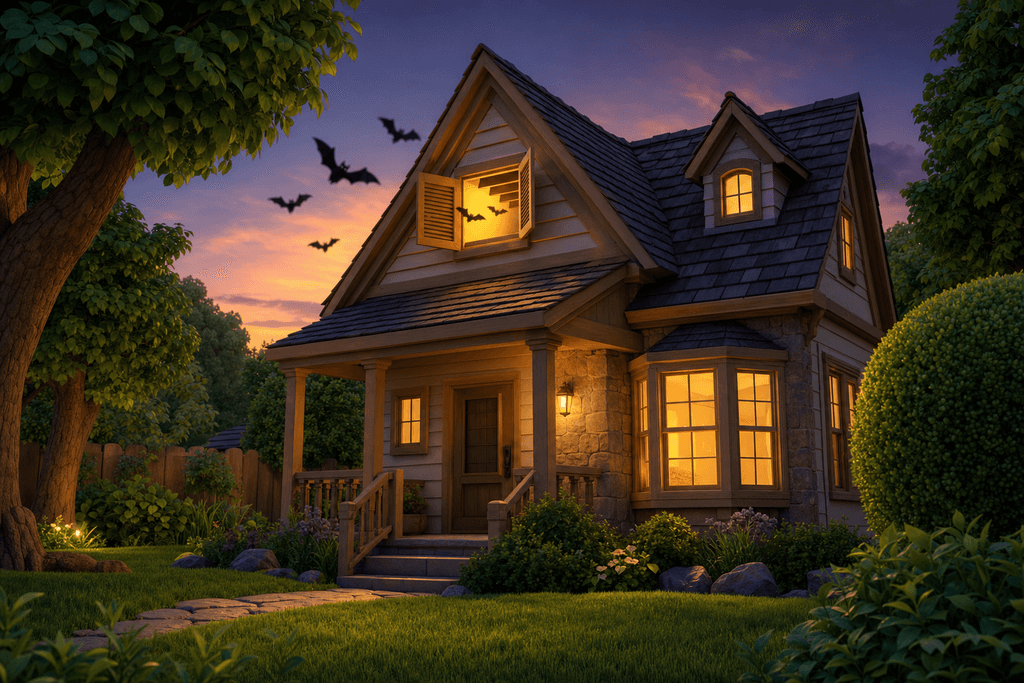
Bats can squeeze through openings as small as a quarter inch, which means your Fort Worth attic might already be hosting a colony without you even knowing it. The warm Texas climate and abundance of older homes with accessible entry points make our area a prime target for bat infestations that can quickly spiral out of control. Understanding why these nocturnal visitors choose local attics and how to safely remove them is the first step toward protecting your home and family from the health risks they bring.
Table of Contents
- Understanding Bat Behavior in North Texas
- Signs You Have Bats in Your Attic
- The Professional Bat Exclusion Process
- Attic Cleanup and Restoration After Bat Removal
- Permanent Bat Prevention and Exclusion
- Why Professional Bat Removal Protects Your Investment
- Getting Started with Bat Removal in Fort Worth
- Common Questions About Bat Removal
Understanding Bat Behavior in North Texas
Fort Worth sits right in the middle of one of the largest bat migration routes in North America. Every spring, millions of bats fly through Texas looking for the perfect place to raise their babies. Your attic might look like just another storage space to you, but to a pregnant bat, it's prime real estate. The warm, dark environment provides exactly what these flying mammals need to survive and reproduce.
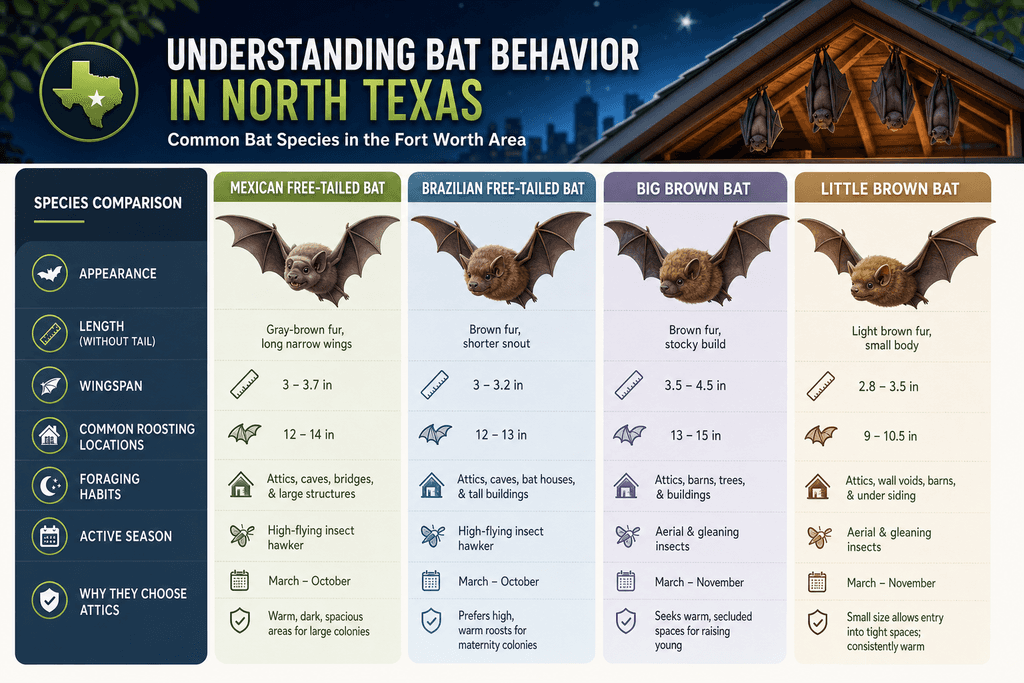
Common Bat Species in the Fort Worth Area
The Mexican free-tailed bat makes up about 90% of all bat problems in Fort Worth homes and businesses. These small brown bats weigh less than half an ounce but can cause serious damage when they move into your attic in groups of dozens or even hundreds. Other species like evening bats and big brown bats also show up occasionally, but they're much less common.
Here's what makes each species different:
- Mexican free-tailed bats are small, fast flyers that form large colonies and prefer high roosts
- Evening bats are slightly larger and typically roost in smaller groups of 20-50 individuals
- Big brown bats are the largest common species and often roost alone or in pairs
- All three species eat insects and hunt at night, consuming thousands of mosquitoes and moths
Why Bats Choose Your Attic
Bats don't need much space to get inside your home. A gap as small as three-eighths of an inch is enough for a full-grown bat to squeeze through. They look for openings around roof vents, chimney caps, fascia boards, and where different building materials meet. Once one bat finds a good entry point, it'll come back year after year, and it'll bring friends.
The temperature inside your attic stays warmer than outside, which is perfect for raising baby bats. Female bats need this warmth because their pups can't regulate their own body temperature for the first few weeks of life.
- Attics provide protection from predators like hawks, owls, and snakes
- The dark environment mimics natural cave conditions that bats prefer
- Nearby water sources and insect populations make Fort Worth ideal for bat feeding
- Undisturbed spaces allow colonies to grow without human interference
Maternity Season and Legal Restrictions
From May through August, bat removal fort worth services face strict limitations because of maternity season. During these months, female bats give birth and raise their flightless pups in your attic. Texas law protects these baby bats, which means exclusion work cannot happen until the pups can fly on their own. This is why Wildlife X Team and other bat removal companies in the area schedule most exclusion work for fall and winter months.
Baby bats take about six to eight weeks to learn how to fly. If you seal up your attic while flightless pups are still inside, they'll die and create an even worse problem. The smell of decomposing bats is incredibly difficult to remove, and it attracts other pests.
- Maternity colonies can include 50 to 500 female bats in a single attic
- Each female typically gives birth to one pup per year
- Pups become independent and can fly by late August or early September
- Adult bats will abandon a roost if it becomes too disturbed during maternity season
- Professional bat removal services conduct inspections year-round but time exclusion work appropriately
The Homing Instinct Problem
Bats have an incredibly strong homing instinct. Research shows that bats can find their way back to the same roost from over 100 miles away. This means that simply removing the bats without proper exclusion work is completely pointless. They'll just come back within a few days or weeks. That's why companies like Wildlife X Team focus on exclusion services rather than just removal.
The bats in your attic right now probably aren't there by accident. If your home has hosted bats before, the scent markers and familiar entry points make it a target for future colonies. Permanent exclusion is the only real solution to keep bats from returning season after season.
Signs You Have Bats in Your Attic
Bats are surprisingly quiet houseguests, which means many Fort Worth homeowners don't realize they have a problem until the colony has grown significantly. Unlike raccoons or squirrels that make loud thumping noises, bats create subtle sounds that are easy to miss during the day. The key is knowing what to look and listen for, especially during those twilight hours when bats are most active. Most people first notice something's wrong when they hear faint scratching or high-pitched squeaking sounds coming from their attic around dusk or dawn.
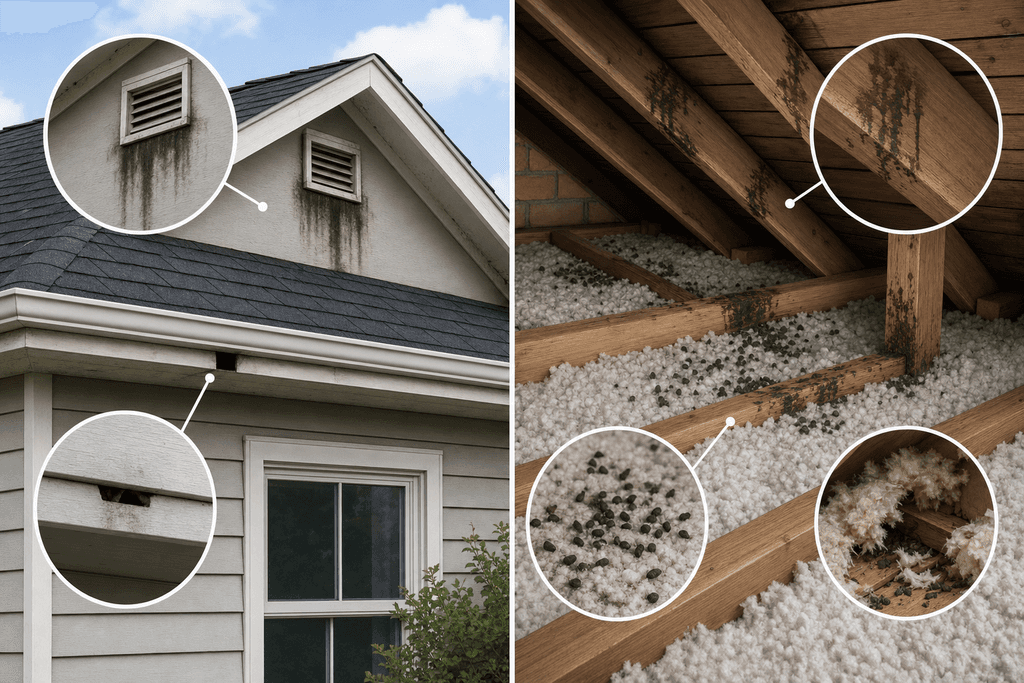
Beyond sounds, there are several visual clues that point to a bat problem. You might spot dark, greasy stains around small openings in your roof, fascia, or soffits where bats squeeze through repeatedly, leaving behind body oils.
- Scratching or squeaking sounds at dusk and dawn when bats are entering or leaving
- Dark stains around entry points from body oils that accumulate over time
- Accumulation of guano (bat droppings) in your attic or piled up around your home's exterior
- Strong ammonia smell from urine buildup that gets worse as the colony grows
- Visible bats flying around your home at sunset, especially near the roofline
The smell is often what finally drives people to call for help. Bat urine creates a sharp ammonia odor that can seep into living spaces below the attic. If you're noticing any combination of these signs around your Fort Worth property, you likely have bats that need professional attention.
Bat Infestation Warning Signs Checklist
- Listen for scratching or squeaking between sunset and sunrise
- Check roof edges and vents for dark staining
- Look for small black droppings that crumble when crushed
- Notice any strong ammonia odors in upper floors
- Watch your roofline at dusk for bat activity
- Inspect attic spaces for guano accumulation
The Professional Bat Exclusion Process
Bat removal isn't like dealing with other wildlife because you can't just trap and relocate them. Texas law protects bats, and the only legal method is exclusion, which means letting them leave on their own while preventing their return. This process requires careful planning and precise execution to work properly. Wildlife X Team starts every bat removal project with a thorough inspection to identify every single entry point, because missing even one small gap means bats can get back in.
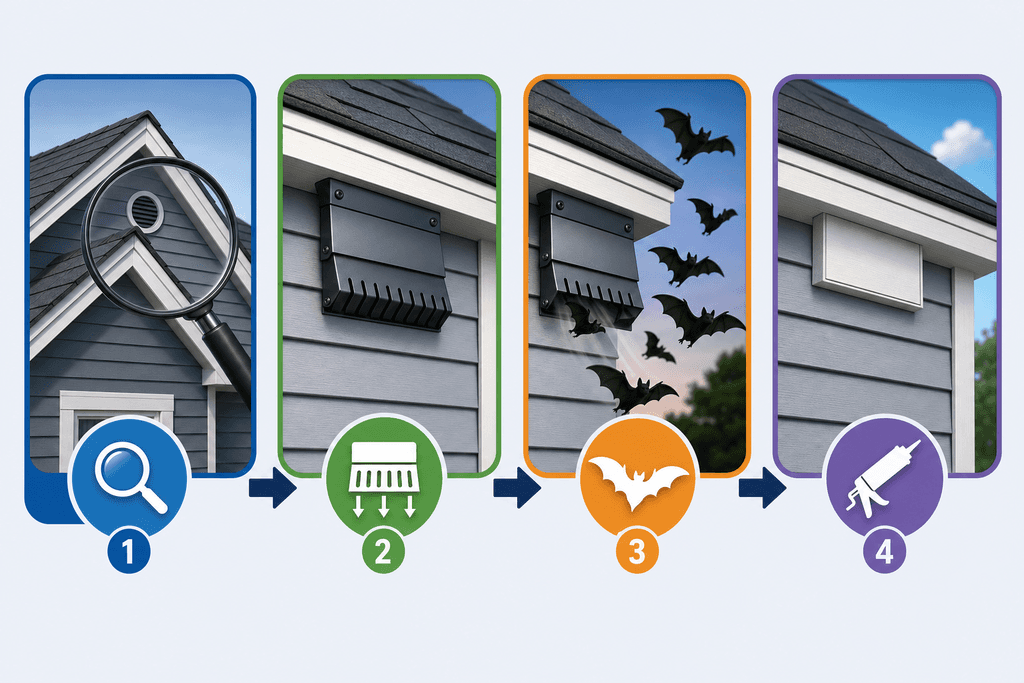
The inspection reveals where bats are roosting and how they're getting inside. Bats only need an opening about 3/8 of an inch to squeeze through, which is roughly the width of a dime.
- Initial inspection identifies all entry points and roosting areas throughout your attic
- One-way exclusion devices are installed that allow bats to leave but not return
- Timing is critical to avoid trapping young bats during maternity season (May through August)
- All entry points sealed after bats have completely vacated the space
- Humane methods that comply with Texas wildlife laws protect both bats and property
- Process typically takes 3-7 days depending on colony size and weather conditions
The exclusion devices are the real trick to this whole process. They're designed as one-way exits that bats can push through when leaving to feed at night, but can't figure out how to get back through. After several nights, once all bats have left and aren't returning, the team at Wildlife X Team seals every opening permanently.
Success Rate: Professional exclusion methods have a 98% success rate when all entry points are properly sealed. The typical exclusion timeline is 3-7 days, though larger colonies may require up to two weeks for complete evacuation.
Attic Cleanup and Restoration After Bat Removal
Getting the bats out is only half the job. What they leave behind can be a serious health hazard that needs professional attention. Bat guano isn't just unpleasant, it can contain histoplasmosis spores that cause respiratory illness in humans when disturbed and inhaled. This fungal disease can be particularly dangerous for children, elderly people, and anyone with compromised immune systems. The ammonia from bat urine also soaks into insulation and wood, creating odors that linger for years if not properly addressed.
Professional cleanup requires protective equipment and proper disposal methods that most homeowners don't have access to. You can't just sweep up bat droppings and call it done.
- Bat guano contains histoplasmosis spores that cause respiratory illness when inhaled
- Professional cleanup requires protective equipment and proper disposal to prevent exposure
- Contaminated insulation must be removed and replaced since it can't be effectively cleaned
- Attic surfaces need thorough disinfection and deodorization to eliminate pathogens and odors
- Wildlife X Team provides complete attic restoration services from cleanup through insulation replacement
- Proper cleanup prevents lingering odors that can attract new bats or other wildlife
The restoration process involves removing all contaminated insulation, vacuuming up droppings with specialized equipment, and treating all surfaces with professional-grade disinfectants. New insulation is then installed to restore your attic's energy efficiency.
DIY Cleanup vs Professional Restoration
DIY Approach: Risks exposure to histoplasmosis, incomplete removal of contamination, improper disposal of hazardous waste, lingering odors, and potential legal issues with waste disposal.
Professional Service: Proper safety equipment, complete contamination removal, legal disposal methods, thorough disinfection, odor elimination, and insulation replacement that restores energy efficiency.
Permanent Bat Prevention and Exclusion
Once your attic is bat-free and cleaned up, the final step is making sure they never come back. This means addressing every possible entry point and weak spot in your home's exterior. Bats are persistent and will test your roofline repeatedly looking for ways back in, especially if they've roosted there before. The good news is that proper exclusion work, when done right, can keep bats out permanently.
The exclusion process focuses on sealing all openings larger than 3/8 inch since that's all the space a bat needs to enter. This includes obvious spots like vents and chimneys, but also less obvious areas like gaps where different building materials meet.
- Seal all openings larger than 3/8 inch to prevent bat entry through even tiny gaps
- Install vent guards and chimney caps as physical barriers that allow airflow but block wildlife
- Repair damaged fascia, soffits, and roof edges where gaps commonly develop over time
- Trim tree branches that provide easy roof access within six feet of your roofline
- Wildlife X Team offers renewable lifetime warranty on exclusion work for long-term protection
- Regular inspections catch new vulnerabilities before bats return to your property
Wildlife X Team serves the entire Fort Worth area from their location at 11833 Katy Rd in Keller, covering communities like Southlake, Grapevine, and Denton. Their renewable lifetime warranty means if bats find a way back in through their exclusion work, they'll come back and fix it at no additional cost.
Real Results from Fort Worth
"We had a squirrel party in our attic. They came out to give an estimate and got to work on the spot. One entry point was obvious and I'd considered closing it up myself, but they found a couple of others I never would have. Great, quick work, and no squirrels, now months later." - Jesse Bernard. This same thorough approach applies to bat exclusion work, where finding every entry point makes the difference between success and bats returning.
Why Professional Bat Removal Protects Your Investment
Most homeowners don't realize that attempting bat removal fort worth on their own can actually make the problem worse and cost thousands more in the long run. The difference between a successful bat exclusion and a nightmare scenario often comes down to understanding the legal requirements and biological behavior of these protected animals. Texas law specifically prohibits bat exclusion during maternity season from May through August, which means timing your removal incorrectly could result in hefty fines or trapped baby bats dying in your walls. Professional services like Wildlife X Team at 11833 Katy Rd in Keller understand these regulations and plan exclusions accordingly to stay compliant while solving your problem.
The Hidden Costs of DIY Bat Removal
When you look at the price of exclusion materials at a hardware store, DIY bat removal seems like an obvious money saver. But the reality tells a different story that most people only discover after their first failed attempt.
- DIY exclusion materials typically cost $150-300 but miss secondary entry points that professionals identify
- Improper sealing can trap bats inside, forcing them into living spaces through vents and ducts
- Guano cleanup without professional-grade respirators exposes you to histoplasmosis spores
- Failed DIY attempts often require professional intervention anyway, doubling your total cost
- No warranty means you pay again when bats return through missed entry points
Health Risks That Require Professional Protection
Bat guano contains fungal spores that become airborne when disturbed, and breathing these spores can cause serious respiratory infections that require medical treatment. The protective equipment needed for safe cleanup costs more than most homeowners want to invest for a single use.
- Professional respirators with HEPA filters cost $200-400 for proper protection
- Full-body protective suits and gloves are necessary to prevent skin contact
- Contaminated insulation must be removed and disposed of following specific protocols
- Disinfection requires commercial-grade products not available at retail stores
Why Warranties Matter for Long Term Protection
The biggest advantage professional bat removal fort worth services offer isn't just the initial exclusion work. Wildlife X Team provides a renewable lifetime warranty that covers future intrusions, something no DIY approach can match. When bats find a new entry point six months later, you're covered without paying again.
- Professional inspections identify all potential entry points, not just the obvious ones
- Certified technicians understand bat behavior and common re-entry attempts
- Warranty coverage means free return visits if bats find new access points
- Documentation of work performed protects your home's resale value
Getting Started with Bat Removal in Fort Worth
Dealing with bats in your attic isn't something you want to put off until next month or next season. The longer a colony stays in your home, the more damage they cause and the harder they become to remove. What starts as a few bats can quickly turn into dozens, and the guano buildup can create serious health risks for your family. Professional bat removal in Fort Worth addresses the problem at its source rather than just chasing bats around your attic with a broom.
The truth is that DIY bat removal rarely works because bats can squeeze through openings as small as a quarter inch. You might seal one hole and miss three others that you didn't even know existed. Wildlife X Team handles everything from the initial inspection to the final warranty, which means you're not left guessing whether the problem is actually solved.
Our team serves the entire Fort Worth area, including Keller, Denton, Southlake, Grapevine, and surrounding communities. We use humane exclusion methods that let bats leave but prevent them from getting back in. The process includes sealing entry points, cleaning contaminated areas, and making sure your attic is protected long-term.
If you're hearing scratching sounds at dusk or noticing dark stains on your walls, those are signs you need help now. You can reach Wildlife X Team at (817) 799-8686 to schedule an inspection. The sooner you address a bat problem, the less damage you'll have to repair and the lower your overall costs will be.
Common Questions About Bat Removal
Dealing with bats in your attic brings up a lot of questions, especially if it's your first time facing this problem. Most homeowners want to know what they're getting into before they call for help. The good news is that bat removal is a pretty straightforward process when you work with professionals who know what they're doing. Here are the answers to the most common questions we hear from Fort Worth homeowners.
How much does bat removal cost in Fort Worth?
The cost of bat removal Fort Worth services typically ranges from $300 to $1,500, depending on the size of your home and how many entry points need to be sealed. Larger infestations or homes with multiple access points will cost more because they require more materials and labor. Wildlife X Team provides detailed inspections through our Wildlife Inspection Report® so you know exactly what needs to be done before any work starts, which means no surprise charges later.
When is the best time to remove bats from my attic?
The best time for bat removal is between August and mid-May in Texas. From mid-May through July, bat removal is restricted because this is maternity season when baby bats can't fly yet. Removing adult bats during this time would trap the babies inside, which is both inhumane and illegal under wildlife protection laws.
Are bats dangerous to my family?
Bats themselves rarely attack people, but they do carry diseases like rabies and histoplasmosis. The bigger health risk comes from their droppings, which can grow fungus that causes respiratory problems when the spores become airborne. That's why professional attic cleanup and restoration is so important after bats are removed, not just the exclusion work itself.
How long does the bat exclusion process take?
Most bat exclusion projects take 1-3 days for the initial installation of one-way doors and sealing of entry points. However, the one-way devices need to stay in place for about a week to make sure all bats have left. After that, we return to remove the devices and seal the final openings permanently.
Will bats come back after removal?
Bats won't return if all entry points are properly sealed, which is why exclusion work needs to be thorough. Some companies just focus on the obvious holes, but bats can squeeze through openings as small as 3/8 of an inch. Our team seals every potential entry point and backs it up with a Renewable Lifetime Warranty, so you're covered if any issues come up down the road.
Does homeowners insurance cover bat damage?
Most standard homeowners insurance policies don't cover bat removal or the damage they cause because it's considered a preventable maintenance issue. Some policies might cover structural damage if it happened suddenly, but you'll need to check your specific policy. The cleanup and restoration costs almost always fall on the homeowner, which is why catching the problem early saves money in the long run.