
Bat Removal in Denton TX What Homeowners Need to Know

Strange scratching sounds in your attic at dusk might seem harmless, but a single bat colony can deposit 30 pounds of toxic guano in your Denton home in just six months. Bats find North Texas homes particularly inviting thanks to our warm climate and older architecture with plenty of small entry points. Understanding why bats choose Denton properties and what makes professional bat removal denton tx services essential can protect both your family's health and your home's structural integrity.
Why Bats Choose Denton Homes
Denton's unique combination of climate, architecture, and geography creates the perfect environment for bat colonies to thrive. The warm Texas summers and mild winters mean bats can remain active longer than in northern states, and they need safe roosting spots to raise their young during maternity season from May through August. Your attic provides exactly what they're looking for: a dark, warm space with minimal disturbance where temperatures stay consistent. Older homes in established Denton neighborhoods are especially vulnerable because settling foundations and aging construction materials create the small gaps bats need to squeeze inside.
Bats can fit through openings as small as three-eighths of an inch, which is roughly the diameter of a dime. This means that tiny cracks around your roofline, gaps where utility lines enter your home, or loose soffit vents all become potential entry points. Once a few bats discover your attic, they communicate the location to others through scent marking and vocalizations that humans can't hear.
The health risks from bat guano accumulation are serious and shouldn't be ignored. Histoplasmosis, a respiratory disease caused by fungus in bat droppings, can develop when disturbed guano releases spores into the air you breathe. Beyond the health concerns, bat urine soaks into insulation and wooden structures, creating permanent odors and potentially compromising your home's structural integrity over time. Wildlife X Team, located at 11833 Katy Rd in Keller, TX, serves Denton and surrounding areas with humane bat removal that addresses both the immediate infestation and the underlying entry points.
The longer a bat colony remains in your home, the more damage accumulates and the harder removal becomes. Female bats return to the same roosting sites year after year to give birth, so a small problem this season can become a major infestation next year. Professional removal isn't just about getting the bats out—it's about understanding their behavior patterns, identifying every potential entry point, and implementing exclusion methods that keep them out permanently while complying with wildlife protection laws.
Table of Contents
Understanding Bat Behavior in North Texas
Denton sits right in the middle of one of the most active bat corridors in Texas, which means homeowners here deal with bat problems more often than they might think. The mix of urban neighborhoods and nearby rural areas creates the perfect setup for bats looking for a place to roost. These flying mammals aren't trying to be pests, they're just looking for warm, dark spaces that remind them of caves, and your attic fits the bill perfectly.
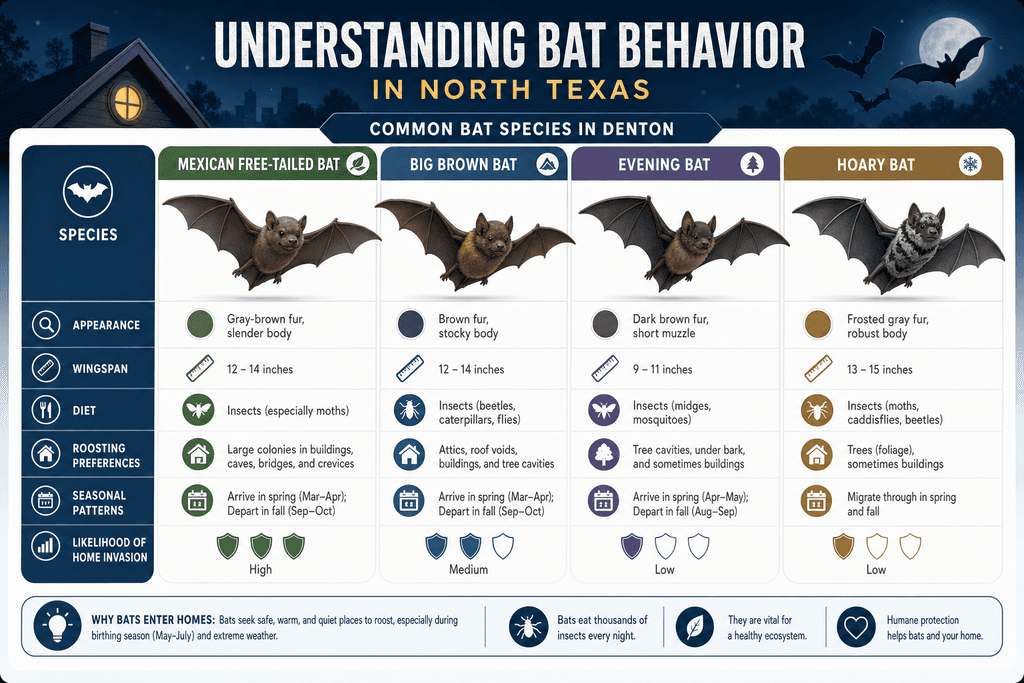
Common Bat Species in Denton Homes
Two main types of bats cause most of the headaches for Denton homeowners. The Mexican free-tailed bat is the most common visitor, and you've probably seen huge groups of them flying around at dusk during summer months. Evening bats are the other frequent guests, and they tend to be quieter about moving in.
Here's what makes each species different when they decide to move into your home:
Denton Area Bat Species Comparison
- Mexican Free-Tailed Bat: Small brown body (3-4 inches), forms large colonies of 100+ bats, prefers high attic spaces and chimneys, very noisy with chattering sounds, leaves strong ammonia smell from droppings
- Evening Bat: Reddish-brown color (3-3.5 inches), smaller groups of 20-50 bats, likes tight wall voids and soffits, quieter than free-tails, less odor but still messy
- Big Brown Bat: Larger size (4-5 inches), solitary or small groups under 10, roosts in attics and barns, occasional visitor in Denton, louder vocalizations when present
Seasonal Patterns That Affect Removal
Timing matters a lot when dealing with bat removal in Denton TX, and it's not just about convenience. Bats follow strict seasonal patterns that actually determine when removal can legally happen. From mid-May through July, female bats give birth to pups that can't fly yet, and Texas law protects them during this maternity season.
The best times for bat removal work are:
- Early spring (March-April) before maternity season starts
- Late summer and fall (August-October) after pups can fly
- Winter months (November-February) when bats are less active
Wildlife X Team works around these natural cycles to remove bats humanely while staying within legal guidelines. We can't just kick bats out whenever it's convenient because that could leave baby bats trapped inside to die.
Why Denton Attracts Bat Populations
Denton's location makes it a bat magnet for several reasons. The city has grown fast over the past twenty years, but there are still plenty of wooded areas, creeks, and open spaces nearby. Bats love this setup because they can hunt insects over the water and fields, then fly back to roost in warm attics.
Local factors that bring bats to Denton homes include:
- Lewisville Lake and smaller water bodies that attract insects
- Older homes with gaps in soffits, vents, and rooflines
- Large trees that provide temporary roosting spots
- Warm Texas climate that supports year-round bat activity
Legal Protections Homeowners Must Know
Texas doesn't mess around when it comes to bat protection laws, and homeowners need to understand the rules before trying any DIY removal. All bat species in Texas are protected, which means you can't harm them, use poison, or seal them inside your home. The penalties for breaking these laws can include serious fines.
Here's what the law says you can and can't do:
- You cannot kill bats or use any lethal removal methods
- You must wait until after maternity season to exclude nursing mothers
- You need to use one-way exclusion devices that let bats leave but not return
- Professional removal services must follow state wildlife guidelines
Many national companies like Terminix and local competitors such as Critter Control offer bat services, but not all of them specialize in the humane exclusion methods required by Texas law. Some Denton homeowners have learned this the hard way after hiring the wrong company and facing legal issues or incomplete removal jobs that let bats return within weeks.
Recognizing the Warning Signs of Bat Infestation
Bats can squeeze through openings as small as 3/8 of an inch, which means your Denton home might have unwanted guests without you even realizing it at first. Most homeowners don't discover they have a bat problem until the colony has already established itself in the attic or walls. The good news is that bats leave behind plenty of clues if you know what to look for. Catching these signs early can save you thousands of dollars in damage and protect your family's health.
The most obvious clue comes from sounds at dusk and dawn. If you hear scratching, squeaking, or high-pitched chirping coming from your attic or walls during these times, you likely have bats. These noises happen when the colony is most active, either preparing to leave for the night or returning before sunrise.
- Guano accumulation in your attic or near entry points (looks like small dark pellets)
- Urine stains on walls or ceilings that appear as brownish streaks
- Grease marks around potential entry points from bat fur oils
- Strong ammonia smell that gets worse over time as waste builds up
- Bats flying around your home at sunset, especially near the roofline
Visual evidence often appears before you ever see an actual bat. The grease marks near entry points come from the natural oils in bat fur rubbing against your home's surfaces as they enter and exit. These marks typically appear around small gaps in fascia boards, under roof tiles, or near chimney openings.
During an attic inspection, you might find piles of guano that look similar to mouse droppings but crumble into dust when touched. The smell is usually what homeowners notice first though. That strong ammonia odor from accumulated bat waste can seep into living spaces below, and it only gets worse as the colony grows.
Bat Infestation Warning Signs Checklist
- Listen for scratching or squeaking sounds at dusk and dawn
- Check attic for guano droppings and urine stains
- Look for grease marks around roof gaps and vents
- Notice any strong ammonia smells in upper floors
- Watch for bats flying near your home at sunset
- Inspect fascia boards and chimney areas for entry points
- Check insulation for contamination or displacement
Health Risks and Property Damage from Bat Colonies
A single bat colony can produce enough guano in one season to completely destroy your attic insulation. But the property damage is actually the least of your worries when it comes to bats living in your Denton home. The health risks associated with bat infestations are serious enough that professional removal becomes necessary, not optional.
Histoplasmosis is the biggest health concern for homeowners dealing with bat guano. This fungal disease develops in accumulated bat droppings and becomes airborne when the material is disturbed. Once you breathe in these spores, they can cause severe respiratory problems that feel like a bad flu at first but can lead to serious lung infections.
This video covers the complete bat removal process and why professional help matters for your safety. Beyond histoplasmosis, bats can carry rabies, though transmission is rare. The real problem is that any contact with a bat requires immediate medical evaluation and potentially expensive rabies treatment protocols.
- Bat bugs, mites, and fleas that infest your living spaces after feeding on bats
- Insulation destruction from urine saturation and guano accumulation
- Wood rot in structural beams from moisture and waste
- Ceiling stains that require complete drywall replacement
- Electrical hazards when urine corrodes wiring in attic spaces
The property damage adds up faster than most homeowners expect. Bat urine doesn't just stain, it actually eats through wood and drywall over time. Insurance companies often won't cover bat damage because it's considered a maintenance issue that should have been prevented. Your home's value can drop significantly if bat damage shows up during inspections.
Professional Bat Removal Process and Timeline
Bat removal isn't something you can handle over a weekend with a trip to the hardware store. Texas law protects bats during their maternity season from May through August, which means timing matters as much as technique. Professional bat removal in Denton TX follows a specific process that ensures both legal compliance and complete colony elimination.
The process starts with a Wildlife Inspection Report® that identifies every entry point and estimates colony size. At Wildlife X Team, we serve Denton from our location at 11833 Katy Rd in Keller, and we've learned that most homes have multiple entry points that homeowners never noticed. Bats don't need much space to get inside.
- Complete property inspection to map all entry and exit points
- Assessment of colony size and species identification
- Installation of one-way exclusion devices (bat valves or cones)
- Monitoring period to ensure all bats have exited
- Permanent sealing of all entry points
- Attic cleanup and restoration services
The humane exclusion methods we use allow bats to leave but prevent them from returning. One-way valves get installed at active entry points, and bats exit naturally during their nightly feeding. This process takes time because you need to be absolutely certain every bat has left before sealing entry points permanently.
After exclusion, the real work begins with attic cleanup and restoration. Contaminated insulation gets removed, surfaces are disinfected, and damaged materials get replaced. This step protects your family from the health hazards that remain even after bats are gone. Our Renewable Lifetime Warranty covers the exclusion work, so you don't have to worry about bats finding their way back in.
Typical Bat Removal Timeline
- Day 1-2: Initial inspection and Wildlife Inspection Report®
- Week 1: Installation of exclusion devices at all entry points
- Week 2-4: Monitoring period as bats exit naturally
- Week 4-5: Permanent sealing of all access points
- Week 5-6: Attic cleanup, disinfection, and restoration
- Ongoing: Renewable Lifetime Warranty protection
Preventing Future Bat Invasions in Your Denton Home
Once you've dealt with a bat infestation, the last thing you want is a repeat performance next season. Prevention comes down to understanding that bats only need a gap the size of your thumb to access your attic. Most Denton homes have dozens of potential entry points that homeowners don't even know exist until a professional inspection reveals them.
Chimney caps and vent guards serve as your first line of defense against bat entry. These areas provide perfect access points because they're designed to allow airflow, which also makes them ideal for bats. Professional-grade guards don't restrict ventilation but completely block wildlife access.
- Seal gaps as small as 3/8 inch around fascia boards and soffits
- Install chimney caps with proper mesh sizing
- Add vent guards to all roof and gable vents
- Repair foundation cracks and gaps in exterior walls
- Maintain proper attic ventilation without creating entry opportunities
Foundation repair and fascia board maintenance might not seem related to bat prevention, but these areas develop gaps over time that bats exploit. The animal proofing services that Wildlife X Team provides address these vulnerable spots with materials designed to last decades, not just a few seasons.
Seasonal inspections matter more than most Denton homeowners realize. Your home expands and contracts with temperature changes, and new gaps can develop where none existed before. A professional inspection twice a year catches these issues before bats move in. The exclusion work we do includes sealing with materials that move with your home instead of cracking and creating new entry points.
Bat-Proofing Prevention Checklist
- Install chimney caps on all open chimneys
- Add vent guards to roof, gable, and soffit vents
- Seal all gaps larger than 3/8 inch around roofline
- Repair damaged fascia boards and trim
- Fix foundation cracks and exterior wall gaps
- Schedule seasonal inspections in spring and fall
- Maintain proper attic ventilation with protected openings
- Keep trees trimmed away from roofline
Why DIY Bat Removal Fails and Costs More
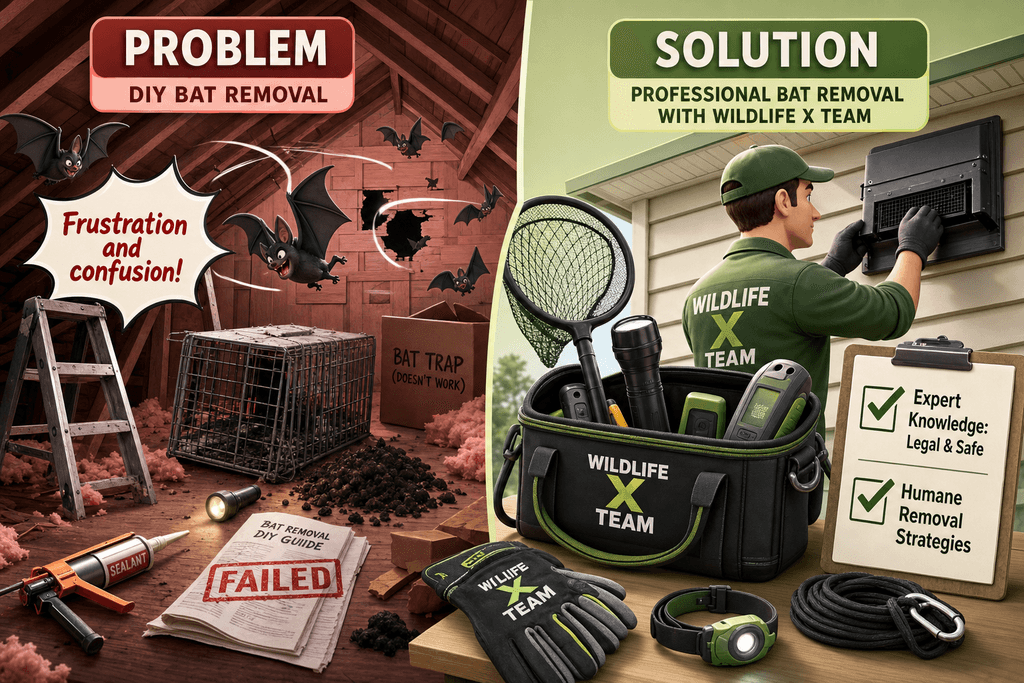
Most homeowners who try to handle bat removal in Denton TX on their own end up calling professionals anyway, but now they're out the money they spent on supplies and wasted time. The problem isn't that people are lazy or incompetent. It's that bat removal requires specific knowledge about bat behavior, legal requirements, and building construction that most people simply don't have. What seems like a simple fix turns into a costly mistake that puts your family at risk and your wallet under strain.
The Hidden Costs of Going It Alone
The financial math on DIY bat removal rarely works out in your favor. You might spend $200-400 on supplies like sealants, screens, and protective gear from the hardware store. Then you discover you sealed the bats inside during maternity season, which violates federal law and can result in fines up to $50,000 per violation.
- Legal penalties for improper removal during protected seasons can exceed tens of thousands of dollars
- Missing even one entry point means bats return within weeks
- Exposure to bat guano without proper respirators risks histoplasmosis infection
- Inadequate cleanup leaves dangerous pathogens in insulation and wood
- Failed attempts mean paying for professional service anyway, doubling your total cost
What Professionals See That You Miss
Bats can squeeze through openings as small as 3/8 of an inch. That's about the width of a dime. Wildlife X Team's inspection process identifies entry points most homeowners never notice, like gaps where different building materials meet or tiny cracks in soffit vents.
Companies like Critter Stop and Omega Animal Removal offer bat services, but the difference comes down to thoroughness and accountability. Wildlife X Team provides a detailed Wildlife Inspection Report® that maps every vulnerability in your property, not just the obvious holes you can see from the ground.
Comparing DIY Versus Professional Approach
The DIY approach seems cheaper upfront but creates expensive problems down the road. You're working without the benefit of thermal imaging to locate hidden colonies, without knowledge of local bat species and their seasonal patterns, and without the proper equipment to safely remove contaminated materials.
- DIY attempts lack legal compliance knowledge about maternity seasons and protected species
- Professional services include warranties that guarantee bats won't return
- Experts have specialized equipment like one-way exclusion devices that ensure complete removal
- Trained technicians can safely handle contaminated insulation and guano cleanup
Wildlife X Team's renewable lifetime warranty means if bats find a way back in, they return to fix it at no additional cost. That peace of mind simply doesn't exist with DIY methods where you're on your own if problems resurface.
The Real Value of Expertise
Professional bat removal in Denton TX isn't just about getting rid of bats today. It's about solving the problem permanently so you're not dealing with the same issue next spring. The inspection process finds structural vulnerabilities you didn't know existed, which protects against future wildlife intrusions of all types.
- Professionals identify secondary damage like compromised insulation and wood rot
- Expert exclusion work addresses the root cause, not just the symptoms
- Proper documentation protects you legally if issues arise
- Comprehensive cleanup eliminates health hazards DIY methods leave behind
When you factor in the cost of failed DIY attempts, potential legal fines, health risks, and the eventual need for professional service anyway, the value proposition becomes clear. Starting with experts who know bat behavior and building science saves money and protects your family from the start.
Taking Action on Your Bat Problem
Dealing with bats in your Denton home isn't something you want to put off until tomorrow. The longer they stay, the more droppings pile up in your attic, and the bigger the health risks become for your family. If you've noticed any of the warning signs we talked about, like scratching sounds at dusk, brown stains on your walls, or that unmistakable ammonia smell, it's time to get a professional inspection. These aren't problems that fix themselves, and trying to handle bat removal denton tx on your own can actually make things worse.
The good news is that humane removal is possible when you work with people who know what they're doing. Wildlife X Team serves the Denton area and handles everything from the initial inspection to sealing up every possible entry point. Our Wildlife Inspection Report identifies exactly where bats are getting in, which is something most homeowners miss when they try to solve it themselves.
What really matters is making sure those bats don't come back next season. That's where proper exclusion work comes in, along with attic cleanup to remove contaminated insulation and droppings. Some companies will remove the bats but leave you to deal with the mess and the open entry points.
If you're in Denton, Fort Worth, or anywhere in the surrounding areas, you can reach Wildlife X Team at (817) 799-8686. The team is based at 11833 Katy Rd in Keller and covers the whole region. Getting started with an inspection is the first step to getting your home back to normal and keeping it protected long-term.
Still have questions about the process or what to expect? Let's cover some of the most common things homeowners ask about bat removal.
Common Questions About Bat Removal in Denton
Dealing with bats in your home brings up a lot of questions, especially when you're trying to figure out the right way to handle the situation. Most Denton homeowners have never dealt with bat removal before, so they're not sure what to expect when it comes to costs, timing, or even what's legal. The good news is that bat removal doesn't have to be complicated once you understand the basics. Here are the answers to the most common questions we hear from homeowners in the Denton area.
How much does professional bat removal cost in Denton?
The cost of bat removal denton tx services typically ranges from $300 to $1,500 depending on the size of your colony and how many entry points need to be sealed. Smaller jobs with just a few bats might cost less, while larger infestations requiring extensive exclusion work and attic cleanup can run higher. Wildlife X Team provides a detailed Wildlife Inspection Report® to identify all entry points before giving you an accurate estimate, so you know exactly what you're paying for upfront.
When is it legal to remove bats in Texas?
Texas law protects bats during their maternity season, which runs from roughly mid-May through mid-August. During this time, you can't seal bats out because baby bats can't fly yet and would be trapped inside. The best time for bat removal is between September and April when bats aren't raising their young. If you discover bats during the restricted season, professionals can still inspect your property and prepare for exclusion work once the season ends.
How long does the bat removal process take?
Most bat exclusion work takes one to three days to complete, depending on how many entry points need to be sealed. The bats themselves usually leave within a few days to a week after one-way exclusion devices are installed. After all the bats are gone, the entry points get permanently sealed and any necessary attic cleanup can begin.
Will bats come back after removal?
Bats won't return if all entry points are properly sealed and exclusion work is done correctly. That's why professional bat removal denton tx services focus heavily on finding every possible gap or crack that bats could use. Some companies like Wildlife X Team even offer a Renewable Lifetime Warranty on their exclusion work, which means if bats find a way back in, they'll come fix it at no additional cost.
Is bat removal covered by homeowners insurance?
Most homeowners insurance policies don't cover bat removal or the damage bats cause because it's considered a preventable maintenance issue. However, some policies might cover structural repairs if bats caused significant damage to your home. It's worth checking with your insurance provider, but most homeowners end up paying out of pocket for removal and exclusion services.
Can I remove bats myself legally?
While it's technically legal to remove bats from your own property in Texas, it's not recommended and you still have to follow state regulations about maternity season. Bats can carry rabies and their droppings contain harmful fungi, so handling them yourself puts you at serious health risk. Professional services have the proper safety equipment, know all the legal requirements, and can guarantee the bats won't return.