
Are Mice the Same as Rats in Your Home?
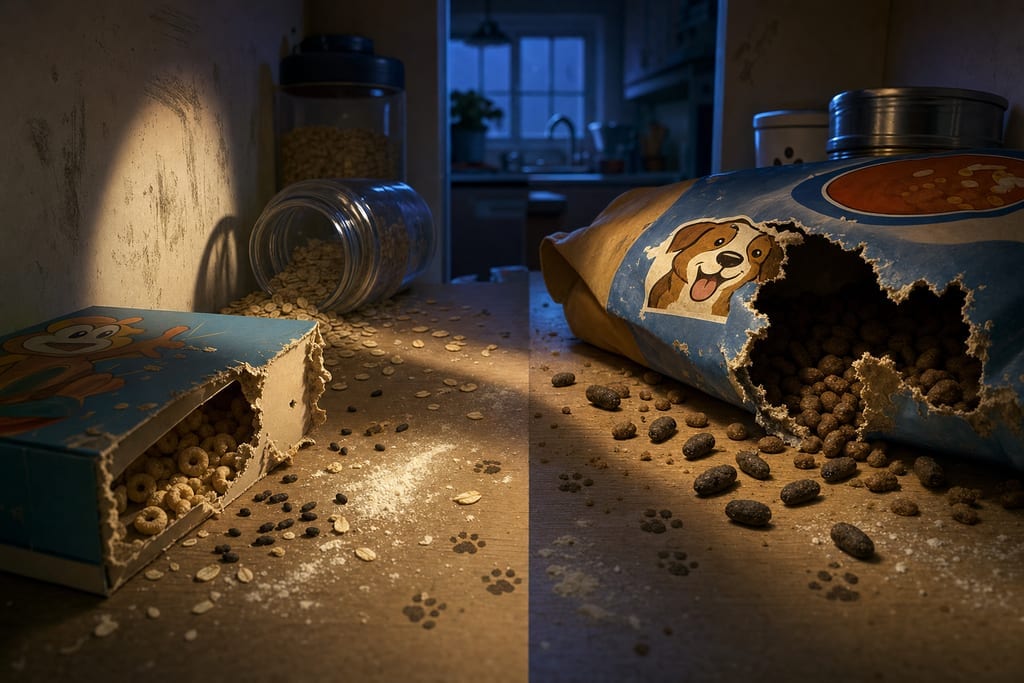
No, are mice the same as rats is a question with a flat answer: they are two different species with their own habits, diets, and ways of tearing up a house. A rat can flatten its body and squeeze through a hole the size of a quarter, while a mouse only needs a gap the size of a dime to get inside. That tiny difference in size means the entry points you are hunting for, and the fixes that actually hold, are not the same for both.
Mice tend to nest close to food, nibble constantly, and breed fast enough to turn one sighting into a real problem within weeks. Rats are heavier, more cautious, and often chew through wood or even soft metal to widen an opening that already exists. Knowing which one is in your walls changes where you look, what bait or trap makes sense, and how tight the seal on your foundation or vents needs to be.
Table of Contents
Why People Mix Up Mice and Rats So Easily
Both animals move around at night, chew on wires and wood, and leave small droppings behind. Since most homeowners never get a clear look at the culprit, those shared habits are usually all they have to go on. A quick scratching sound at 2 a.m. does not come with a name tag.
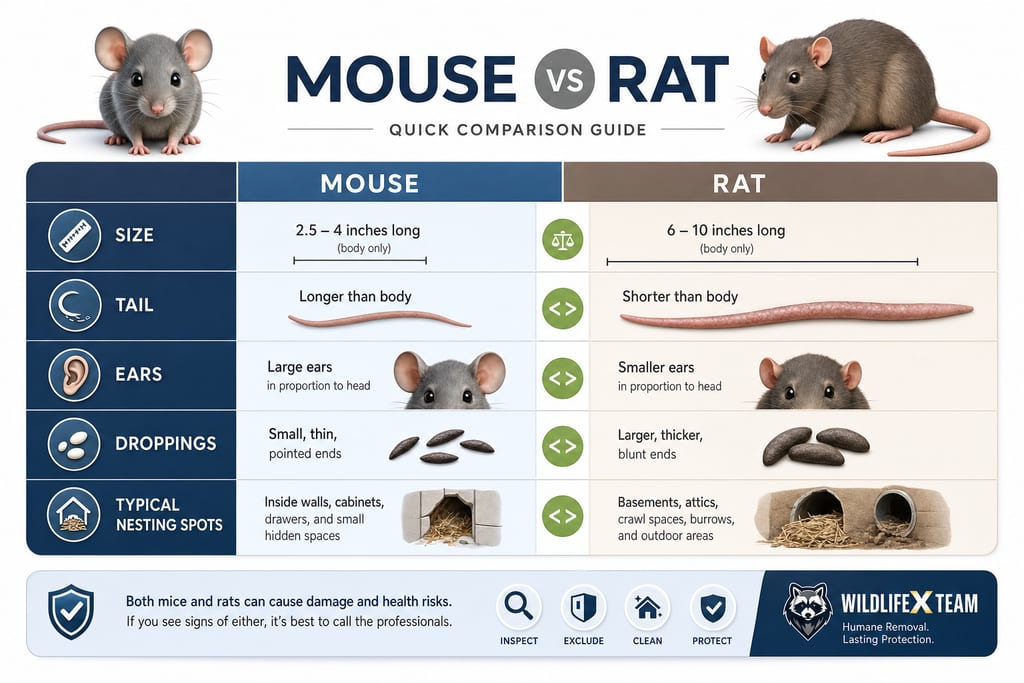
Age adds another layer of confusion. A baby rat can be close to the size of a full grown mouse, so a small rodent you spot does not always mean you have a mouse problem. The only way to be sure is to check a few physical traits side by side.
Here is a fast way to sort out what you are dealing with:
- Size: mice run 2 to 4 inches long, rats run 7 to 9 inches not counting the tail
- Tail: mice have thin, hairy tails, rats have thick, hairless tails
- Droppings: mouse droppings are rice sized, rat droppings are closer to a raisin
- Behavior: mice explore new objects without much caution, rats tend to avoid anything new in their space for days
Watching how a rodent reacts to a new trap or object can tell you more than its size alone. A short video from Orkin Canada breaks down these differences with a side by side look at both animals.
Spotting the Physical Differences Fast
Look at the ears and tail first. A mouse has large ears relative to its head and a thin, almost hairless tail, while a rat has smaller ears for its body size and a thick tail that looks more like a cable. Mice also have pointed snouts and mice fur tends to be smooth and gray or light brown, while rat fur is coarser and often darker, closer to brown or black.
Droppings give away the species just as fast. Mouse droppings look like grains of rice, small and pointed at the ends, while rat droppings are bigger and have blunt, rounded tips. Finding a pile of either near a food source or along a baseboard tells you where to focus your search.
Body shape decides where each animal can get in, and that matters more than most people think. A mouse can flatten its skull and ribs to slide through gaps most homeowners never notice. A rat needs a wider opening and tends to rely on existing cracks, pipe gaps, or rooflines it can widen over time.
- Check ear size against the head, mice look oversized, rats look proportional
- Feel the tail if you can, thin and hairy means mouse, thick and bare means rat
- Note droppings shape, rice-like and tapered points to mice
- Look at fur color and texture, smoother and lighter usually means mouse
- Rats weigh several times more than mice, which changes how much structural damage they can do in the same amount of time
How Their Behavior Inside Your House Differs
Mice are curious and will nest close to whatever food source they found first, often inside a kitchen wall or near pantry shelves. Rats are more cautious and tend to settle farther away, in attics, wall voids near plumbing, or behind insulation where they feel hidden.
Movement patterns also split the two apart. Rats travel the same paths night after night and leave greasy smudge marks where their fur brushes against walls and beams, while mice wander more randomly and rarely leave a consistent trail.
Reproduction speed is where mice cause trouble fast. A female mouse can have a litter every few weeks, so a single pair can turn into dozens of mice within a couple months if nothing is done. Rats breed more slowly but chew harder, often damaging wiring and pipes enough to cause real repair bills.
- Check pantry shelves and kitchen walls first if you suspect mice
- Look along attic beams and wall voids for rat nesting signs
- Watch for grease marks on baseboards, a sign of repeated rat travel
- Track how fast the problem grows, mice multiply quicker than rats
Checking the Signs They Leave Behind
Gnaw marks tell you a lot once you know what to compare. Mouse gnaw marks are small, thin scratches, often found on food packaging or soft wood, while rat gnaw marks are wider and deeper, sometimes cutting through plastic pipe or electrical insulation.
Grease smudges along a wall or baseboard almost always point to rats, since their body oil builds up over repeated trips along the same route. Mice rarely leave this kind of mark because they do not stick to one path the way rats do.
Nesting material can belong to either animal, shredded paper, fabric, or insulation all work for both, but where you find it narrows things down. A nest tucked inside a kitchen cabinet leans mouse, while one found deep in attic insulation leans rat.
- Check cardboard boxes and food packaging for small, thin gnaw marks
- Run a hand along baseboards for greasy residue near entry points
- Look inside cabinets and low walls for mouse-style nests
- Check attic insulation and rafters for larger rat nests
- Gnaw marks wider than a quarter inch usually mean rats, not mice
Why Treating Them the Same Can Backfire
Trap size matters more than most people assume. A trap built for rats is too heavy and too wide to trigger reliably on a mouse, and a mouse trap will not hold a rat long enough to do any good.
Sealing work has the same problem. Closing gaps sized for a rat still leaves openings a mouse can slip through, since mice only need a gap about the width of a pencil to get inside. That means a repair job aimed at the wrong rodent looks finished but fails within weeks.
Misidentifying which animal is inside often leads to incomplete exclusion work and a repeat call a few months later. Wildlife X Team runs a Wildlife Inspection Report before any repair starts, so the species and every entry point get identified first, and the fix matches the actual problem instead of a guess.
- Match trap size to the species, never use a one-size-fits-all trap
- Seal every gap to mouse-level tightness, not just rat-level
- Confirm species before buying bait, since preferences differ between the two
- Get entry points mapped before sealing, so nothing gets missed
Guessing Versus Checking Before You Buy a Trap
A homeowner who grabs a trap off a store shelf is making a bet on which rodent is in the house, and that bet often loses. The wrong size trap or the wrong bait means weeks go by with nothing caught, while the rodent keeps breeding and chewing. An inspection settles the question before any money goes toward a fix.
The entry point problem is harder to solve alone. A homeowner walking the foundation looking for rat-sized gaps will walk right past the dime-sized hole a mouse used, since nobody checks for both sizes without knowing which animal they are dealing with. Professional crews trained to spot both kinds of openings find what a quick walk-around misses.
Long-term sealing only works if it is done to the tighter standard. A foundation sealed to keep rats out still lets mice through, so any real fix has to close every gap down to mouse size, even if a rat was the original complaint. That is a lot of extra caulking and vent guard work for a homeowner to take on without a map of every weak point first.
A renewable lifetime warranty matters here because misidentifying the rodent is common, not rare. If the wrong species gets blamed and the wrong gaps get sealed, a warranty backed repair covers the repeat call instead of charging for the same job twice.
Deciding Whether to Call for an Inspection
If scratching, droppings, or gnaw marks are still showing up after you have checked size, tails, and travel paths, stop guessing and get a professional set of eyes on it. A trained inspector can confirm the species in minutes using signs that are easy to miss on your own, and that answer decides which traps, bait, and seal work actually hold. Wildlife X Team covers Fort Worth, Denton, Granbury, and the surrounding towns with that kind of inspection before any repair starts. Paying for the wrong trap or sealing only the larger gaps wastes money twice, once on the first attempt and again when the rodent gets back in. A confirmed answer upfront is cheaper than a second try.
Mouse and Rat Questions People Still Ask
Can mice and rats live in the same house at the same time?
Yes, though it is less common than you might think. Rats are territorial and often push mice out of an area they claim, so a heavy rat presence can actually keep a mouse population down nearby. If you are finding signs of both, you likely have two separate entry points that need to be checked and sealed on their own.
Will rat poison also work on mice or do I need a different product?
Some rodenticides are labeled for both, but the bait station size and placement still need to match the animal. A station built for rats sits too high or too open for a cautious mouse to approach. Check the label for both species before buying, and place stations along the walls or paths where you actually found droppings or gnaw marks.
How can I tell if it's a baby rat instead of a full grown mouse?
Look at the feet and head shape rather than overall size. A baby rat has noticeably larger feet and a blunter nose compared to its body, while a full grown mouse has a pointed snout and proportionally smaller feet. A baby rat's tail also looks thick for its size, even before the rest of its body catches up.
Does having mice mean rats will show up next?
Not directly, since one does not attract the other. What does happen is that a house with entry points loose enough for mice often has larger gaps nearby that a rat could use too. Wildlife X Team checks for both sizes of opening during a single visit, so a mouse problem does not turn into a second call a few months later for rats.