Animal Control for Raccoons vs Wildlife Removal
If a raccoon is living in your attic, animal control for raccoons is not who you call, a wildlife removal company is. City animal control handles strays, bite reports, and public safety calls, the stuff that involves an animal loose on the street or a dog bite that needs documenting. A raccoon tearing up insulation above your bedroom ceiling is a different job, one that needs someone trained to find entry points, remove the animal without hurting it, and seal the house back up.
Raccoons are smart enough to open latches, twist door handles, and remember which gutter got them onto your roof last year. That memory is part of why they're one of the most common nuisance calls across North Texas neighborhoods, from Fort Worth out through Denton and Granbury. Animal control will not climb into your attic to catch one or fix the hole it came through. That part falls to a wildlife removal service.
Table of Contents
What Each Service Actually Covers
Animal control is a government or county department. Its job is public health and public safety, not property repair, so it answers calls about bites, suspected rabies, loose or aggressive animals, and dead animal pickup along roads or in yards.
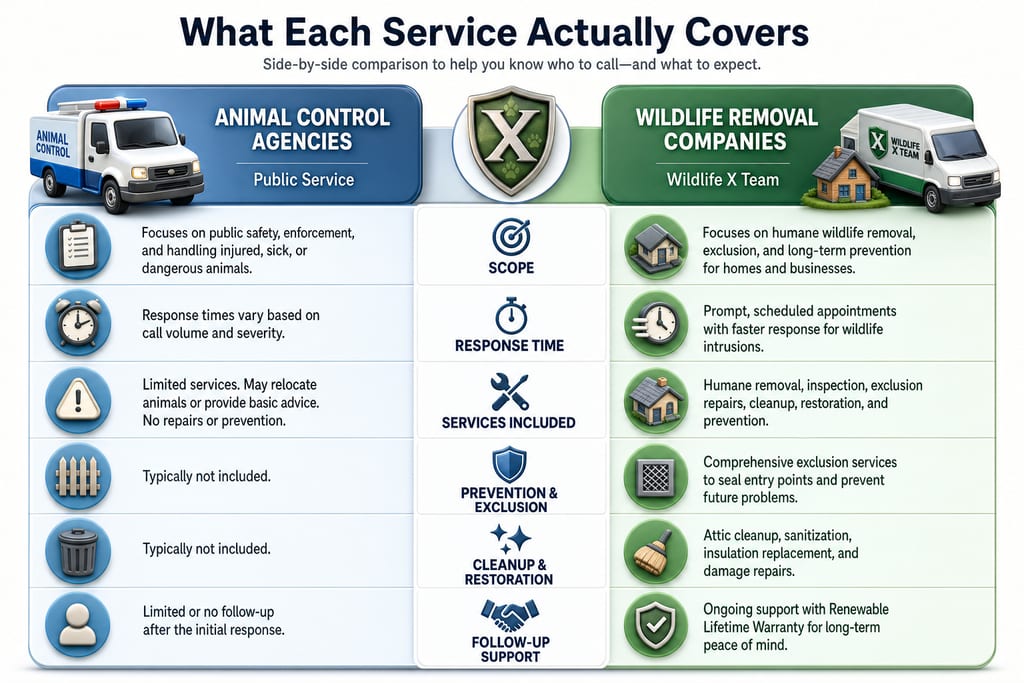
A county officer can take an hour or more to respond, depending on call volume, and once the animal is gone the job is closed. They are not staffed or funded to patch holes, clean attic insulation, or guarantee an animal will not return.
A wildlife removal company works the opposite end of the problem. They catch the live raccoon inside the structure, find every entry point it used, and repair the house so a new animal cannot get in the same way.
Here is the short version of who handles what:
- Animal control: bite reports, rabies concerns, strays, dead animal pickup, response usually within hours, no follow-up repair
- Wildlife removal: live raccoons in attics or walls, entry point repair, same-day or next-day scheduling, warranties on completed exclusion work
Knowing which one to dial saves you a wasted call and a longer wait with an animal still in your attic.
When a Raccoon Problem Needs Animal Control for Raccoons
Call animal control when the raccoon is a public safety issue, not a house issue. A raccoon wandering in daylight, stumbling, circling, or showing no fear of people needs a trained officer to assess it, since that behavior can point to rabies or distemper. The same goes for any raccoon that has already bitten a person or a pet, because that triggers a mandatory report and sometimes testing.
Dead raccoons on a road, sidewalk, or city park also fall to animal control, not a homeowner with a shovel. These are the calls county departments are built for, and most of them come at no cost to the resident.
A few situations where animal control is the right first call:
- A raccoon acting disoriented or aggressive in daylight
- A bite or scratch that broke skin on a person or pet
- A raccoon carcass on a street, sidewalk, or public lot
- A raccoon trapped somewhere it can't get out, like a storm drain
What animal control will not do is climb into your attic, find a den, or repair the hole a raccoon chewed through your soffit. Their job stops at public safety, so a raccoon living quietly above your ceiling is outside their scope even if you call them first.
When You Actually Need Wildlife Removal
If the raccoon is inside your structure and not bothering anyone on the street, you need a removal company, not a government line. Scratching in the attic at night, torn vents, flattened insulation, or soffit damage are all signs an animal has already moved in. A mother raccoon denning with babies before winter is one of the most common calls Wildlife X Team gets across Fort Worth and Denton, since females look for warm, dry, enclosed spaces exactly like an attic.
Here's what tells you it's a structural problem and not a one-time sighting:
- Repeated noise in the same spot, especially after dark
- Torn or bent vent covers, chimney caps, or soffit panels
- Insulation pushed flat or pulled into a nest shape
- A strong, persistent odor coming from one area of the attic
A wildlife removal company finds every entry point, not just the one that's obvious from the ground, removes the animal humanely, and closes the gap so another raccoon can't use the same route. That's a different job entirely from a public safety call, and it's the one that actually stops the damage.
What Happens After the Raccoon Is Gone
Getting the raccoon out is half the job. A Wildlife Inspection Report checks the whole property for weak points, roof edges, vent screens, foundation gaps, not just the hole the raccoon already used, since raccoons often scout more than one way in. Jesse Bernard's experience with a squirrel job showed the same pattern: the obvious entry point was there, but the crew found two more he'd never have spotted on his own.
Animal proofing closes those gaps for good. Expect some combination of:
- Vent guards and chimney caps to block common entry points
- Foundation repair where raccoons have dug or pried their way in
- Caulking and sealing around smaller gaps and joints
- Attic cleanup to remove contaminated insulation and disinfect the space
The exclusion work at Wildlife X Team is backed by a renewable lifetime warranty, so if a new raccoon tries the same trick, the fix is already covered. That's the difference between trapping an animal once and keeping the house closed for good.
Raccoon Calls Across Fort Worth and Surrounding Towns
Raccoon intrusions aren't a Fort Worth-only problem. Wildlife X Team covers Denton, Granbury, Glen Rose, Weatherford, Possum Kingdom Lake, Southlake, Grapevine, Colleyville, North Richland Hills, Roanoke, Trophy Club, Flower Mound, Azle, Saginaw, Haslet, Watauga, and Argyle, towns where raccoon activity shows up in both homes and businesses.
Commercial properties see their own version of the problem: raccoons working dumpster enclosures, climbing roof access ladders, or denning in crawl spaces under loading docks. In dense neighborhoods, a raccoon pushed out of one attic often just moves to the house or building next door within days, which is why local response time matters as much as the repair itself.
A few things worth checking before you call anyone:
- Whether the raccoon is seen daily at the same time or spot
- Whether the noise or damage is coming from one area or spreading
- Whether neighbors have reported the same activity recently
For inspection scheduling anywhere in that service area, Wildlife X Team can be reached at (817) 799-8686.
Why That First Phone Call Matters
Most people dial animal control out of habit, since it sounds like the right government number for any animal problem. For a raccoon in the attic, that call usually ends with a redirect to a private company, because the county line isn't set up to send anyone up a ladder. That redirect costs you a day, sometimes two, while the raccoon stays put.
Every day it stays, the damage adds up. Insulation gets flattened or pulled into bedding, wires get chewed, and the smell from a latrine spot gets harder to clean out. None of that reverses itself just because the animal eventually leaves on its own.
Timing matters even more if a mother has young with her. Once she's settled in and nursing, removal takes more care and more time, since the babies can't be relocated the same way an adult can. Waiting a few extra days to figure out who to call can turn a one-visit job into a multi-step one.
The fix is knowing before you pick up the phone. A raccoon loose on the street or acting sick is animal control's job. A raccoon scratching above your ceiling is a wildlife removal job from the start, and skipping the wrong call saves you a wasted visit and a few more days of damage.
Which Number You Pick Up First
Look at where the raccoon is before you dial anything. On the street, sick, aggressive, or already bit someone, that's animal control. In your attic, in a wall, or showing up again after you thought it left, that's a structural problem, and it needs inspection, removal, and sealing done together, not as separate calls weeks apart. Splitting those jobs is how homeowners end up paying twice. For towns across Fort Worth, Denton, and Granbury, Wildlife X Team handles the structural side start to finish, so the hole gets found and closed the same visit the raccoon comes out.
Raccoon Removal Questions People Still Ask
Will animal control come out for a raccoon stuck in my chimney?
Usually not, unless the raccoon is sick, aggressive, or already bit someone. A raccoon stuck in a chimney is a structural problem, not a public safety one, so county officers typically redirect that call to a wildlife removal company. Wildlife X Team handles chimney cases directly, including capping the flue afterward so another animal can't climb in the same way.
Can I just block the hole myself after the raccoon leaves on its own?
You can try, but it often backfires. Raccoons test an entry point before giving up on it, and a weak patch gets torn open again within days. There's also a real risk of sealing an adult out while young ones are still inside, which creates a bigger problem than the one you started with.
How do I know if there are baby raccoons before sealing anything up?
Listen for high-pitched chirping or shuffling sounds during the day, since mothers often leave at dusk to feed and the babies stay behind. Sealing a hole without checking first traps them inside, where they can't survive long and create an odor problem that's hard to trace. A trained inspector checks for a den before any repair work starts.
What does a raccoon exclusion job typically include beyond removal?
Exclusion means closing every gap a raccoon used or could use next, not just the one hole that's visible from the ground. That can include chimney caps, vent guards, foundation repair, and caulking smaller gaps around the roofline. The goal is a house a raccoon can't get back into, not just one that's temporarily empty.